 Property
You've been checking the rate every Thursday for months now, hoping this is the week it finally turns. This week it didn't. The 30-year fixed climbed to 6.76%, Freddie Mac's highest reading since June 2025, and it landed four days before the Fed meets to decide what happens next. Here's the part almost nobody is watching: the number that actually determines whether you can negotiate a good deal right now has almost nothing to do with that meeting, and it just hit its best level for buyers in over a decade.
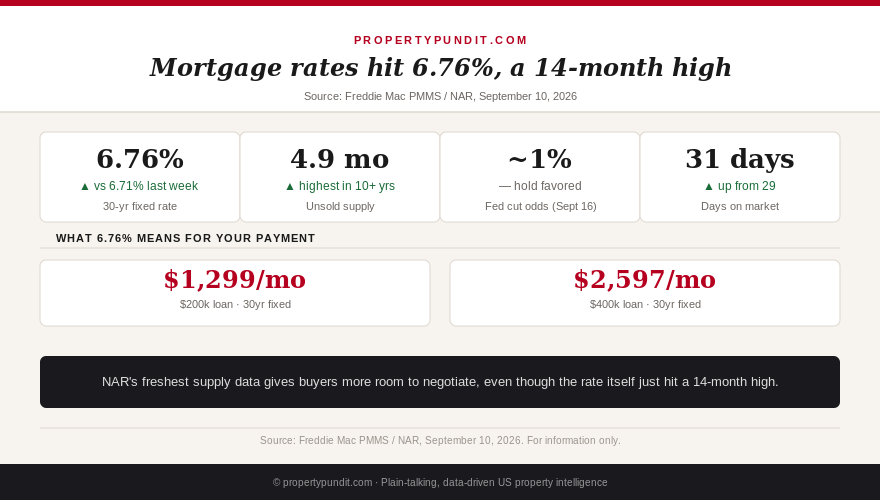
Two numbers moved this week, in opposite directions, and only one of them is the one most people are watching. Freddie Mac's Primary Mortgage Market Survey put the 30-year fixed at 6.76% for the week of September 10, 2026, up from 6.71% the week before and the highest reading since June 26, 2025 (Freddie Mac PMMS, September 10, 2026). The same day, NAR's August existing-home sales report showed unsold inventory climbing to a 4.9-month supply, the highest level in more than ten years, with the median home now sitting 31 days on the market before it sells (NAR, September 10, 2026). One number is working against you. The other is working for you. This article is about which one should actually decide your timeline.
The rate just hit its worst level in 14 months
There's no sugarcoating the rate itself. The 30-year fixed bottomed at 6.05% in late February 2026, and it has spent six of the last seven months mostly climbing since, reaching 6.76% this week, the highest since June 26, 2025, when it briefly touched 6.77% (Freddie Mac PMMS, September 10, 2026). The 15-year fixed followed the same path, up to 6.09% from 6.04%. On a $400,000 loan, that climb from February's low costs you about $186 more a month, roughly $2,232 a year, in principal and interest alone. Even the past week by itself, from 6.71% to 6.76%, added about $13 a month on the same loan size. So what for you: if you've been waiting for the rate itself to hand you relief, seven months of data says that relief hasn't shown up, and pretending it might arrive next week just delays a decision this week's other numbers can already inform.
Get this in your inbox every Friday.
One email. The number that matters and what it means for you.
The Fed meets in four days, and a cut is barely on the table
The next FOMC meeting is September 15-16, 2026, and the setup going in is about as far from "cut" as it gets. The Fed has held its target range at every meeting so far this year, and prediction markets currently price a hold near 59-60%, a 25 basis point hike as high as 26-40% depending on which market you check, and an actual rate cut at roughly 1% (Kalshi, week of September 4-9, 2026). July's PCE inflation reading came in at 3.7% year over year, with core inflation at 3.3%, both well above the Fed's 2% target, while unemployment sits at a still-low 4.1% and August payrolls beat expectations, rising 162,000 (Bureau of Labor Statistics, September 4, 2026). None of that combination produces a rate cut next month. So what for you: treating the September 16 meeting as the moment your rate improves isn't a plan, it's a hope, and the specific outcome you're hoping for currently has roughly a 1-in-100 chance of happening.
Supply just hit a level buyers haven't seen in over a decade
Here's the number that should actually be driving your timeline. NAR's August existing-home sales report, released September 10, 2026, put total housing inventory at 1.62 million units, up 3.2% from July and up 5.9% from a year earlier, the first time since November 2019 that inventory has topped 1.6 million. That works out to a 4.9-month supply, up from 4.6 months in July and the highest reading in over ten years. The median home now sits 31 days on the market before it sells, up from 29 days the month before, and first-time buyers made up 30% of sales, the highest share this cycle. NAR's chief economist put it plainly: the ample supply on the market is giving buyers better room to negotiate. Housing affordability improved too, with NAR's index at 104.7, up from 101.2 a year earlier. So what for you: this is the part of the market you have real influence over right now, and unlike the rate, it isn't waiting on a Fed decision to move in your favor.
What waiting for the meeting actually costs you
Run the two threads together and the case for holding out until September 16 falls apart. If you wait for a cut that has roughly a 1% chance of arriving, you're not gaining anything on the rate, and there's a real chance, priced as high as 26-40% by the same markets, that the Fed moves the other way and rates creep up further instead. Meanwhile, the negotiating conditions you actually have some influence over, supply, days on market, and price flexibility, are already the best they've been in a decade, and they could tighten again the moment a genuine rate cut eventually does arrive and pulls other buyers back into the market alongside you. So what for you: the version of "waiting" that makes sense is waiting for the right property and the right offer, not waiting on a Fed decision that this week's data already says isn't coming.
What this actually means for your monthly payment
Put real numbers on it. At 6.76%, a $200,000 loan runs about $1,299 a month in principal and interest, and a $400,000 loan runs about $2,597. On a $400,000 home with 10% down, a $360,000 loan runs roughly $2,337 a month before tax and insurance. None of those figures will look meaningfully different on September 17 than they do today, because the meeting almost certainly won't move them. What is different today than it was even a month ago is your ability to ask for a price cut, a rate buydown, or a longer closing window, and that's a function of the 4.9-month supply sitting on the market right now, not the calendar. For a buyer earning $112,000 a year, the standard 28% front-end affordability rule caps a comfortable monthly housing payment around $2,613, which means that $2,337 payment on a $360,000 loan still fits, but only with little room left for a rate that climbs further while you wait. Before you run your own numbers, check where your credit score actually lands you on rate and what a realistic down payment really needs to be, since both move your real payment more than a single week's rate print ever will. So what for you: the payment math barely changes next week either way, but your negotiating position might, and it's already moving your way.
Put it together and the smarter move isn't waiting on the Fed meeting, it's using the room the market has already given you. The math points toward getting pre-approved now, while today's supply and days-on-market numbers still favor an offer with real negotiating room attached, rather than sitting out a meeting that prediction markets say won't change your rate anyway. Frankly, if you've been telling yourself you're waiting for rates to drop before you act, most people who run these numbers end up realizing they were really waiting on a specific Fed decision that was never likely to happen on their timeline. Before you make an offer, get a clear handle on what closing costs will actually run you, and if you want the fuller picture on how this rate climb happened, this site's rate-climb breakdown from earlier this month walks through the full path from February's low to today.