 Property
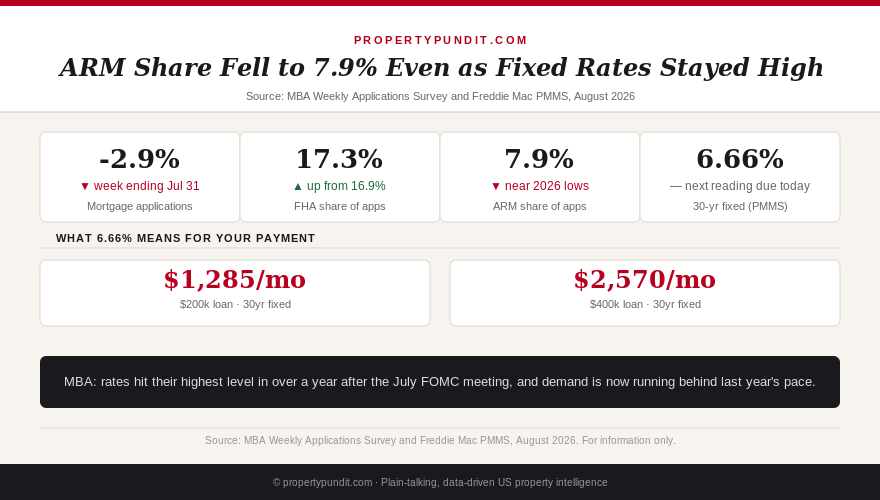
You've probably seen the adjustable-rate line on your lender's rate sheet, priced maybe half a point below the 30-year fixed sitting above it, and wondered why more buyers aren't taking the cheaper option. This week's mortgage data has the answer: they aren't. Adjustable-rate mortgages made up just 7.9% of all applications for the week ending July 31, 2026, according to the Mortgage Bankers Association, even as the fixed rate they're being compared against sits near a one-year high. Buyers are paying more for certainty rather than betting on a reset that increasingly looks like it lands in a worse environment than the one they signed up in.
Here's what actually moved in this week's data, why the ARM snub is the more telling number than the headline application decline, and what the math says about locking a rate versus gambling on an adjustable one right now.
What this week's mortgage data actually shows
The MBA's Weekly Applications Survey for the week ending July 31, 2026, released August 5, showed the Market Composite Index down 2.9% on a seasonally adjusted basis. The Purchase Index fell 4%, and the Refinance Index dropped 2% and now sits 9% below the same week a year ago. MBA's chief economist, Mike Fratantoni, tied the decline directly to the Fed's July 28-29 meeting: "In the wake of the July FOMC meeting, longer-term rates increased, with mortgage rates reaching their highest level in more than a year." He added that volume for both purchase and refinance loans is "now running behind last year's pace, indicating that higher mortgage rates have weakened overall demand."
Buried inside that same report is a mix shift that matters more than the headline decline: FHA's share of applications rose to 17.3% from 16.9% the week before, VA held at 12.3%, and USDA ticked up to 0.5%. Buyers aren't just applying less. Among the ones still applying, more are reaching for the lower-down-payment, government-backed option instead of a conventional loan, a sign that affordability, not just willingness, is doing the filtering.
Get this in your inbox every Friday.
One email. The number that matters and what it means for you.
Why ARM demand is falling instead of rising
Standard economics says an adjustable-rate mortgage should get more popular, not less, when fixed rates climb, because the initial ARM rate typically undercuts the fixed one by a meaningful margin. That is exactly the opposite of what is happening. The reason traces back to last week's FOMC decision: the Fed held at 3.50%-3.75% on a 9-3 vote, with three regional presidents dissenting in favor of a hike, and futures markets now price two additional quarter-point hikes before the end of 2026 rather than the cuts that dominated forecasts earlier this year. An ARM's entire value proposition depends on rates being flat or lower when the first adjustment hits. When the forward-looking market is pricing hikes instead, that bet gets a lot less attractive, and buyers are pricing it correctly even if they've never looked at a CME FedWatch chart.
Run the numbers on a $350,000 loan and the appeal fades fast. A 5/1 ARM priced around 6.16%, roughly half a point under today's 6.66% fixed rate, would carry a payment near $2,135 a month for the first five years, about $114 less than the fixed option. But a standard 2/2/5 cap structure allows the first reset to rise as much as 2 percentage points. If that reset lands at 8.16%, the payment jumps to roughly $2,607 a month, a $472 increase in a single adjustment and $358 more than just staying on the fixed rate from day one. Five years of $114 monthly savings totals about $6,840. One bad reset erases more than four years of that in higher payments alone.
If a lower initial ARM rate is tempting you toward a purchase you're otherwise stretching for, the reset math above is the number to run before you sign, not after your first adjustment notice arrives.
What the FHA and VA numbers say about who's still buying
FHA's climb to 17.3% of applications, its highest share in recent weeks, lines up with a market where the 3.5% minimum down payment and more forgiving credit requirements matter more than they did when rates were lower and more buyers qualified for conventional financing outright. VA's 12.3% share stays near its own multi-year highs, reflecting continued strong demand from veteran and military borrowers who don't need a down payment at all. Conventional loans, by contrast, are the share losing ground in this mix, the same pattern behind the record-low median down payment and rock-bottom first-time buyer share this site has tracked for months.
If your down payment is the thing holding you back from applying at all, this week's data says you're not alone, and an FHA or VA loan is doing more of the market's heavy lifting than a conventional 20%-down loan right now.
Where the actual rate sits today
Freddie Mac's PMMS still shows 6.66% as of July 30, 2026, unchanged from that reading, with today's official update due at noon ET, the first confirmed print since last week's FOMC decision. A daily tracker from Mortgage Research Center, reported by Fortune this morning, put the 30-year conventional rate at 6.710%, actually down 2 basis points from 6.730% a week earlier, even as MBA describes the broader rate environment as the highest in over a year. Trackers and the official survey rarely move in perfect lockstep, and this week is another reminder to treat PMMS as the benchmark and daily quotes as directional color only.
On a $350,000 loan, 6.66% works out to about $2,249 a month in principal and interest, up from roughly $2,197 at the 6.43% rate seen in early July, a $52 monthly gap that has built up gradually rather than in one dramatic jump. Your credit score still swings your actual quote by more than that entire gap, and it's the one variable in this article you control before you ever lock.
The call: what to actually do this week
If you're shopping a purchase loan right now, the math points toward locking a fixed rate rather than reaching for an ARM's lower headline number. The forward market has moved from pricing cuts to pricing hikes since late July, which is precisely the environment where a fixed rate's certainty is worth paying for. If an ARM's lower payment is the only way a home fits your budget today, that's useful information, but it's a signal to shop a smaller loan amount or a different property, not a signal to accept a reset risk the market itself now says is more likely to go against you. And if FHA or VA financing gets you into a deal that conventional underwriting won't, this week's data says you'd be following the same path a growing share of buyers are already on. Before you compare offers, weigh the full closing costs on each loan type, since FHA's upfront mortgage insurance premium can shift the true cost of "cheaper" financing more than the rate alone suggests.
Frequently asked questions
Why are ARM mortgages losing popularity in 2026? Adjustable-rate mortgages made up just 7.9% of applications for the week ending July 31, 2026, per MBA data, even though an ARM typically prices below a 30-year fixed. With futures markets now pricing Fed rate hikes rather than cuts before the end of 2026, the math on an ARM's first reset looks worse than it did earlier this year, so buyers are choosing rate certainty over a lower starting payment.
What percentage of mortgages are FHA loans right now? FHA loans made up 17.3% of mortgage applications for the week ending July 31, 2026, up from 16.9% the week before, according to the Mortgage Bankers Association. VA loans held 12.3% and USDA loans 0.5% over the same week.
Is an ARM a bad idea if the Fed might raise rates? Not automatically, but the risk-reward has shifted. A 5/1 ARM roughly half a point below today's fixed rate can still save money in years one through five. The problem is the first reset: under a standard 2/2/5 cap structure, a rate that resets into a hike environment rather than a cut environment can add several hundred dollars a month, wiping out years of savings in a single adjustment.
What is the current 30-year mortgage rate today? Freddie Mac's PMMS most recently confirmed the 30-year fixed at 6.66% on July 30, 2026. Today's official reading, the first since that print, publishes at noon ET. A daily tracker from Mortgage Research Center showed the 30-year conventional rate at 6.710% this morning, down slightly from 6.730% a week earlier.