 Property
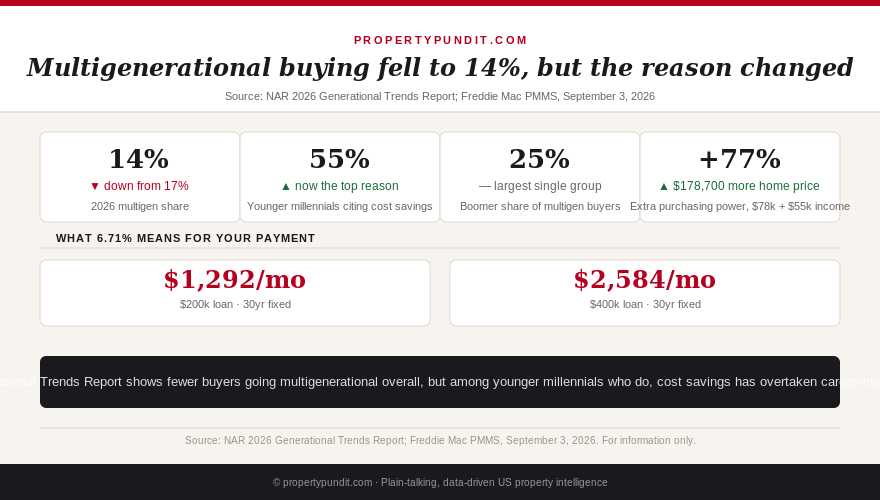
You keep hearing that buying a house with your parents, or your adult kid moving back in to help split the mortgage, is the affordability move of the decade. Every headline this year has framed it as a booming trend, the natural response to a market where a $78,000 salary in Atlanta buys a fraction of the home it used to. So here is the number that doesn't fit that story: multigenerational home buying actually fell in 2026. It dropped to 14% of purchases, down from 17% the year before, according to NAR's 2026 Home Buyers and Sellers Generational Trends Report. Fewer people are doing this, not more. But the buyers who are still doing it are doing it for a different reason than they used to, and that shift is the part actually worth your attention if you're stuck on how to afford a home alone.
What actually happened to the multigenerational share
NAR's generational survey found 14% of all 2026 buyers purchased a home intended for multiple generations of the same family, down from 17% the prior year. Break it down by age group and the picture gets more specific: Boomers made up the largest share of multigenerational buyers at 25%, followed by millennials at 23%, Gen X at 19%, and the Silent Generation at 16%. That ordering matters because it tells you this isn't primarily a story about desperate 20-somethings moving in with mom and dad. It's older buyers, often boomers planning for aging-in-place or bringing an adult child's family under one roof, who make up the largest single slice of this group.
The top motivations across every age group were, in order: caring for aging parents, cost savings, and adult children moving back home. That ranking held for the overall pool of buyers. It's when you isolate younger millennials specifically that the picture flips, and that flip is the actual story here, not the headline percentage.
If you have been putting off a home search because you assumed "everyone" is buying multigenerationally now and you're somehow behind, the data says the opposite: this is a smaller, more targeted group than the coverage suggests, and most of them aren't doing it for the reason you think.
Get this in your inbox every Friday.
One email. The number that matters and what it means for you.
Why the reason changed even as the share shrank
Among younger millennials who bought a multigenerational home in 2026, 55% cited cost savings as their primary motivation, ahead of caregiving or a returning adult child. That is a reversal from the pattern that dominates the overall buyer pool, where caring for aging parents still ranks first. Younger buyers aren't pooling households mainly to look after a parent. They are doing it because a single income, even a solid one, isn't stretching far enough against a median home price above $434,000 and a 30-year rate still sitting at 6.71%.
That distinction changes how you should think about the arrangement if you're considering it yourself. A caregiving-driven multigenerational purchase is a family decision that happens to have a mortgage attached. A cost-savings-driven one is fundamentally a financing strategy, and financing strategies need to be underwritten with the same discipline you would apply to any other borrowing decision, not treated as a given because it worked out for someone in a magazine article.
If your reason for considering this route is closer to "I cannot qualify for what I want alone" than "my parent needs support," you're in the fastest-growing sliver of this trend, and the math below is written for you specifically.
The math: what pooling two incomes actually buys you
Take a buyer earning $78,000, roughly Marcus's income in our own persona modeling, using the standard 28% front-end housing ratio lenders apply and a 3% down payment. That income alone supports a maximum monthly housing payment of about $1,820, which caps out at a home price near $232,500 once you factor in principal, interest, an estimated 1.1% property tax rate, and around $150 a month in insurance at today's 6.71% rate.
Now add a parent's income of $55,000 to the application as an occupant co-borrower. Combined household income of $133,000 supports a housing payment closer to $3,103 a month, which pushes the maximum home price to roughly $411,200, a jump of about $178,700, or 77% more purchasing power than either person could qualify for alone. That isn't a rounding error. That is the difference between being priced out of most metro markets and being able to compete for a genuinely median-priced home in a lot of them.
It still doesn't fully close the gap to the current national median of $434,100, where the full PITI payment on a 3%-down loan runs about $3,268 a month. Even combined, this hypothetical household is about $165 a month short of that specific number, though it clears plenty of below-median markets outright. The lesson isn't that pooling income solves everything. It's that it moves the needle by a specific, calculable amount you can check against your own numbers before you assume the strategy will or won't work for you.
How lenders actually treat combined income on paper
The mechanics matter more than the headline percentage. If everyone on the loan will also live in the home, most conventional and FHA programs simply combine incomes and average credit profiles for underwriting, the same as any other joint application. Complications show up when one person won't live in the property, known as a non-occupant co-borrower. Fannie Mae's guidelines cap that structure at a 43% debt-to-income ratio under manual underwriting, and crucially, the lender prices your interest rate off the lowest median credit score on the application, not the highest earner's score and not an average. A parent with excellent income but a mediocre credit history can raise your qualifying power while simultaneously raising your rate, and both effects need to be modeled before you assume the arrangement is a pure upside.
Down payment sourcing gets scrutinized closely too. If the parent or adult child is contributing cash rather than income, that money needs a paper trail: a signed gift letter and proof of the donor's ability to give, not just a large unexplained deposit. Personal loans and unsecured lines of credit are explicitly banned as a down payment source under Fannie Mae's Selling Guide, so "I'll just borrow it from a personal loan and pay it back later" isn't a workaround, it's a disqualifying move if an underwriter catches it. Check our breakdown of how gift funds actually need to be documented before you assume a family contribution will sail through underwriting on a verbal agreement.
Before you count on a specific combined income number, get everyone's paperwork, income documentation, and a credit pull organized the way an underwriter will actually see it. A verbal commitment from a parent isn't the same as a qualifying co-borrower once the file is assembled.
The part the trend pieces skip: ownership and the exit
A co-borrower is on the title and owns a real stake in the property. A co-signer guarantees the debt but has no ownership claim at all. Both are equally on the hook for the mortgage payment every month, but only one of them has a legal right to the home if the arrangement needs to be unwound, whether that is a parent's health changing, a relationship breaking down, or someone simply wanting to buy their own place five years from now. None of the coverage celebrating the multigenerational trend spends much time on what happens when it ends, and it does eventually end for most households that weren't built around permanent caregiving in the first place.
Before you sign anything, put the exit terms in writing separately from the mortgage paperwork itself: who gets refinanced out and when, how equity gets split if the home is sold, and what happens to monthly contributions if one party's circumstances change. This isn't a legal requirement anywhere, which is exactly why it gets skipped, and exactly why it shouldn't be.
If you cannot get specific, written agreement on those three questions before you make an offer, frankly, that is a signal the arrangement isn't ready, no matter how good the combined-income math looks on paper.
What this means for your next move
The math points toward pooling income being a legitimate tool, not a trend to follow because it's popular, and definitely not something to avoid because you assumed it was mainly for people caring for elderly parents. If a specific combined-income number gets you meaningfully past what either of you could qualify for alone, and everyone involved agrees in writing on ownership shares and an exit plan before you make an offer, the numbers above suggest it's worth running your own version of this math with a lender rather than dismissing it. If the honest reason you're considering it's that you cannot otherwise afford anything close to what you want, that is a completely normal reason, and it's the same reason 55% of younger millennials who did this gave. You're not behind a trend. You're looking at the same math they ran.