 Property
If you've been eyeing Hampton Roads because the military BAH demand felt like a sure thing, here's the number that should give you pause: the two Virginia markets that actually cleared DSCR two months ago, Virginia Beach and Norfolk, both fail now. Not by a little, either. Virginia Beach drops from a DSCR of 1.15 to 0.94. Norfolk, the state's prior best performer, comes in at 0.99, a rental income shortfall by one one-hundredth of a point. The military demand you were counting on is still there. What changed is the insurance bill nobody itemized correctly the first time.
This is a second-pass update to our July 2026 Virginia spotlight. Statewide, Virginia's median home price now sits at $463,549 (Redfin, June 2026), up 4.2% year over year and above the $453,000 our first pass recorded in May. The state carries a flat-adjacent 5.75% top income tax bracket, no assessment caps to speak of, and, as of this pass, a materially different insurance picture for its coastal cities than the statewide average implies.
Virginia Beach: the military demand was never the problem
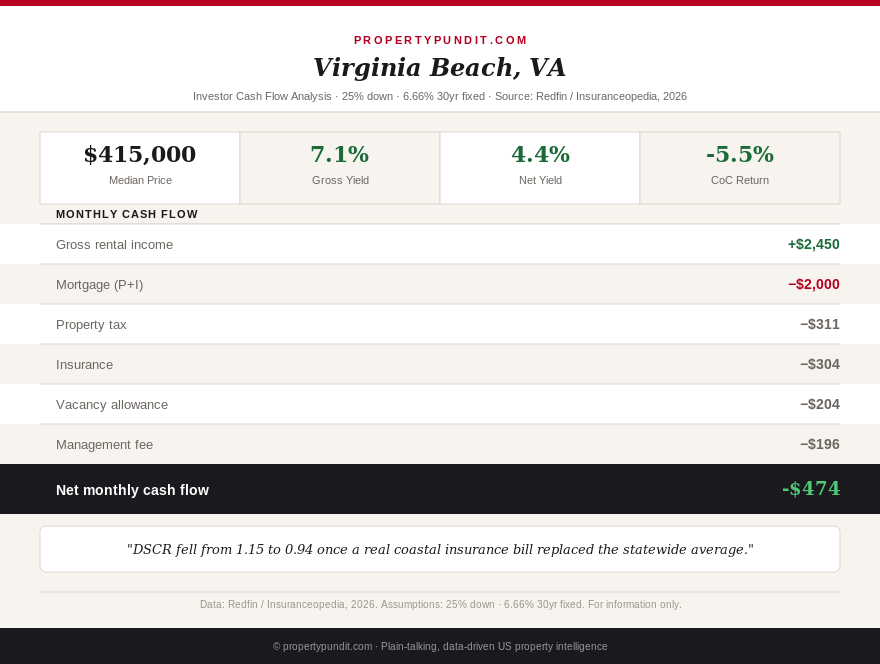
Virginia Beach's investor case has always rested on Hampton Roads' military-driven rental demand, and that demand hasn't gone anywhere. A representative single-family rental at the city's current $415,000 median (Redfin, three months ending May 2026, up 5.1% year over year) still rents for roughly $2,450 a month, comfortably above what a comparably priced home commands almost anywhere else in the state outside Northern Virginia. What broke the math is the line item our first pass never itemized separately: insurance.
| Item | Monthly |
|---|---|
| Purchase price | $415,000 |
| Down payment (25%) / loan | $103,750 / $311,250 |
| P&I (6.66%, 30yr) | $2,000 |
| Property tax (0.90%, Virginia Beach) | $311 |
| Insurance (Atlantic coastal exposure, 2026) | $304 |
| PITI total | $2,615 |
| Gross rent (3BR SFR, 2026) | $2,450 |
| DSCR (gross rent / PITI) | 0.94: FAILS |
| Vacancy (5%) / management (8%) | -$123 / -$196 |
| Monthly cash flow | -$474 |
Insuranceopedia and Insure.com both put Virginia Beach's average homeowners premium at roughly 36% above the statewide average, driven by direct Atlantic coastline and hurricane exposure, with figures ranging from about $1,274 to $3,650 a year depending on coverage assumptions and source. We used the more conservative, higher figure, $304 a month, for this underwrite, consistent with how PropertyPundit treats disagreeing insurance sources elsewhere. Even the lower end of that range would still leave Virginia Beach with a materially worse DSCR than our first pass recorded, since that earlier analysis effectively assumed an inland-level premium it never actually priced.
So what for you: if you've been treating Virginia Beach's military rental demand as the whole investment case, it was never the weak link, and it still isn't; the coastal insurance bill is what turned a passing deal into a $474-a-month loss, and any Hampton Roads underwrite that skips a real quote is missing the number that actually decides the outcome.
Get this in your inbox every Friday.
One email. The number that matters and what it means for you.
Norfolk: closest to breakeven, still not there
Norfolk fares slightly better, and it's the closest thing Virginia currently offers to a working rental market. At a $330,000 median (Redfin, blending the $325,583 three-month figure and the $334,818 June all-types reading), a 0.97% city property tax rate, and a coastal insurance premium of $261 a month, monthly PITI runs $2,118 against a current 3-bedroom rent of $2,100. That produces a DSCR of 0.99, a rounding error from breakeven on the loan-coverage test, though real operating costs still push monthly cash flow to roughly -$283 once a 5% vacancy allowance and 8% property management fee are applied.
That's a meaningfully smaller loss than Virginia Beach's, and it means Norfolk is the market where a motivated investor is closest to making the numbers work, whether through a lower purchase price, a higher actual rent than the city-wide average, or house-hacking the property rather than renting it out fully passively. It is not, at today's prices and insurance costs, a market that clears its own DSCR threshold on paper.
So what for you: if you're set on investing in Hampton Roads specifically, Norfolk is where to concentrate your search, but "closest to breakeven" is not the same claim as "breaks even," and you should underwrite your specific property's actual insurance quote before assuming a citywide average will hold.
What just changed for every Virginia landlord, not just these two cities
Separate from the insurance story, Virginia's General Assembly passed a set of Virginia Residential Landlord and Tenant Act amendments that took effect July 1, 2026 and apply statewide, regardless of which city a rental sits in. Tenants who fall behind on rent now get 14 days to cure a nonpayment default before a landlord can move to terminate the lease, up from 5 days previously, a change that meaningfully extends how long a nonpaying tenant can occupy a unit before an eviction filing becomes possible. Landlords must also accept checks and money orders as payment, with any processing fee capped at the landlord's actual cost, and Virginia Code § 55.1-1208 now bars every landlord in the state, not just public housing authorities, from billing a tenant for unit maintenance or repairs except where the tenant caused the damage. A further change requiring 90 days' notice of a rent increase, for landlords who own more than four units, follows in July 2027.
None of these changes appear as a line item in a DSCR spreadsheet, but they raise the real cost of a nonpayment event and shift maintenance expense that some Virginia landlords had previously passed through back onto the owner's own ledger. For an investor already underwriting a razor-thin Norfolk deal at -$283 a month, a longer nonpayment exposure window is the kind of tail risk that matters more than it would on a property with real cash-flow cushion.
So what for you: budget maintenance and a longer worst-case nonpayment window into your Virginia underwriting starting now, not as a footnote, since these are statewide, already-enacted rules that apply the day you close, not a future risk to model around.
Northern Virginia: still an appreciation play, now a bigger one
Fairfax County's median climbed to $813,000 (Redfin, three months ending May 2026, up 3.4% year over year), well above the roughly $650,000 figure our first pass used, a gap likely reflecting a difference in geographic scope between that earlier estimate and a specific Fairfax County pull rather than a genuine two-month price surge of that size; we're flagging the discrepancy rather than treating it as confirmed appreciation. At that price, 25% down, and 6.66%, PITI runs roughly $4,910 a month against a current 3-bedroom rent near $3,350, a DSCR of 0.68 and a monthly cash flow loss around $1,982, the widest gap of any Virginia market in this analysis.
Northern Virginia was never pitched as a cash-flow market, and nothing here changes that framing. Federal employment and the broader Beltway economy anchor demand in a way few other US metros can match, and investors there are underwriting long-run appreciation and tenant stability, not monthly income. The state's 5.75% top income tax bracket applies here just as it does statewide, a drag on net returns that doesn't show up in the DSCR math but does show up on the tax return.
So what for you: if Northern Virginia is on your list, go in explicitly pricing a multi-year hold and appreciation-driven exit, because at today's prices, the monthly numbers alone would talk almost anyone out of the deal.
Richmond and Henrico: cheaper, but the same problem
Richmond city sits at $414,000 (Redfin, three months ending May 2026, down 0.3% year over year, essentially flat), with a 1.20% city property tax rate pushing PITI to roughly $2,632 against a $1,900 rent, a DSCR of 0.72. Henrico County, the lower-tax alternative just outside the city, comes in at a $420,000 median with a more favorable 0.85% rate, but a similar $2,100 rent leaves it at a DSCR of 0.83, still well short of breakeven. Chesapeake, the fourth Hampton Roads city in this analysis, lands at a DSCR of 0.74 on a $410,000 median and a Hampton Roads-adjacent insurance premium of $280 a month, worse than Virginia Beach's ratio despite a lower price point, since its rent hasn't kept pace.
So what for you: outside Virginia Beach and Norfolk specifically, Virginia's mid-tier metros offer lower entry prices but not better math, and a lower purchase price alone doesn't rescue a deal if the rent-to-price ratio hasn't improved along with it.
The investor verdict
Virginia's honest 2026 investor map is smaller than it was two months ago. Norfolk is the closest thing the state has to a working rental deal, and even that is a $283 monthly loss before you account for maintenance surprises or the extended nonpayment exposure the new tenant-protection law now requires you to plan around. Virginia Beach, Richmond, Henrico, and Chesapeake all run clearly negative. Northern Virginia remains what it's always been: an appreciation-and-federal-employment thesis dressed up in a rental listing, not a cash-flow one.
The math points toward treating Virginia, outside a highly specific Norfolk deal you've personally underwritten with a real insurance quote, as a market where you're buying tax-bracket exposure and long-term appreciation rather than day-one income. Frankly, if a Hampton Roads listing agent shows you a pro forma using a statewide insurance average instead of an actual quote for that address, ask for the real number before you make an offer; it's the single line item that decided every market in this analysis.
Before underwriting any Virginia deal, run it past a DSCR lender's real minimum, which typically sits above the bare 1.0 threshold used here, and check county-level yield data for markets outside Hampton Roads before ruling out the rest of the state. If the down payment itself is the constraint, the 20%-down assumption is often wrong and worth revisiting, and Virginia's West Virginia neighbor offers a useful lower-price contrast for the same Mid-Atlantic tenant pool.