 Property
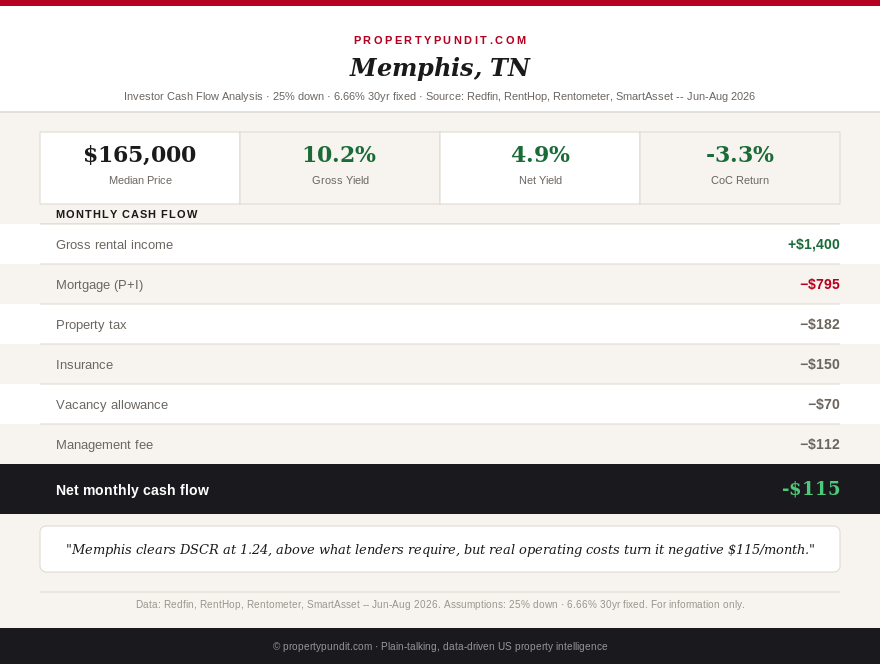
Here's a number that should worry any investor who leans on DSCR as a green light: 1.24. That's the debt service coverage ratio on Memphis's entry-level rental tier right now, comfortably above the 1.0 minimum most DSCR lenders require and well past the 1.20 to 1.25 threshold plenty of them prefer. By the numbers lenders check, this deal qualifies. Run the same property through a realistic operating budget, vacancy, property management, and a maintenance reserve, and it loses $115 a month.
This is a second-pass update to our June 2026 Tennessee spotlight, and two things have changed since then. Memphis has appreciated 8.7% year over year, pushing both its entry and median tiers higher. And our own numbers needed a correction: the property tax rate we used for Memphis understated what an investor inside city limits actually pays, because Memphis, like Nashville and Knoxville, layers a city tax rate on top of its county rate that most published averages don't reflect.
Memphis passes the lender's test. The math still says no.
Memphis's sub-$175,000 entry tier is the one part of Tennessee that has consistently cleared DSCR across both passes of this spotlight, and it still does. At a representative $165,000 purchase price with 25% down and today's 6.66% rate (Freddie Mac PMMS, August 27, 2026), here's the full picture.
| Item | Monthly |
|---|---|
| Purchase price | $165,000 |
| Down payment (25%) | $41,250 |
| Loan amount | $123,750 |
| P&I (6.66%, 30yr) | $795 |
| Property tax (1.32%, in-city Memphis, corrected) | $182 |
| Insurance (corrected) | $150 |
| PITIA total | $1,127 |
| Gross rent (3BR SFR) | $1,400 |
| DSCR (gross rent / PITIA) | 1.24: PASSES |
| Vacancy allowance (5%) | -$70 |
| Property management (8%) | -$112 |
| Maintenance reserve (1.5%/yr) | -$206 |
| Monthly cash flow | -$115 |
Rent is sourced from June 2026 3-bedroom rental data averaging $1,294 to $1,436 across Rentometer, RentHop, and Zillow, up roughly 8% year over year, and we used $1,400 as the representative figure. That's a real, current rent number on a property that clears every threshold a DSCR lender checks. The gap between "the loan qualifies" and "the property pays for itself" is exactly the $288 a month in vacancy, management, and maintenance costs that DSCR, by design, never counts.
So what for you: if you've been underwriting Tennessee deals on DSCR alone, add a full operating budget before you commit, because the number your lender cares about and the number your bank account will actually see aren't the same number here.
Get this in your inbox every Friday.
One email. The number that matters and what it means for you.
The tax rate everyone quotes is the wrong one
Our June first pass used a 0.83% effective property tax rate for Memphis. That number is closer to a rough approximation than an in-city reality, and it turns out the widely cited county-wide average (about 0.89%, SmartAsset, 2026) is also too low for anyone buying inside Memphis proper. Both miss the same thing: Memphis levies its own city rate of $2.58081 per $100 of assessed value on top of Shelby County's $2.702382 per $100 (City of Memphis and Shelby County tax records, 2026 fiscal year). Add them together, apply Tennessee's 25% residential assessment ratio, and the effective rate on market value comes out to about 1.32%, roughly 48% higher than the county-wide figure most sources quote and 59% higher than our own first-pass estimate.
This isn't a Memphis-only quirk. Nashville's Davidson County runs a similar structure: a combined city-county Urban Services District rate near $3.288 per $100 for anyone inside city limits, working out to about 0.82% effective, close to what we used in June. Knoxville's combined city-county rate in Knox County, $1.5540 from the county plus $2.1556 from the city, works out to about 0.93% effective, actually higher than our first pass's 0.82% estimate. County-wide averages published by sites like SmartAsset blend in unincorporated areas that pay county tax only, which is why they read lower than what an investor buying an actual city address will pay.
So what for you: before you trust a state's advertised low property tax reputation, check whether the number you're looking at is a county-wide blend or the actual combined rate inside the city limits where you're buying, because in Tennessee's three biggest markets that gap runs from modest to nearly 50%.
Nashville and Knoxville: appreciation plays, not cash-flow plays
Memphis's own median tier, not just its entry-level stock, tells the same story. At the current $210,000 three-month median (Redfin, up 8.7% year over year) with the corrected 1.32% tax rate and a scaled-up rent near $1,450, DSCR comes out to 1.03, barely above the 1.0 floor, and monthly cash flow after vacancy, management, and maintenance runs about negative $405. Our June first pass showed this tier as a thin but positive $107 a month before those costs were counted; a fuller accounting flips it negative.
Nashville and Knoxville don't even clear the DSCR floor. At Nashville's $480,000 median (Redfin, three months through July 2026) with a corrected 0.82% tax rate and $185 monthly insurance, PITIA runs about $2,827 against roughly $1,950 in rent, a DSCR of 0.69 and monthly cash flow near negative $1,731 once full operating costs are included. Knoxville, at a $325,000 median (Redfin, three months through July 2026, up 1.7% year over year) with a corrected 0.93% tax rate, runs a DSCR of 0.88 and cash flow near negative $861. Both numbers are worse than our June figures, consistent with a pattern we've now seen across several second-pass states: prices moved up, and a more careful accounting of taxes and real operating costs moved the honest number down.
So what for you: no Tennessee metro clears positive cash flow at its median in 2026, and the entry-level Memphis exception only looks like an exception until you subtract the costs a DSCR calculation was never designed to include.
What this means for a Tennessee investor in 2026
None of this erases Tennessee's real advantages. Zero state income tax on rental income is still worth real money, no statewide rent control still means market rent is what you actually collect, and Tennessee's 14-day nonpayment notice before an eviction filing is still faster than most states. Those are structural, durable edges, and they explain why Tennessee, and Memphis specifically, keeps showing up on national investor-market rankings despite math that doesn't cash-flow at the median.
The math points toward Memphis's entry-level tier for an investor who needs a specific number to work, but only after you rerun it with a full operating budget rather than a DSCR figure alone, since a $115-a-month gap is small enough that a slightly better insurance quote, a self-managed unit, or a marginally higher rent can flip it positive. For Nashville or Knoxville, you're underwriting appreciation and tax efficiency, not monthly income, and you should size the check you're willing to write accordingly. Before you commit real cash to any of these numbers, check your deal against a DSCR lender's actual minimum, since it's typically higher than the bare 1.0 breakeven this article uses, and compare Tennessee against county-level yield data in neighboring markets like Kentucky, where our second-pass Louisville and Lexington underwrite found the identical entry-level-passes-metro-fails pattern. If the down payment itself is the sticking point, the 20%-down assumption is often wrong and worth revisiting before you rule out a market on cash requirements alone.
Frankly, if a DSCR number above 1.0 has been your green light so far, it's time to add a second gate: run the same property past a realistic vacancy, management, and maintenance line before you sign, the way this Memphis number should have been checked from the start.