 Property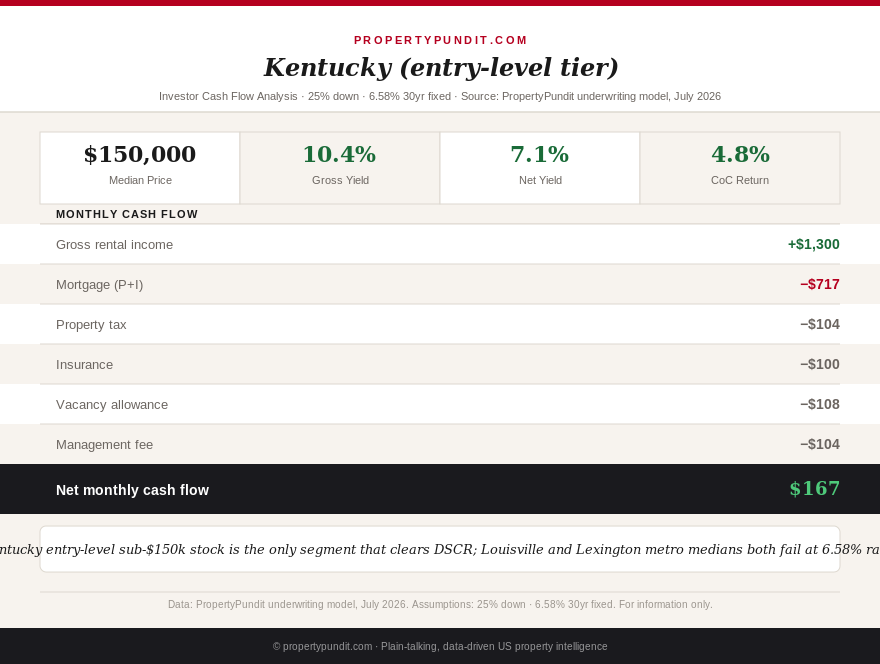
You've been circling Kentucky on the map for months. The pitch sounds right on paper: a 5-out-of-5 landlord-friendliness rating, no rent control anywhere in the state, a flat 3.5% income tax, and property taxes well below the national average. Then you run the actual numbers on a Louisville or Lexington listing at today's prices and 6.58% rates, and the deal that was supposed to work on reputation alone comes up short. That gap between what Kentucky advertises and what the math actually returns is exactly where you need to be looking before you wire an earnest money deposit.
Kentucky's statewide median sale price hit $281,500 in May 2026, up 2.4% year over year, with sales volume up 10.4% over the same month last year (Redfin, May 2026). Mortgage rates just climbed to 6.58%, the highest level in nearly a year (Freddie Mac PMMS, July 23, 2026). Run the underwriting on the two cities carrying most of that statewide number, Louisville and Lexington, and neither clears the 1.0 debt-service coverage ratio institutional and DSCR lenders use as their pass/fail line. The state's real investor opportunity sits well below its metro medians, not at them.
Louisville: close, but the numbers still lose money
Louisville's Jefferson County median sale price was $295,000 in May 2026 (Redfin). At 25% down and 6.58% rates, the loan payment runs about $1,410 a month. Jefferson County's combined effective property tax rate of roughly 0.93% adds another $229 a month, and insurance runs approximately $130. Total PITIA lands near $1,769. Against a typical single-family rental rate of $1,697 a month (Zillow, 2026), that's a DSCR of about 0.96, just under the 1.0 minimum most DSCR lenders require. After an 8% management fee and a one-month vacancy allowance, net cash flow runs roughly negative $338 a month, before any maintenance reserve.
Louisville is the closest thing Kentucky has to a working metro-median deal, and it still loses money every month at today's price and rate combination. If you're underwriting a Louisville rental at the county median, budget for a monthly loss, not a monthly return, unless you can buy meaningfully under $295,000.
Lexington: the higher price makes the gap worse
Lexington's Fayette County median ran $350,000 over the three months ending May 2026, up 5.7% year over year (Redfin), the priciest of Kentucky's major metros. Fayette County's effective property tax rate is a comparatively modest 0.87%, but the higher purchase price still pushes the numbers further from breakeven than Louisville. At 25% down and 6.58%, PITIA runs about $2,072 a month, against average rent near $1,734, a DSCR of roughly 0.84. Net cash flow after management and vacancy runs close to negative $610 a month, nearly double Louisville's monthly loss.
Lexington's appreciation story, driven by the University of Kentucky and a deep horse-industry economic base, is real, but it is an equity play for patient capital, not a cash-flow play at today's price and rate. If monthly income is the goal, Lexington's current median works against you, not for you.
Bowling Green: a cheaper price that still doesn't clear the bar
Bowling Green, home to Western Kentucky University, posted a median sale price of $319,900 in April 2026, meaningfully above both Louisville's median and its own reputation as an affordable secondary market. At 25% down and 6.58% rates, PITIA runs approximately $1,881 a month against a realistic student-and-workforce rental rate near $1,550, a DSCR of about 0.82. Net cash flow after management and vacancy comes in around negative $574 a month.
Bowling Green's price has caught up with Louisville's without the deeper rental market to support it, so the college-town label alone isn't enough reason to expect this deal to cash-flow at its current median. You need a specific below-median property, not the market average, to make Bowling Green pencil.
Get this in your inbox every Friday.
One email. The number that matters and what it means for you.
The tier that actually works: sub-$150k B/C-class stock
Outside Louisville's and Lexington's cores, and in Kentucky's smaller cities and older neighborhoods, B/C-class single-family stock in the $100,000-$175,000 range with rents of $1,100-$1,500 a month is common, producing gross yields of 8-11%. Run a representative $150,000 property at 25% down and 6.58% rates: the loan payment is about $717 a month, property tax at the statewide 0.83% average adds roughly $104, and insurance runs near $100. Total PITIA lands at $921. Against $1,300 a month in rent, that's a DSCR of 1.41, comfortably above the 1.0 minimum. After management and vacancy, net cash flow comes in around positive $175 a month, real income, not a hoped-for return.
This is the pattern the same underwriting has already surfaced in Tennessee's Memphis entry tier and Oklahoma's sub-$185k Tulsa stock: Kentucky's investor advantage lives in its cheapest, most overlooked inventory, not in the metro markets that show up first in a listing search.
Why the landlord-friendly reputation isn't the whole story
Kentucky's regulatory environment is a genuine, quantifiable advantage: no rent control anywhere in the state, a streamlined eviction process, and a 3.5% flat income tax, down from 4% at the start of 2026, that applies evenly to rental income with no graduated brackets to push you into a higher bracket as your portfolio grows. Kentucky's $49,100 homestead exemption, which shields owner-occupants 65 and older or totally disabled from a slice of assessed value, does not apply to rental property, so investors pay full assessed value regardless of what a homeowner-focused tax guide advertises. None of that regulatory advantage shows up as extra cash in your pocket if the purchase price is wrong for the rent it commands.
Frankly, if you're underwriting Kentucky on its landlord-friendly reputation and its low income tax rate alone, you're pricing in an advantage that only pays off below the metro medians; most investors who run these numbers at Louisville or Lexington's actual asking prices end up passing on the deal or hunting specifically for the sub-$150k stock where the math, not the reputation, actually works.