 Property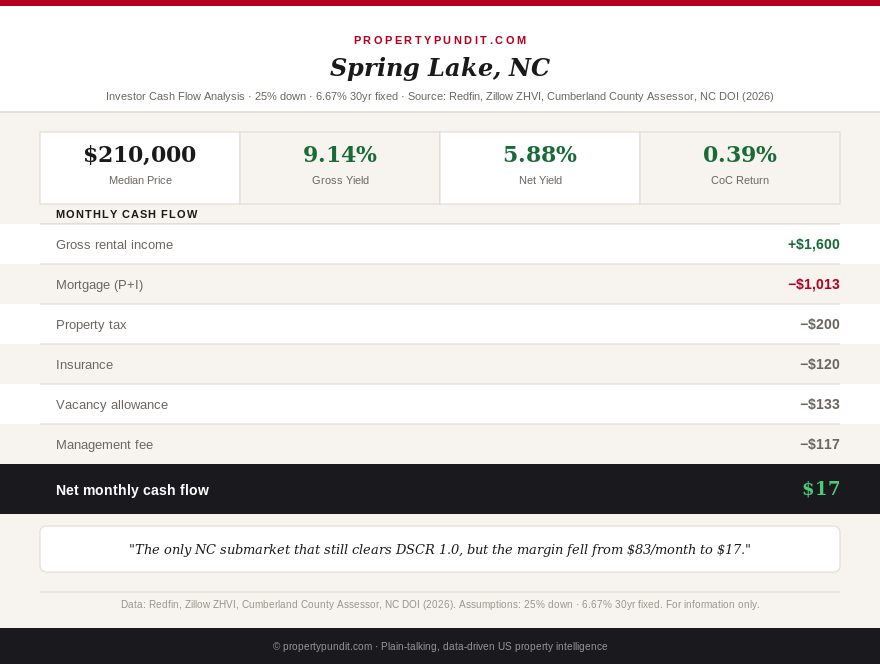
North Carolina's income tax fell to a flat 3.99% this year, the state's insurance commissioner just talked insurers down from a 68.3% rate hike to roughly a tenth of that, and the Triangle keeps adding jobs. On paper, 2026 reads like a good year to be a North Carolina landlord. Run the actual PITI math on the state's two biggest metros, though, and neither Charlotte nor Raleigh comes close to clearing breakeven at today's mortgage rates. The one submarket that does still work is the same unglamorous corner of the state we flagged in June, and even there, a corrected insurance number just cut the margin by 80%.
Charlotte at $435,000: DSCR 0.67
Charlotte's median sale price ran $435,000 over the three months ending May 2026 (Redfin), up modestly from a year earlier. At 25% down and Freddie Mac's 6.67% rate (PMMS, August 13, 2026), that's a $326,250 loan carrying $2,099/month in principal and interest. Add Mecklenburg County's 0.80% effective property tax rate ($290/month) and landlord insurance estimated at 0.68% of value for this inland, non-coastal market ($247/month, Steadily/Insurify 2026 bands), and PITI runs $2,636/month.
Three-bedroom rents in Charlotte average $2,050-$2,117/month (Zumper/RentCafe, 2026); using $2,100 and applying management and vacancy (8% management, one month vacancy allowance) gives effective rent of $1,771/month. That's a monthly loss of $865 and a DSCR of 0.67, well short of the 1.0 minimum most DSCR lenders require. Gross yield is 5.79%, respectable on paper, but property tax and insurance alone consume more than the rent brings in after realistic operating costs. Charlotte is an appreciation story for an investor with a long horizon, not a cash-flow market at current rates.
Get this in your inbox every Friday.
One email. The number that matters and what it means for you.
Raleigh at $444,326: the Triangle's growth story runs DSCR 0.62
Raleigh's Zillow ZHVI put typical value at $444,326 as of June 30, 2026, closely tracking Redfin's roughly $449,000 figure from recent closings, a rare case this pass where the two major sources actually agree. Wake County's 0.75% effective property tax is the lowest of the three markets in this piece, at $278/month, and insurance at the same 0.68% inland estimate runs $252/month. The loan itself is the problem: $333,245 at 6.67% carries $2,144/month in principal and interest, pushing PITI to $2,674.
| Item | Charlotte | Raleigh |
|---|---|---|
| Price | $435,000 | $444,326 |
| Loan (75%) | $326,250 | $333,245 |
| P&I (6.67%) | $2,099 | $2,144 |
| Property tax | $290 | $278 |
| Insurance | $247 | $252 |
| PITI | $2,636 | $2,674 |
| Effective rent | $1,771 | $1,645 |
| Cash flow | -$865 | -$1,029 |
| DSCR | 0.67 | 0.62 |
Raleigh's cheaper property tax isn't enough to offset a higher purchase price and softer rent-to-price ratio; three-bedroom rents run closer to $1,950/month (Zumper, August 2026) against a price nearly identical to Charlotte's. If you're underwriting the Triangle expecting Wake County's lower tax rate to be the deciding factor, it isn't. Both metros lose roughly a thousand dollars a month combined at 25% down, and an investor chasing Raleigh's job growth needs to be underwriting appreciation and rent growth over a multi-year hold, not next month's bank statement.
Spring Lake still clears DSCR, barely
Our first look at North Carolina in June found one submarket that worked: Spring Lake, adjacent to Fort Liberty, at a $215,000 entry price with $83/month in positive cash flow. Fayetteville itself has since drifted to a $235,000 median (Redfin, three months through May 2026), down 2.1% year over year, and Spring Lake has moved down proportionally to roughly $210,000. The military rent base hasn't changed: $1,600/month remains the reliable midpoint for a three-bedroom near the base, still comfortably covered by an E-5's roughly $1,620/month BAH.
What's changed is the insurance line. Our June estimate used $100/month, a placeholder that undershot the real cost the same way this site's first-pass Nebraska and New Mexico estimates did before correction. Cumberland County landlord insurance, scaled at the same 0.68%-of-value rate used for Charlotte and Raleigh, runs closer to $119/month on a $210,000 property. Re-run the numbers at $210,000, 25% down, 6.67%: a $157,500 loan carries $1,013/month in principal and interest, Cumberland County's 1.14% property tax adds $200/month, and corrected insurance adds $119/month, for PITI of $1,332. Effective rent on $1,600 gross comes to $1,349. That's a monthly cash flow of positive $17, DSCR 1.013. It still clears the 1.0 lender minimum, but a margin that was $83 in June is now close to a rounding error.
For an investor, $17/month isn't a return, it's a tie. A single month of vacancy above the modeled rate, one deferred maintenance call, or the next round of the state's insurance rate settlement erases it entirely. Spring Lake remains technically the only cash-flow-positive market in North Carolina we've found, but "technically positive" and "worth the risk" are no longer the same sentence they were two months ago.
The insurance scare that didn't fully happen
The headline number that circulated through late 2025 and early 2026 was alarming: the North Carolina Rate Bureau requested a 68.3% two-year increase on dwelling policies, the landlord-relevant coverage type, with 28.5% proposed for year one alone. Insurance Commissioner Mike Causey rejected that filing outright, stating the department was "not in agreement with the Rate Bureau's proposed increases," and scheduled a formal hearing. Rather than litigate it to conclusion, the Department of Insurance settled the case at approximately 5% per year for two years, roughly 10% cumulative, a fraction of what was originally sought.
That settlement is genuinely good news relative to the fear that drove headlines for months, and it's the reason this piece's insurance corrections add real cost without adding catastrophic cost. The property tax and insurance line items above already reflect current 2026 market premiums, not the rejected 68.3% scenario. If you paused a North Carolina purchase decision based on the worst-case number from last year's news cycle, the actual settlement is a meaningfully better outcome, even if it still moves the Spring Lake math from comfortable to marginal.
Regulatory environment: still landlord-friendly, with new procedural detail
North Carolina still has no rent control at the state or local level, and state law preempts any city or county from imposing one, a genuine advantage over markets like New York or Oregon covered elsewhere on this site. The flat income tax fell to 3.99% for 2026 from 4.5% in 2025, with further scheduled cuts to 3.49% in 2027 and 2.99% in 2028 contingent on the state hitting revenue targets, applying equally to rental income with no local add-on anywhere in the state. Eviction timelines remain fast relative to the Northeast, and 2026 brought procedural refinements rather than a change in landlord favorability: clearer renters-insurance-limitation language, accelerated removal timelines for unauthorized occupants, and a new option allowing landlords to write an attorneys'-fees clause into the lease, recoverable up to 15% of the amount owed or one month's rent in an eviction case.
None of that regulatory detail moves the cash flow math in this piece, but it does mean the downside case, an eviction, is cheaper and faster to resolve in North Carolina than in a market like Massachusetts, where a single eviction can consume 18 months of positive cash flow. If you're weighing North Carolina's negative day-one cash flow against a market with better numbers but worse landlord protections, the regulatory side of that trade still favors North Carolina.
What the data means for you
The math points toward treating North Carolina as two different investment theses depending on where you buy. Charlotte and Raleigh are appreciation and job-growth bets that require a multi-year hold and outside income to cover a four-figure monthly shortfall; neither pencils as a standalone cash-flow purchase at 6.67% rates, regardless of how favorable the state's tax and regulatory backdrop looks. Spring Lake is the opposite: real, current, positive cash flow, but a margin now thin enough that it functions more as a break-even hold with upside from BAH growth and Fort Liberty's demand base than as an income property in the traditional sense. Frankly, if you're underwriting North Carolina purely for monthly cash flow, Spring Lake is still the only defensible entry, and it needs rent growth or a lower purchase price to be worth the operational risk of a $17 margin. Investors who want the Triangle's growth story should budget for years of negative carry, not treat this month's insurance settlement as the thing that fixes the math. For general first-time buyer guidance rather than an investor lens, see our down payment myth breakdown and how DSCR loans are underwritten before you commit to either strategy.