 Property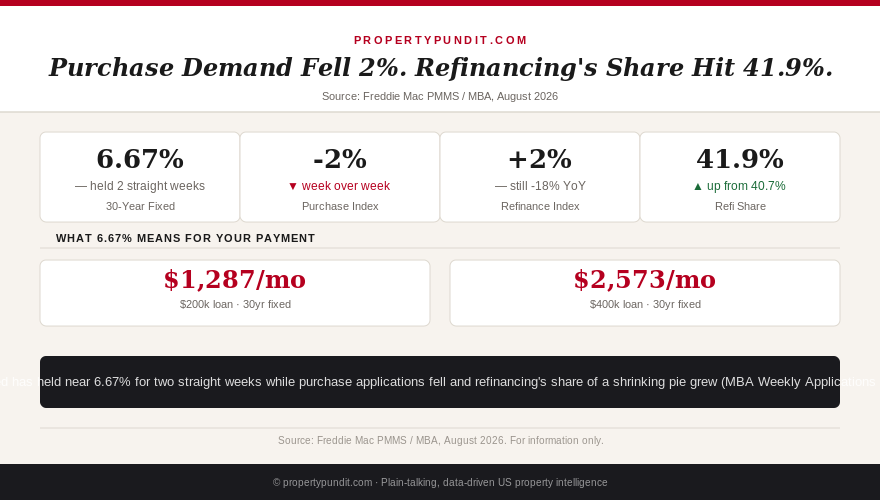
You've checked mortgage rates again this week, and if you're sitting on a loan from a few years back at something in the 3s or low 4s, you already know the number that would need to show up before refinancing makes sense: a rate with a 4 or a very generous 5 in front of it. What actually showed up this week isn't a rate move at all. It's a shift in who's applying. Mortgage applications fell 0.4% for the week ending August 14, and inside that small decline, purchase demand dropped 2% while refinance applications rose 2% and grabbed a bigger slice of the pie, 41.9% of all activity, up from 40.7% the week before (MBA Weekly Applications Survey, released August 19, 2026). If you were hoping for a number that changes your math, this isn't it. But it explains something you may have noticed: refinancing is suddenly a bigger part of the conversation, even though nobody's rate actually got better.
Freddie Mac's next official reading, covering the week through today, publishes at noon ET, several hours after this goes up, so what follows uses the most recent confirmed number rather than guessing at one that hasn't printed yet.
What actually moved this week
The Mortgage Bankers Association's Market Composite Index, a measure of total loan application volume, fell 0.4% on a seasonally adjusted basis for the week ending August 14, 2026. Inside that headline number, the Purchase Index dropped 2% from the prior week, while the Refinance Index rose 2% over the same span, though it remains 18% below where it stood a year ago. Freddie Mac's 30-year fixed averaged 6.67% as of August 13, down from 6.69% the week before, and has now sat in a 2-basis-point band for two consecutive readings. A year ago at this point, the same loan averaged 6.58%, so today's rate is still meaningfully higher than where it stood twelve months back, even after two weeks of essentially flat movement.
For a homeowner already parked well under 5%, none of this moves the needle. The rate hasn't dropped enough to matter, and the applications data confirms that most of the market agrees: purchase activity is what's actually shrinking, not refinance demand expanding to meet a rate that isn't there.
Get this in your inbox every Friday.
One email. The number that matters and what it means for you.
Why refinancing's share is rising without a lower rate
A rising refinance share sounds like it should mean more people are finding a rate worth switching to. Read the two index numbers together and a simpler explanation shows up: purchase applications are falling faster than refinance applications, so refinancing takes up a bigger percentage of a shrinking total, without a single additional household actually applying. The MBA's own commentary points to affordability, not rate optimism, as the reason purchase demand keeps softening: higher monthly payments at today's rate, combined with a cooler labor market, are giving prospective buyers another reason to wait rather than a reason to act.
None of that means nobody is refinancing for real. It means the growth in refinance share this week is a math artifact of purchase demand pulling back, not evidence that 6.67% suddenly works for the broad population of homeowners still sitting on 2021-era rates. If you were about to read "refi share climbs" as a signal to check your own rate, the signal that actually matters is your own, not this week's ratio.
The refi math at 6.67%, worked through
The borrowers for whom this week's rate genuinely does work are a narrower group than the headline suggests: people who bought in 2023 or 2024, when the 30-year fixed spent long stretches above 7%, and who are carrying a large enough balance that even a modest rate drop produces a real monthly number. Take a $350,000 loan taken out at 7.35%. The principal and interest payment on that loan runs about $2,412 a month. Refinancing the same balance to today's 6.67% drops that payment to roughly $2,252, a savings of about $160 a month. Against typical closing costs of around $5,500 for a loan that size, the break-even point lands at about 34 months, under three years. If you plan to stay in the home that long, and most people relocating for a job or a growing family don't move inside three years without a specific reason to, that math clears.
Compare that to a homeowner sitting on a 3.8% rate from 2021, the more common profile among people actively checking this site's rate updates every week. Refinancing that loan into 6.67% would raise the payment, not lower it, no matter how the closing costs are financed. The rate move that would make that refinance worth even considering, something clearly under 4.8% on a like-for-like term, isn't close to today's number, and nothing in this week's data suggests it's coming soon.
What today's still-pending PMMS reading means for timing
Freddie Mac publishes its Primary Mortgage Market Survey every Thursday at noon ET, averaging loan rates offered from the prior Thursday through the preceding Wednesday. Today's reading, covering the week that just ended, publishes after this article does, which is why nothing here claims a rate move that hasn't happened yet. What the last two confirmed readings do show is a rate holding almost perfectly still: 6.69% on August 6, 6.67% on August 13. A two-basis-point drift over two weeks is closer to rounding noise than a trend, and there's no data-driven reason to expect today's number to break sharply in either direction.
If you're deciding whether to lock this morning or wait for the noon print, that history is the relevant context: the odds that today's reading moves your monthly payment by more than a few dollars on a typical loan are low, and waiting on a number this stable rarely pays off the way waiting on a genuinely volatile week can.
Who should actually be checking refi rates this week
Three groups are worth separating here, because this week's data treats them very differently. Homeowners under 5%, the largest group reading this, have no action to take; the math simply isn't there, and won't be until rates fall by a full percentage point or more. Homeowners who bought in 2022 through 2024 above 7% with a balance over roughly $300,000 are the group the worked example above actually applies to, and for them the math already clears in under three years at today's rate. FHA and VA borrowers eligible for a streamline refinance, which typically requires less documentation and no new appraisal, are a third group, and the data hints they may be a meaningful part of who's actually driving this week's refinance share higher, since streamline volume moves independently of the broader rate environment.
Frankly, if you're in that second group, a 2022-to-2024 buyer above 7% with a loan balance large enough for a percentage point to matter, the math points toward locking in a rate check this week rather than waiting for a number that may not come. Most people who run these numbers end up refinancing not because 6.67% feels exciting, but because their existing rate feels so much worse by comparison. Before you start that process, it's worth reviewing what you'll actually pay in closing costs on a refinance, since that figure drives the break-even math as much as the rate spread does, and if your original loan still carries PMI, check whether PMI cancels automatically before refinancing purely to remove it. If your credit score has moved since your original loan closed, it's also worth confirming where you land against current credit score pricing tiers, since a jump of even 20 points can change the rate a lender actually offers you.
For the fuller picture on how this week connects to last week's applications data, including why refinance volume overall is still running well below last year's pace, the trend lines up: purchase demand is the side of the market actually weakening, and refinancing's rising share is a reflection of that, not a signal that the broader refinance opportunity has arrived.
Frequently asked questions
Did mortgage rates change this week? Not as of the most recent official reading. Freddie Mac's 30-year fixed averaged 6.67% as of August 13, 2026, down slightly from 6.69% the week before, and has now held in a narrow 2-basis-point band for two straight weeks. A new PMMS reading publishes today, Thursday August 20, at noon ET.
Why did the refinance share of applications rise if rates didn't drop? Mostly composition, not a wave of new refinancers. Purchase applications fell 2% for the week ending August 14 while refinance applications rose 2%, so refinancing simply became a bigger slice of a smaller overall pie, pushing its share to 41.9% of applications from 40.7% the prior week (MBA Weekly Applications Survey, August 19, 2026).
Is it worth refinancing at 6.67%? It depends entirely on your current rate. If you're under 5%, the math still doesn't work. If you bought in 2023 or 2024 above 7%, a worked example on a $350,000 loan shows refinancing to 6.67% saves about $160 a month and breaks even on roughly $5,500 in closing costs in under three years.
When does Freddie Mac release new mortgage rate data? Every Thursday at noon ET, based on loan applications submitted the prior Thursday through Wednesday. When a holiday falls on a Thursday, the release moves to Wednesday. The next reading after this week's is due August 27, 2026.