 Property
You're 34, your rent just went up again, and you've finally worked up the nerve to make an offer on a house at $112,000 income. Your agent mentions earnest money. Your loan officer mentions an escrow account. Your Closing Disclosure has a line called "initial escrow deposit." Three different documents, three uses of the same word, and nobody stops to tell you they're not the same thing. That gap in understanding is exactly where first-time buyers get blindsided by a bill they didn't see coming, at the one moment they can least afford a surprise: the closing table.
Here's the direct version. "Escrow" describes three separate accounts in a home purchase, each holding different money for a different reason, at a different point in the process. Mixing them up doesn't just cause confusion. It causes buyers to under-budget the actual cash required to close, sometimes by $1,000 or more. Below is what each one actually holds, what it costs, and the specific number you need to ask your lender for before you finalize your budget.
The $6,000 that isn't a fee
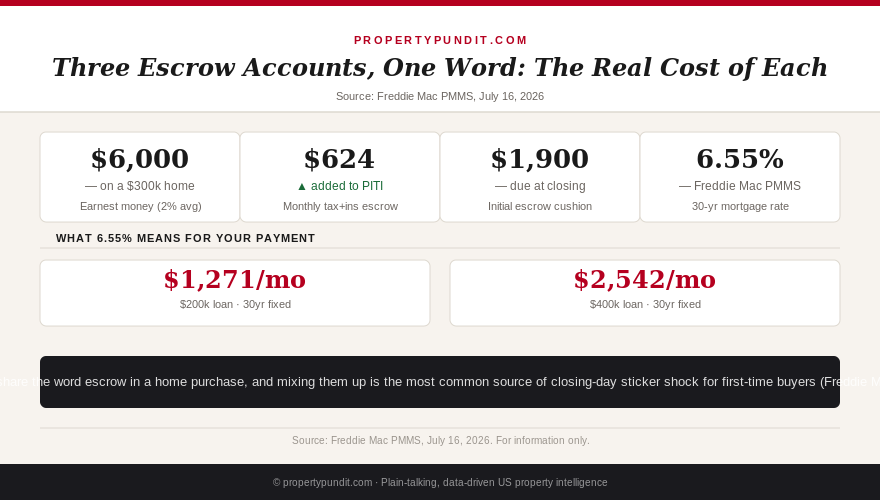
The first escrow you'll encounter is earnest money, sometimes called a good-faith deposit. Within a day or two of your offer being accepted, you wire a deposit, typically 1% to 3% of the purchase price, to a neutral third party: a title company, an escrow agent, or an attorney, depending on your state. On a $300,000 home, that's $3,000 to $9,000. It is not a fee. It's your money, held by someone who works for neither you nor the seller, as proof you're serious about the deal.
At closing, the earnest deposit gets applied toward your down payment or closing costs, so it isn't an extra cost on top of what you'd already planned to bring. But you need it in liquid cash weeks before closing, separate from your down payment savings, and if your offer falls through for a reason your contract doesn't protect, most commonly backing out after your contingency deadlines have passed, you can lose it entirely. So what for you: budget your earnest deposit as cash you need available immediately after an accepted offer, not cash you'll pull together later, and know your down payment math before you're sitting across from a seller's agent.
Get this in your inbox every Friday.
One email. The number that matters and what it means for you.
What actually happens on closing day
The second use of "escrow" is the closing process itself. In many states, people say a deal is "in escrow" between contract and closing, and "close of escrow" simply means closing day. On that day, every dollar involved in the transaction, your down payment, your lender's loan proceeds, your earnest deposit, the seller's payoff to their existing lender, and each side's closing costs, flows through a neutral settlement agent (again, usually a title company) that disburses it correctly and records the deed. You're not paying an extra fee for this use of the word; it's the mechanism, not a cost. But it's the reason your closing paperwork uses "escrow" a second time in a completely different sense than your earnest deposit did, which is exactly where confusion sets in for a first-time buyer trying to figure out what they still owe.
The settlement agent also charges its own fee for coordinating this process, typically bundled into your closing costs alongside title insurance and recording fees. Our closing costs breakdown covers those line items in full. So what for you: when your Closing Disclosure references "escrow," check the surrounding line item before assuming it's your earnest deposit or your down payment. It usually isn't either one.
The account that adds $624 a month to your payment
The third escrow is the one that actually changes your monthly budget for years, not just at closing. Most lenders require an ongoing escrow account for property tax and homeowners insurance. Instead of trusting you to save for a once- or twice-a-year tax bill, the lender collects one-twelfth of your estimated annual property tax and insurance premium every single month, on top of principal and interest, and pays the bills directly when they come due.
The national averages make this concrete. Property tax now averages $4,427 a year per home, and homeowners insurance is projected to average $3,057 a year by the end of 2026 (LERETA / Ownwell escrow survey, March 2026). Add those together and divide by 12: $7,484 a year comes to $624 a month, added on top of whatever your principal-and-interest payment already is, before you've spent a dollar on maintenance. This is a fixed part of your "fixed-rate" mortgage that isn't actually fixed. It moves every year your local tax assessment or your insurance renewal moves, and we've covered how badly that can go: about 65% of escrow accounts are running short in 2026, averaging a $2,157 shortfall, which is exactly what happens when a bill rises faster than your escrow account assumed (see our breakdown of the escrow shortage problem hitting homeowners this year). So what for you: the number that determines whether you can afford a house isn't your principal-and-interest payment alone. It's principal, interest, taxes, and insurance combined, and only your lender's actual escrow analysis tells you that fourth number with any accuracy.
The number nobody budgets for
Here's the part that catches buyers off guard at the closing table specifically. Federal rules (RESPA) let lenders collect an initial cushion when they open your new escrow account: generally up to two months of your total escrow payment, plus whatever prorated amount is needed to have enough on hand before the next tax or insurance bill actually comes due. Using the $624 monthly figure above, that cushion alone can run $1,200 to $1,900, due in certified funds at closing, in addition to your down payment and your other closing costs.
This is the single most common reason a first-time buyer's "cash to close" number comes in higher than they expected, even after they've correctly budgeted their down payment and standard closing costs. It isn't a hidden fee. It's fully disclosed on your Closing Disclosure, under a line most buyers skim past because they assume "escrow" already means something they've accounted for. So what for you: ask your loan officer for your projected initial escrow deposit as soon as you're under contract, not the week of closing, so it's a planned line item instead of a last-minute scramble to find another $1,500.
What this means for you this week
If you're actively house hunting at $112,000 income, treat "escrow" as three separate line items on your worksheet, not one. First, your earnest deposit: cash you need within 24 to 48 hours of an accepted offer, refundable only within your contingency windows. Second, closing escrow: the mechanism your closing costs move through, not an extra fee itself. Third, your ongoing tax-and-insurance escrow: a recurring monthly cost that can run $500 to $700 a month nationally and an upfront cushion of $1,200 to $1,900 due at closing.
The math points toward getting your lender's full escrow projection in writing before you set your maximum offer price, not after. Most people who skip this step end up discovering their real cash-to-close number is a few thousand dollars higher than the down payment calculator they used months earlier. Frankly, if your closing is more than a month out, call your loan officer this week and ask two specific questions: what will my initial escrow cushion be, and what's my projected monthly escrow payment once the account is fully seeded. A strong credit score gets you a better rate, but it won't save you from an escrow bill you never asked about. Get the real number now, while you can still adjust your offer or your closing date around it, not at the table when it's too late to do anything but sign.