 Property
You saw the headline this week: home sales surged 7% in July. If you've spent the past two years watching prices climb out of reach, that number probably landed like a door closing. Another summer gone, another round of buyers who moved faster than you did.
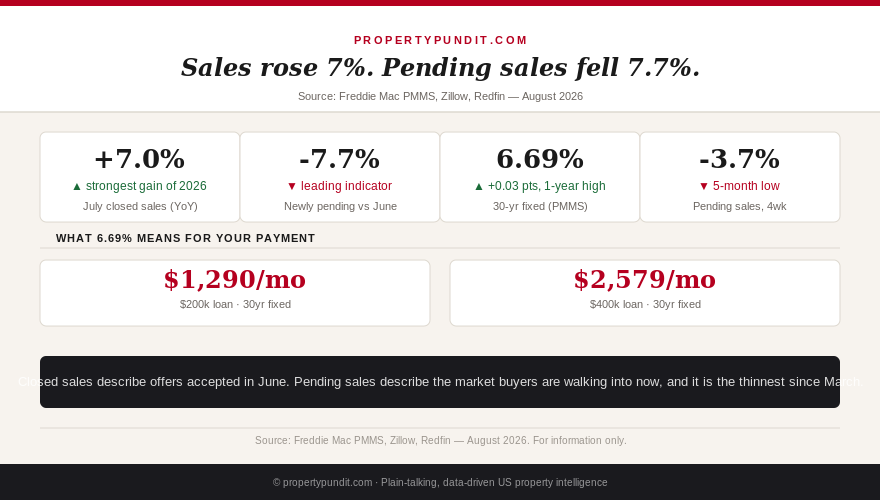
Read the second paragraph of that report and the story flips. Zillow counted roughly 382,898 closed transactions in July, the strongest year-over-year gain of 2026. But newly pending listings, the measure of offers actually accepted during July, rose just 0.3% from a year earlier and fell 7.7% from June (Zillow July Market Report, August 2026).
Those two numbers describe two different months. One of them is the market you missed. The other is the market you are standing in.
Get this in your inbox every Friday.
One email. The number that matters and what it means for you.
The 7% number describes June, not August
A financed home purchase takes 30 to 45 days between accepted offer and closing. Every sale that closed in July was agreed in late May or June, when the average 30-year fixed rate was running closer to 6.5% and buyers were still working through spring inventory.
Closed sales are the rearview mirror. Pending sales are the windshield. And the windshield is showing something the rearview mirror can't: Zillow's own note said a "fresh oil price shock in July sent mortgage rates higher," which likely prompted a chunk of prospective buyers to pause their search mid-month.
So when a report tells you sales surged, check which sales it means before you conclude you're competing with more people. In this case you are competing with fewer.
Pending sales just hit a five-month low
Redfin's read on the same period is blunter. For the four weeks ending August 2, 2026, US pending home sales fell 3.7% week over week and 1.9% year over year, the lowest level in more than five months and the steepest decline since 2022 (Redfin, August 6, 2026).
The regional split matters more than the national average. Seattle, Houston, and Phoenix all posted double-digit percentage drops in pending sales. West Palm Beach, Cincinnati, and Pittsburgh posted year-over-year growth. Newark and West Palm Beach led price gains at 9.8% and 9.5% year over year, while prices fell outright in seven major metros including San Jose and Seattle.
If you're shopping in one of the metros where pending sales dropped hardest, the seller of the house you're looking at has fewer people to choose from this month than at any point since March. That's not a headline. That's your bargaining position.
Rates went the wrong way, and the weekly move is smaller than you think
Freddie Mac's 30-year fixed averaged 6.69% for the week ending August 6, 2026, up from 6.66% the week before and the highest weekly average in over a year. A year ago the same survey read 6.63% (Freddie Mac PMMS, August 6, 2026). Five months into the war in Iran, oil prices and inflation expectations are keeping Treasury yields elevated, and mortgage rates track those yields rather than the Fed funds rate.
Now put the weekly move in dollars. On a $360,000 loan, the difference between 6.66% and 6.69% is $7.16 a month. Seven dollars. That's the entire practical impact of the rate headline that dominated housing coverage this week.
One oddity worth flagging: the 15-year fixed moved the opposite direction in the same survey, slipping to 6.01% from 6.04%. The gap between the two products has narrowed to 68 basis points. On that same $360,000 loan, a 15-year at 6.01% costs $3,040 a month against $2,321 for the 30-year, so the narrower spread doesn't make the shorter term affordable for most buyers. It does tell you the bond market is pricing near-term inflation risk rather than a long-run repricing.
The lesson for your own decision: stop refreshing the weekly rate. A three-basis-point move is noise. What happened to buyer competition this month is signal.
Run the trade: a price cut now versus a better rate later
Here is the calculation almost nobody does properly. Take a $400,000 home with 10% down.
Option A: buy now. You negotiate 5% off the asking price, paying $380,053. With 10% down, the loan is $342,047 at 6.69%. Principal and interest: $2,205 a month.
Option B: wait. Rates fall to 6.20% next spring, you pay the full $400,000 because the buyer pool came back, and your loan is $360,000. Principal and interest: $2,205 a month.
Identical payment. That's the break-even, and it says a 5% price concession today is worth exactly the same monthly cost as a half-point rate improvement later. But the two aren't equivalent in any other respect. Option A carries $17,953 less debt, needs $1,995 less cash at the table for the down payment, and reaches 20% equity sooner, which matters if you're paying mortgage insurance. Option B gives you a rate you like on a balance you cannot renegotiate.
And the rate is the only one of the two you can change later. If rates do fall to 6.20% in 2027, the Option A buyer refinances into it. The Option B buyer is stuck with a purchase price that's set in ink at closing.
Before you model any of this, get the full cash number straight, because a negotiated price doesn't reduce every line at closing proportionally. Our breakdown of what closing costs actually cover is the place to start, and if the down payment is your real constraint rather than the rate, the 20% down payment myth is worth reading before you delay another year saving for a threshold you don't need to hit.
The concession is often easier to win than the price cut
Sellers resist headline price cuts for a reason that has nothing to do with money. A visible reduction advertises weakness to every buyer still watching the listing, and it drags down the comparable sales their neighbors are relying on. A concession does neither, because it sits in the contract rather than on the listing page.
That's why concessions have become the standard currency of this market. Redfin found 46.2% of spring 2026 sales included a seller concession, a record since it began tracking in 2019, and 15.7% of sales included both a price cut and a concession (Redfin, May 2026). Nashville led at 75.5%, with Charlotte at 71.4% and Atlanta at 68.7%.
The limits are set by your loan type, not by negotiation. FHA caps seller-paid costs at 6% of the price. Conventional loans with less than 10% down cap at 3%, rising to 6% between 10% and 25% down and 9% above that. VA allows 4% plus unlimited closing costs (FHA Handbook 4000.1; Fannie Mae Selling Guide). A concession also can't exceed your actual closing costs and can't be applied to the down payment.
Work out your cap before you write the offer, because asking for 5% on a conventional loan with 5% down wastes the one piece of bargaining power the pending-sales data just handed you.
The catch: this window may not stay open
Weak buyer demand only helps you for as long as supply holds up. Zillow put active inventory 1.5% higher than a year earlier in July, and the typical US home value reached $371,757, up 0.4% month over month and 1.1% year over year. That's close to flat in real terms.
But Zillow also warned that the listings pipeline may be drying up, projecting "flat to declining transaction volumes for the remainder of the year in some regions." Sellers who can't get their price tend to withdraw rather than cut, a pattern we covered when delistings hit their highest share since 2020. Fewer buyers plus fewer listings is a thinner market, not automatically a cheaper one.
Which means the negotiating advantage you have in August is a function of the specific houses sitting unsold right now, not of a trend that will keep improving. Look at inventory that has been listed 45 days or longer, and treat anything newly listed as priced for a market that no longer exists.
What to actually do this month
The math points toward acting on price rather than waiting on rates, and doing it on a house that has already been sitting.
Concretely: pull the days-on-market figure for every property on your shortlist, and be careful, because a relisted home shows a reset counter. Anything past 45 days in a metro with falling pending sales is a seller who has already watched the buyer pool thin out twice. Open at 6% to 8% under asking on those, and ask for the seller to cover a rate buydown on top rather than instead of a price cut, since a buydown lowers your payment without lowering your equity.
Frankly, if you are sitting on a solid down payment and a stable income and you've been waiting for rates to break 6%, the past nine months have already told you that isn't the trade on offer. Most people who run the break-even honestly end up concluding the same thing: the discount is available now, the rate is available later, and only one of them expires.
Then re-run your own numbers rather than trusting these. Our mortgage calculator will take a negotiated price and a current rate and tell you what the payment actually is, which is the only number that decides whether you can live with the house.