 Property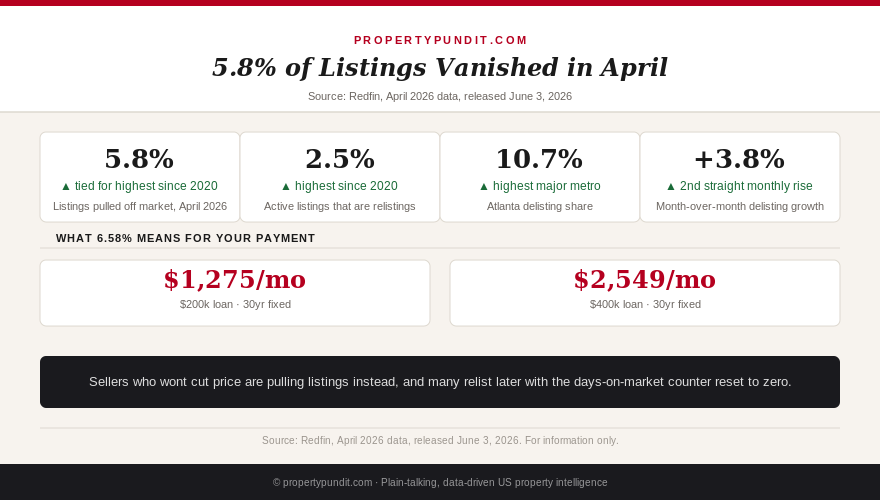
You've been refreshing the listing portals every morning for weeks, and there it is: a "new" home, 0 days on market, in your price range, in your neighborhood. Your pulse picks up because a fresh listing means less competition and more room to negotiate before anyone else circles it. Except it might not be fresh at all. It might be the same house that sat unsold for four months last spring, pulled off the market by a seller who'd rather make the listing disappear than admit the price was wrong, then relisted this week with the clock quietly reset to zero.
That's not a hunch, it's a documented and growing pattern. In April 2026, 5.8% of all US home listings were taken off the market, tied with December 2025 for the highest share since March 2020 (Redfin). Delistings rose 3.8% month over month on a seasonally adjusted basis, the second straight monthly increase. And 2.5% of active listings that same month were relistings, homes previously pulled off the market and put back up, also the highest share since 2020. Atlanta (10.7%) and San Jose (9.3%) posted the highest delisting shares of any major metro. If you're buying right now, the "0 days on market" tag you're trusting to gauge competition is less reliable than it's been in six years.
Why sellers are quietly pulling listings instead of cutting the price
Cutting the asking price is a public, permanent event. It shows up in the price history every buyer's agent pulls up, and it signals to every future viewer that the seller is under pressure. Pulling the listing does neither. The property simply vanishes from search results, with no price cut attached to the record, and the seller gets to wait for better conditions or relist later without that price reduction following the home around. In a market where 37% of builders and a rising share of individual sellers are already cutting prices (NAHB, July 2026), delisting is the version of that decision that doesn't leave a visible scar.
If you're wondering why a home you were watching suddenly disappeared instead of dropping its price, this is very likely the answer, and it means the seller was more motivated to avoid the appearance of a price cut than to actually accept a lower number.
The relisting trick: how the days-on-market clock gets reset
Most listing portals treat a relisted property as a brand-new listing, assigning it a new list date and resetting days-on-market to zero, the same number a buyer uses to judge whether a home is fresh competition or a property that's already struggled to sell. A home that sat for 120 days last winter, got pulled, and reappeared this month can show up in your search results looking identical to a home that hit the market yesterday. Unless you specifically check the full listing history, not just the current listing's stated days-on-market, you have no way to tell the difference between genuine new inventory and a stale one wearing a fresh coat of paint.
This matters most in exactly the situation you're probably in right now, comparing two similarly priced homes and assuming the one with fewer days on market has less negotiating room. If one of them is a relist, that assumption is backwards, and it's costing you bargaining power you don't know you have.
Get this in your inbox every Friday.
One email. The number that matters and what it means for you.
How to spot a relist before you write an offer
Both Redfin and Zillow display a property's full listing history, not just the current active listing, including prior list dates, prior asking prices, and any gaps where the home was off-market entirely. Scroll past the current listing card to the price and status history before you assume "0 days on market" tells the whole story. Your agent can also pull the complete MLS history for any address directly, which shows every list date, delisting, relisting, and price change on record, information the public-facing portals don't always surface clearly. If a home has been relisted once or twice in the past year, that's the same signal as a long, uninterrupted days-on-market count: the original price met resistance.
Treat that discovery the same way you'd treat any other sign a seller has already tested the market and come up short, it's a legitimate reason to open with a lower number, not a reason to assume you're competing against fresh buyer interest.
If you're house-hunting in Atlanta right now, this isn't a hypothetical. Atlanta posted the highest delisting share of any major US metro in April 2026, 10.7% of listings pulled in a single month. Picture two nearly identical $310,000 three-bedroom homes on the same street, both showing "0 days on market" this week. Pull the full history on each and you might find one is genuinely brand new, while the other was listed in December, sat for 97 days without an offer, got pulled in March, and reappeared this month at the same price with a fresh listing date. Nothing on the surface tells you which is which. The listing history does, in about ninety seconds of scrolling.
What a relist history is actually worth at the negotiating table
A property with a documented relist carries real information: the seller has already lived through at least one round of showings, inspections, or offers that didn't close, and is choosing to try again rather than adjust the price. Combined with the current national backdrop, 47% more sellers than buyers and record seller concessions running 46.2% of spring 2026 sales, a relisted home is a strong candidate for the same aggressive ask you'd bring to a market already tilted toward buyers. Pair a documented relist history with a contractor-quoted repair credit instead of a repair request, and you're negotiating from a position the seller's own listing history just handed you.
The math points toward doing the five minutes of listing-history homework on every property you're seriously considering, because a relisted home with a reset clock is one of the few negotiating advantages that's sitting in plain public records rather than requiring you to guess at a seller's motivation. Most buyers who skip that check end up paying full asking price for a home that already failed to sell once.