 Property
You've been circling Kansas because the headline numbers look right: a $294,000 statewide median, no coastal price tag, an aerospace and logistics employer base that doesn't evaporate in a downturn. Then you run the actual PITIA math on a listing near that median and the deal doesn't clear. That's not a mistake in your spreadsheet. In Kansas, the statewide median is not the number that tells you whether a rental cash-flows. One price tier in one city does the work, and almost everything else in the state is an appreciation bet wearing a cash-flow costume.
Here's the full breakdown, market by market, at today's rates.
The statewide number hides the real story
Kansas's statewide median sale price was $293,956 as of May 2026, up 5.0% year over year (Redfin). That's a genuinely affordable number next to the $440,600 national median. But "affordable state" and "cash-flowing state" are different claims, and Kansas is a clean example of why you have to underwrite the specific submarket, not the state-level headline. Sedgwick County (Wichita) carries an effective property tax rate of 1.16%. Wyandotte County (Kansas City, Kansas) runs 1.69%, nearly 50% higher. Johnson County (Overland Park) sits closer to 1.0% but starts from a median price nearly triple Wichita's entry tier. Three counties, three tax rates, three completely different cash-flow outcomes on paper prices that all say "Kansas." If you're underwriting off a statewide average instead of pulling a county-level rental yield map, you're already wrong before you look at a single listing. The pattern echoes what showed up one state over in yesterday's Iowa spotlight: a cheap statewide average that hides a much narrower cash-flowing submarket underneath it.
Get this in your inbox every Friday.
One email. The number that matters and what it means for you.
Wichita: the only tier that actually clears
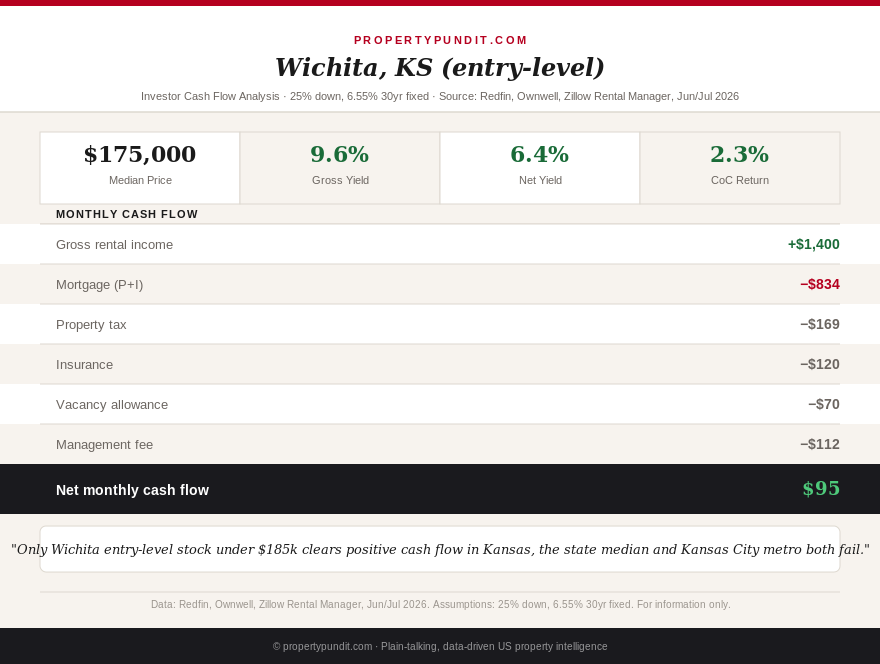
Run the numbers on Wichita's entry-level stock, roughly $175,000, at 25% down and 6.55%: principal and interest of about $834 a month, property tax of $169 (Sedgwick County's 1.16% effective rate), and insurance around $120. That's a PITI of $1,123 against a realistic 3-bedroom SFR rent of $1,400. After an 8% management fee and a 5% vacancy allowance, effective rent comes to $1,218, leaving roughly $95 a month in positive cash flow with a DSCR of 1.25, comfortably inside most lenders' preferred tier.
Move up to Wichita's own $224,000 monthly median and the math flips. The same 25%-down, 6.55% structure produces a PITI near $1,414 against a comparable rent of $1,425. After costs, that's roughly negative $174 a month, and a DSCR of 1.008, technically above the 1.0 lender floor but cash-flow negative once real operating costs are subtracted. Wichita's aerospace and defense employer base, Spirit AeroSystems, Textron Aviation, Bombardier's Learjet plant, and Koch Industries' global headquarters, together anchor tens of thousands of stable, long-tenured jobs. That employer depth is exactly why the entry-level tier holds up: it's not a speculative rental market, it's a working-class housing stock serving a real, durable workforce. That stability doesn't extend to the median-priced stock, where rents haven't caught up to the price run-up.
Kansas City, Kansas and Overland Park both fail the math
Wyandotte County, the Kansas side of Kansas City, has a median sale price around $238,000 (three months ending April 2026). At 25% down and 6.55%, PITI runs approximately $1,599 once you layer in Wyandotte's 1.69% effective property tax, nearly 50% above Sedgwick County's rate. Against a realistic $1,500 SFR rent, effective income after management and vacancy comes to $1,305, roughly negative $294 a month with a DSCR of 0.938, a straightforward fail.
Overland Park, in Johnson County, tells a different but equally discouraging story for cash flow. The median sale price there is roughly $495,000, and even with Johnson County's lower roughly 1.0% effective tax rate, the PITI on that price point runs near $2,926 a month. Against an estimated $2,000 SFR rent, the negative cash flow balloons to roughly $1,186 a month, and the DSCR falls to 0.68. Overland Park is a high-income, high-amenity Kansas City suburb with genuine long-term appreciation potential, but it is not a cash-flow market at today's rates by any reasonable underwriting. If you're chasing yield in the Kansas City metro, the Kansas side's affordability advantage evaporates the moment you cross from Wyandotte's entry stock into Johnson County's higher price tier.
The tax nuance most listings won't tell you
Kansas passed SB 269 in 2025, a law that sets up a phase-in toward a 4% flat income tax, but only once specific state revenue and budget-reserve triggers are met. As of 2026, those triggers haven't fired, so Kansas is still taxing income on a two-bracket graduated schedule: 5.20% up to roughly $23,000 for single filers, 5.58% above that. If you're modeling a Kansas deal off a headline that says "Kansas is moving to a 4% flat tax," you're underwriting a rate that doesn't exist yet. Use the current graduated rate until the trigger conditions are confirmed to have fired, not the eventual target rate.
One thing that does work in an investor's favor here: Kansas doesn't layer an additional non-homestead tax penalty on rental property the way Michigan, South Carolina, or Alabama do. The state's homestead refund and the $75,000 school-levy exemption are unavailable to a non-owner-occupied property, but there's no separate, higher assessment ratio applied to investors the way South Carolina's 6% versus 4% split works. The property tax gap you see between Sedgwick, Wyandotte, and Johnson counties is a local millage-rate difference, not an investor penalty, and that's a genuinely useful distinction when you're comparing Kansas against a state that does carry a structural investor surcharge.
What this means for your next Kansas deal
If you're underwriting a Kansas rental this month, the math points toward treating everything above Wichita's entry-level tier as an appreciation play, not a cash-flow play, and pricing your offer accordingly. Frankly, if you're being pitched a Kansas City, Kansas duplex or an Overland Park single-family as a "cash-flowing Midwest deal," ask for the seller's actual rent roll against Wyandotte's or Johnson's real millage rate before you believe the pro forma. Most investors who run these numbers themselves end up concentrating Kansas capital in Wichita's sub-$185,000 stock and treating the rest of the state as a hold-for-appreciation position, not a monthly-income one.
Frequently asked questions
Is Kansas a good state for rental property investors? Only in specific submarkets. Wichita's entry-level stock under $185,000 is the one tier that clears positive cash flow at current rates. Kansas City, Kansas, Overland Park, and Wichita's own median price point all fail DSCR minimums once realistic vacancy and management costs are included.
Does Kansas have a flat income tax now? Not yet. SB 269 (2025) sets up a phase-in toward a 4% flat rate, contingent on revenue and reserve-fund triggers. As of 2026, the graduated 5.20%/5.58% brackets remain in effect. Model the current rate, not the eventual one.
What is the best city in Kansas for cash-flowing rental property? Wichita, specifically its sub-$185,000 entry-level single-family stock, backed by a stable aerospace and defense employer base including Spirit AeroSystems, Textron Aviation, and Bombardier.
Why does Wyandotte County have higher property taxes than the rest of Kansas? Wyandotte's effective rate of about 1.69% reflects overlapping city, county, and school district levies on a lower average assessed-value base, pushing the percentage rate higher even where dollar tax bills can be lower than pricier Johnson County homes.