 Property
You saw the headline this morning: mortgage rates just hit their highest level in a year. Your first instinct is probably to sit tight, wait it out, check back in a few months when things "calm down." That instinct is costing you money right now, because the same report that delivered the scary rate number also showed the typical American's monthly housing payment fell to its lowest level in three months. Rates went up. Your actual bill, on paper, went down. Here's why, and what it means for the offer you're sitting on.
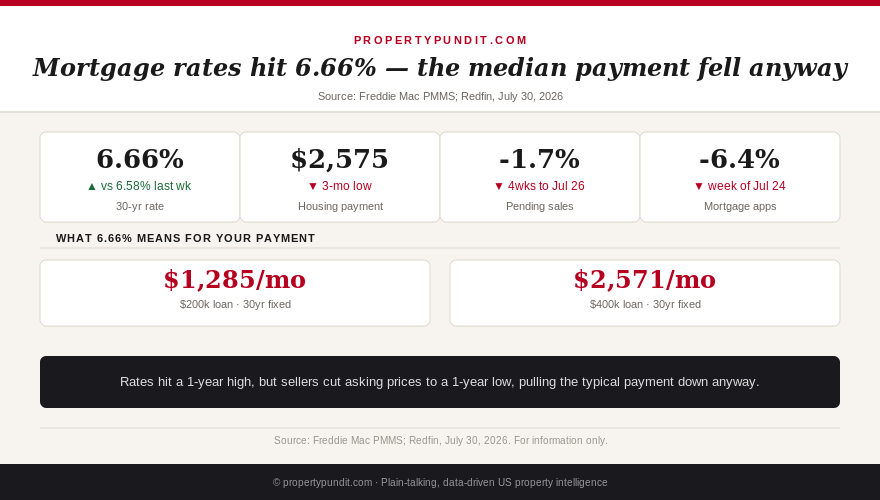
Freddie Mac's Primary Mortgage Market Survey put the 30-year fixed at 6.66% for the week of July 30, 2026, up from 6.58% the week before and the highest reading in a year. The 15-year fixed climbed to 6.04% from 5.96%. It's the first official rate check since Wednesday's Fed decision, and it moved the wrong direction for anyone hoping a hold meant relief. Before you talk yourself into waiting another quarter, look at what actually happened to the number that determines your budget: not the rate, the payment.
Why a Fed hold pushed your rate up, not down
The Fed voted 9-3 on Wednesday to hold its target rate at 3.50%-3.75%, a fifth straight pause. But three regional presidents dissented in favor of a hike, and the statement's tone was hawkish enough that futures markets flipped from pricing cuts to pricing two more 25-basis-point hikes before the end of 2026. Mortgage rates track the 10-year Treasury yield, not the Fed's overnight rate directly, and that yield moved higher on the dissent and the hike odds, not lower on the hold itself. It's a mechanism worth understanding: a "no change" Fed decision can still move your rate, because markets react to what the Fed signals about the next move, not just the one it just made.
So what for you: don't wait for a specific Fed meeting expecting it to fix your rate. The next FOMC meeting isn't until September 15-16, and this week just showed that even a hold can push rates the wrong way if the vote and the tone lean hawkish.
Get this in your inbox every Friday.
One email. The number that matters and what it means for you.
The number that actually moved in your favor
Redfin's weekly report, also released July 30, showed pending home sales fell 1.7% over the four weeks ending July 26 to their lowest level since early April, and mortgage applications dropped 6.4% for the week, with purchase applications down 3% and refinance applications down 10% (Mortgage Bankers Association). That's a market cooling off fast under the weight of a rate that's now brushing 6.85% on Redfin's own daily tracker, the highest in over a year.
Here's the part that gets buried under the rate headline: sellers responded by cutting their median asking price to its lowest level in a year, and that price move was large enough to drag the typical US housing payment down to $2,575, its lowest level in three months, even with the rate spike layered on top. A cooling market doesn't just mean a scarier rate. It means sellers with less room to hold firm than they had a month ago, and that shows up directly in what you'd actually pay.
So what for you: the rate you see in a headline and the payment you'd actually sign up for are two different numbers right now, moving in opposite directions. Anchor your decision to the payment, not the rate alone, because the payment is the number your actual budget has to absorb.
The math on a real price cut versus a real rate hike
Take a home listed at $425,000 a month ago, back when the 30-year averaged 6.49% (Freddie Mac PMMS, July 9, 2026). Put 20% down and you're financing $340,000; principal and interest at 6.49% runs $2,147 a month. Now say that same home has since taken a 4% price cut, roughly in line with this month's national asking-price pullback, and lists today at $408,000. Finance 20% down on that lower price at this week's 6.66% and you're borrowing $326,400, with principal and interest of $2,098 a month.
Split the two effects apart and the math gets clearer. The rate move alone, from 6.49% to 6.66% on the same $326,400 loan, costs you about $37 more a month. The price move alone, from $425,000 to $408,000 at this week's 6.66% rate, saves you about $87 a month. Net result: a payment that's roughly $49 a month lower than it would have been at last month's rate and last month's price, purely because the price gave up more ground than the rate took back. Your specific credit score still sets your actual quote, and a stronger credit profile can widen that gap further in your favor.
So what for you: a rate increase feels like the whole story because it's the number everyone reports, but a comparable price negotiation, the kind sellers are already conceding in this market, can more than cancel it out. Run this same math on the actual home you're looking at before deciding the rate alone is a reason to walk away.
Not every loan type moved the same way this week
The 6.66% headline is the standard 30-year conventional PMMS figure, the one every outlet quotes. If you're shopping FHA, VA, or USDA instead, the daily numbers behind that headline moved differently. Mortgage Research Center's July 31 tracker put 30-year conventional at 6.721%, 15-year conventional at 5.882%, 30-year FHA at 6.101%, 30-year VA at 6.159%, and 30-year USDA at 6.099%. Jumbo loans, which serve higher-cost markets and larger loan amounts, ran the highest of the group at 6.876%. Government-backed programs are running roughly 60 basis points below the conventional headline right now, a gap wide enough to change your monthly number by well over $100 on a typical loan.
So what for you: the single rate everyone quotes in a headline isn't necessarily your rate. If you qualify for an FHA, VA, or USDA loan, this week's "rates near a 1-year high" story overstates how much your own quote likely moved. Ask your lender for the number on your specific program before deciding the headline rate applies to your situation.
The call
Frankly, if you're sitting on an offer or eyeing a listing right now, the data argues for negotiating harder on price rather than waiting on the rate. Pending sales at a four-month low and a national asking-price pullback both point the same direction: sellers have less room to hold firm than they did a month ago. Most people who run these numbers end up finding that a realistic price concession does more for their monthly payment than betting on a rate drop that isn't supported by anything on the Fed's calendar between now and mid-September. If you're stretching for a bigger down payment to offset the rate instead of negotiating price, that math usually loses to the seller concession sitting in front of you. And if you're deciding whether to pay extra to lock in today's number, the float-down math from two weeks ago still applies: it's a bet on a fast reversal that this week's data doesn't support.