 Property
Your fixed rate isn't up for years, but the refinance decision you keep circling back to lives and dies by half a percentage point, and this week the number you'd use to make that call couldn't hold still long enough to read. On July 13, one tracker said rates had eased to roughly 6.42% to 6.44%. By July 14, a different set of trackers said 6.51%, 6.58%, and 6.77%, three numbers, one day, a 26-basis-point spread between the highest and lowest reading. If you're the kind of homeowner who checks a rate tracker the way other people check the weather, this week is a reminder that the forecast depends entirely on which app you opened.
Here's what actually happened, and which number should carry weight in your own decision.
What the numbers actually say
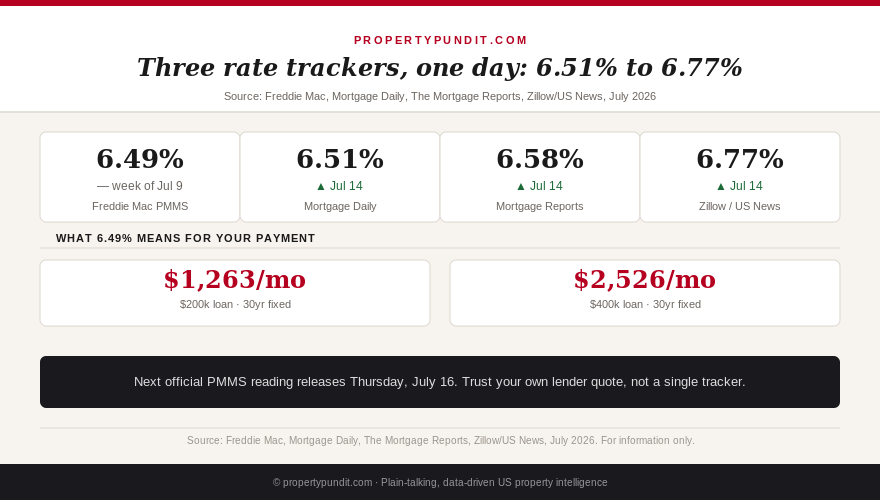
Freddie Mac's Primary Mortgage Market Survey, the official weekly benchmark, put the 30-year fixed rate at 6.49% for the week ending July 9, 2026, up from 6.43% the week before (Freddie Mac PMMS, July 9, 2026). That number holds until Thursday, July 16, when the next official reading releases. In the days between official readings, daily trackers are the only signal available, and this week they disagreed sharply with each other: Mortgage Daily reported 6.51%, The Mortgage Reports reported 6.578%, and a Zillow-sourced figure via U.S. News reported 6.771%, all dated July 14, 2026. Two days earlier, NerdWallet's tracker had been running closer to 6.42% to 6.44%. The MBA's own weekly applications survey, covering the week ending July 3, put the average 30-year conforming contract rate at 6.58% and showed purchase applications down 1% on a seasonally adjusted basis (MBA, July 9, 2026).
None of these trackers are wrong, exactly. They're measuring different things, and the gap between them tells you more about methodology than about where your own rate would actually land tomorrow morning.
Why trackers can't agree with each other
Daily trackers pull from different lender panels, different assumed credit scores and loan-to-value ratios, and different assumptions about discount points. A tracker that assumes a 740 credit score and 20% down will show a lower number than one built around a broader, average borrower profile. None of them is a survey of actual closed loans the way Freddie Mac's PMMS is; they're composites of quoted rates from a sample of lenders, refreshed daily, which makes them useful for spotting direction but unreliable for pinning down an exact number. A 26-basis-point spread in a single day is a methodology story, not evidence that the bond market moved that violently overnight.
If you've been reading this site since the last time trackers and PMMS diverged, in early July, you'll recognize the pattern: trackers ran above PMMS then too. What's new this week is trackers disagreeing with each other, not just with the official benchmark, which is a sharper version of the same underlying problem.
Get this in your inbox every Friday.
One email. The number that matters and what it means for you.
What actually moved this week, and what didn't
The underlying driver of higher rates hasn't changed since PMMS jumped from 6.43% to 6.49% the week of July 9: renewed tension around the Iran conflict has kept Treasury yields elevated, not a fresh domestic economic data release. That's a geopolitical driver, and geopolitical rate spikes tend to be choppier and less predictable than a Fed-driven or CPI-driven move, which helps explain why daily trackers are bouncing around more than usual right now. Your credit score still moves your specific quote more than any of this national noise; if you haven't checked where you stand recently, that's a better use of ten minutes than refreshing a tracker, since a jump from the high 600s into the low 700s can matter more to your rate than a full week of tracker whiplash (see our credit score and mortgage rate breakdown for the exact math).
What this means for your lock-or-float decision
If you're actively shopping a purchase or refinance this week, don't anchor your decision to whichever tracker your news feed happened to show you. Call your loan officer and get an actual quote for your actual credit profile and loan amount; that number is worth more than any national average. If your closing or rate-lock window falls before Thursday's PMMS release, locking now removes the risk that the official print comes in above where trackers already sit. If you have more runway, ask your lender about a float-down option, which lets you capture a better rate if Thursday surprises to the downside without giving up the protection of a lock. Review our refinance trigger framework if you're deciding whether this week's number, whichever one you trust, is even worth acting on yet.
What to actually watch on Thursday
Thursday's PMMS print matters more than any single day's tracker reading because it's a survey of actual lender rate sheets, not a composite built on assumed borrower profiles. If the official number holds near 6.49% or drifts only slightly, that's consistent with a market that's absorbed the Iran-related yield pressure without a fresh shock. If it jumps meaningfully above 6.58%, that would suggest the higher end of this week's tracker range was the more accurate signal all along, and the geopolitical pressure is still building rather than leveling off. Either way, the print gives you one clean, comparable number instead of three conflicting ones, which is exactly why the industry still treats it as the benchmark even in an era of real-time daily data.
In the meantime, resist the urge to make a lock decision based on a single day's tracker reading, up or down. A rate that looks great on Monday and terrible by Wednesday tells you more about which lenders happened to be sampled that day than about where the market is actually headed. The steadier approach is to watch the trend across a full week of PMMS readings, not the noise between them.
Most people who get burned by rate trackers aren't reading the wrong number, they're reading the right number and then holding it to a precision it was never built to offer. Treat every daily tracker as a directional signal, treat Thursday's PMMS print as the actual scoreboard, and treat your own lender's live quote as the only number that determines your payment.