 Property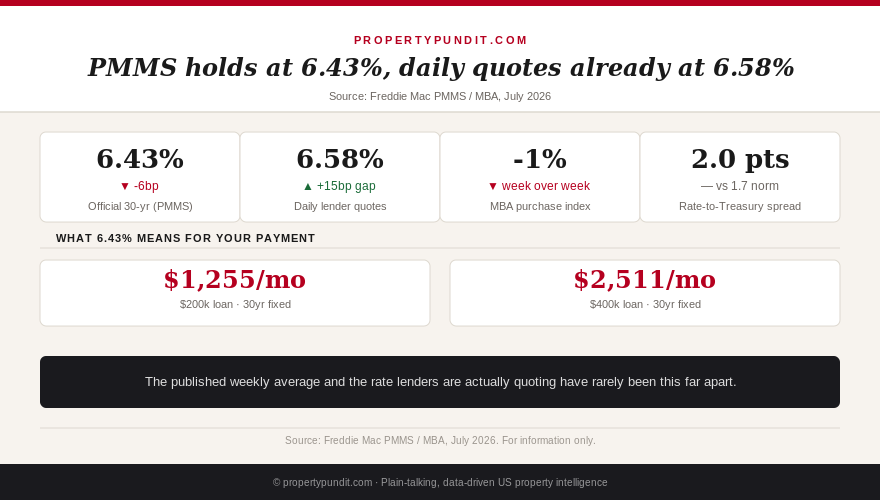
You checked the news this morning and saw the 30-year rate is 6.43%, the lowest it has been in seven weeks. Then you called your loan officer to lock, and the number on the screen said 6.58%. You're not being overcharged, and the headline wasn't wrong. You're looking at two different clocks, and right now they are further apart than they have been all year.
If you're refinancing, timing your own float-versus-lock decision against a headline number, this gap matters more than usual this week. Freddie Mac's Primary Mortgage Market Survey (PMMS) is the benchmark every housing article, including this one, is required to cite. But it's a survey average, taken Monday through Wednesday and released Thursday, of a specific type of borrower: strong credit, 20% down, a conforming loan amount. Your lender's live quote reflects today's bond market, your actual credit profile, and the loan size you're asking for. Most weeks the two numbers sit within a few basis points of each other. This week, the gap is real.
The official number and the number in your inbox
The 30-year fixed averaged 6.43% for the week ending July 2, 2026, down from 6.49% the week before, according to Freddie Mac's PMMS. The 15-year fixed averaged 5.79%. Both are genuine multi-week lows and both are accurate readings of where rates stood earlier in the survey window.
But the Mortgage Bankers Association's own weekly lender survey, covering the week ending July 3, put the average contract rate for 30-year conforming loans at 6.58%, up from 6.57% the week before. Daily rate trackers such as Mortgage News Daily showed purchase quotes ranging from 6.57% to as high as 6.66% as of July 6. That is a 15-basis-point gap between the number in the headline and the number a real borrower is being quoted, one of the widest divergences of the year. The reason is straightforward: PMMS is measuring last week's market, and the bond market has moved since then. Anyone shopping a lock-or-float decision this week needs the lender's live quote, not the survey average, to make the call.
Why the gap opened up
Mortgage rates track the 10-year Treasury yield, not the Fed funds rate directly, and the 10-year has stayed elevated near 4.5% since the Fed's June 17 meeting. That meeting was the real trigger. The Fed held its target range at 3.50%-3.75%, as expected, but the accompanying dot plot removed the committee's previous easing bias and raised the median year-end 2026 fed funds projection to 3.8% from 3.4%. Combined with April's 3.8% CPI print, well above the Fed's 2% target, bond investors concluded that rate relief is further away than they had priced in a month ago. The mortgage-to-Treasury spread, the extra cushion lenders charge above the 10-year, is running near 2.0 percentage points right now versus a more typical 1.5 to 2.0-point band. A spread that wide is itself a signal that lenders are pricing in extra uncertainty, not just following the Treasury higher.
Mortgage applications are already responding. The MBA's Market Composite Index fell 2.2% for the week ending July 3, with the seasonally adjusted purchase index down 1% and the refinance index down 4%. If you have been waiting for one of the five refi triggers to fire, this week's move is in the wrong direction, not the right one.
What 6.43% versus 6.58% actually costs you
On paper, 15 basis points sounds trivial. In dollars, it's not nothing, and it compounds with loan size. Here is the same loan priced at the PMMS headline rate and at this week's real daily quote, both on a standard 30-year fixed term.
| Loan amount | At 6.43% (PMMS) | At 6.58% (daily quote) | Difference |
|---|---|---|---|
| $300,000 | $1,882/mo | $1,912/mo | +$30/mo |
| $400,000 | $2,510/mo | $2,549/mo | +$39/mo |
| $500,000 | $3,137/mo | $3,187/mo | +$50/mo |
Get this in your inbox every Friday.
One email. The number that matters and what it means for you.
For context on how far rates would need to fall to matter, a $400,000 loan at a genuine 6.00% runs $2,398 a month, $112 less than today's PMMS figure and $151 less than this week's real daily quote. That is the size of the move you would need to see before a refinance conversation is worth having on rate alone. If your own loan's amortization schedule still has you paying mostly interest in year one or two, a small rate improvement changes your payment more than it changes your progress toward equity.
What today's other release adds to the picture
The Commerce Department's June existing-home sales report from the National Association of Realtors is scheduled for release today, July 9, the same day as this PMMS reading. The most recent confirmed data, for May 2026, showed existing-home sales running at a 4.17 million seasonally adjusted annual rate, up 3.2% both month over month and year over year, with the median existing-home price at a record $429,300 for the month of May and 4.5 months of supply on the market. Pending home sales, which lead closed sales by roughly 30 to 60 days, jumped 3.8% month over month in May, nearly four times the pace economists had forecast. That's a genuine demand signal moving in the opposite direction from this week's rate move, and it's worth remembering that NAR's figures are monthly data, not a live daily read, even when they land on rate-update day.
For a rate watcher tracking her own refinance math, the combination isn't contradictory so much as it's two different clocks running at two different speeds: rates are drifting up in real time while May's demand data, already six weeks old, was still improving. The math you should trust for your own decision is the live quote in front of you, not the lagging monthly print.
What to do with this right now
If you're closing within 30 days, lock. The spread has been widening, not narrowing, and floating here is a bet against a bond market that just repriced on real information from the Fed. If you're 60 days or more from closing, ask specifically whether your lender offers a float-down option, and set a concrete trigger rate rather than checking rates every morning. If you already own and are weighing a refinance, the math still points toward waiting: your original rate would need to be meaningfully above 7% for today's real 6.58% quote to clear a typical break-even inside three years once closing costs are included, and if you're comparing that math against an ARM's first reset, the actual reset numbers are usually smaller than the headline percentage suggests. Most people checking rates daily right now end up making the same decision they would have made a week ago; the news is the gap, not a reason to change your plan.