 Property
The payment on the house you can almost afford stretches your budget, and everyone you know has the same answer: buy now, refinance when rates fall. At 7.18% (Freddie Mac PMMS, November 5, 2026) that plan sounds free, like a coupon you can redeem later. It isn't free, it has a date attached, and for a buyer putting 10% down it has a second catch that most refinance calculators never mention.
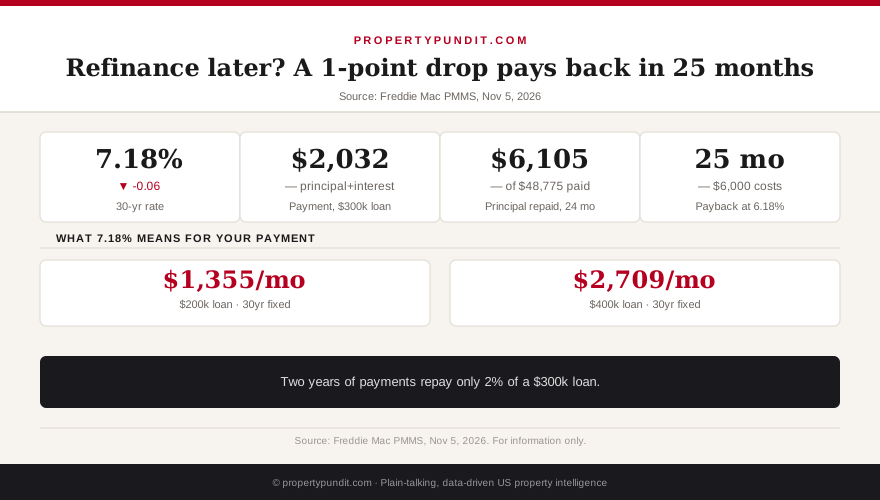
Here's the test case we'll use throughout: a $300,000 loan on a $333,333 home (10% down), a 30-year fixed rate of 7.18%, and a household income of $78,000. Principal and interest comes to $2,032 a month. That's before property tax, insurance or mortgage insurance, and it's already 31% of gross monthly income of $6,500. The numbers are illustrations built on stated assumptions, so swap in your own quote.
Get this in your inbox every Friday.
One email. The number that matters and what it means for you.
What "later" costs before it arrives
Start with what you pay while you wait. In the first 24 months of that $300,000 loan you make payments totaling $48,775. Of that, only $6,105 reduces what you owe, because early payments on a 30-year loan are almost all interest. After two years your balance is $293,895, which is 98% of what you borrowed.
That matters for the refinance plan in two ways. You haven't built much equity, so you have little to put toward a lower rate or toward dropping mortgage insurance. And every month you wait for rates to fall is a month at the $2,032 payment, with no refund when the rate finally does move.
So what for you: if the plan depends on a refinance, treat the first two years as the full price of the wait, about $48,775 out the door for $6,105 of progress.
What a refinance costs and what it saves
A refinance is a new mortgage, so it comes with new closing costs. Our closing costs guide puts typical costs at 2% to 5% of the loan, and we assume $6,000, about 2% of the $293,895 balance, which is the low end. The table below refinances that balance into a new 30-year loan at three possible future rates and divides the cost by the monthly savings versus your current $2,032 payment.
| Future 30-year rate | New payment (P&I) | Monthly savings vs $2,032 | Months to repay $6,000 |
|---|---|---|---|
| 6.68% (half-point drop) | $1,893 | $140 | 43 months |
| 6.18% (one-point drop) | $1,796 | $236 | 25 months |
| 5.68% (one-and-a-half-point drop) | $1,702 | $330 | 18 months |
Two things stand out. A half-point drop, which is the kind of move that makes headlines, takes about 3.6 years to repay the closing costs, and by then you've restarted a 30-year clock on a balance that was already 24 months old. Our refinance break-even math shows why: the savings only count if you stay in the house long enough to collect them. A full point makes the plan work at 25 months, and a rate of about 6.62% is the point where savings reach $150 a month and the payback drops to 40 months.
So what for you: a refinance pays only if rates fall at least a full point and you stay at least three years afterward, so price your move against that bar, not against a headline.
The equity problem nobody mentions at 10% down
Lenders don't only look at the rate. They look at your loan against the home's value. On a $333,333 home with a $293,895 balance, you owe 88% of the value if the price hasn't moved. That's above the 80% line where private mortgage insurance can end, so a refinance at 88% keeps the insurance on the new loan. At an illustrative 0.80% a year that's about $196 a month, which eats most of the $236 you saved by dropping a point.
To reach 80%, your balance has to fall to $266,667, which is $27,228 below where it sits after two years, or the home has to rise about 10.2%, to $367,369. Neither is a safe bet on a calendar. Our PMI cancellation guide explains how the 80% and 78% thresholds work, and the same math applies to a new loan.
So what for you: with 10% down, the refinance that matters most is the one that removes mortgage insurance, and that depends on equity, not on the rate.
What the forecasters expect from rates
Everything above assumes rates fall a full point. The published forecasts don't expect it soon. Fannie Mae's October forecast (October 12, 2026) put the 30-year rate at 7.4% for the fourth quarter and 7.5% through the third quarter of 2027, and the Mortgage Bankers Association (October 11, 2026) put it at 7.3% for the fourth quarter and 7.2% through the third quarter of 2027, as reported by The Mortgage Reports on November 4, 2026. Both sit above today's 7.18%.
The Federal Reserve gives no help either. It held its target range at 3.75% to 4% on October 28 by a 10-2 vote, and the two dissenters wanted a quarter-point hike, not a cut (Federal Reserve, October 28, 2026). Rates did slip from 7.40% on October 15 to 7.18% on November 5 (Freddie Mac via FRED), but a three-week slide of 22 basis points is a long way from a full point.
So what for you: nobody who publishes a forecast is promising the one-point drop your refinance plan needs, which means you should price the loan as the one you may keep.
The call: buy the payment, not the rate forecast
The math points toward a simple rule: buy a house only if you'd be comfortable carrying the 7.18% payment for five years, and treat any refinance as a bonus. If $2,032 plus taxes and insurance fits inside the 28% of income that most lenders prefer, the plan works whether or not rates move. If it only works at 6.18%, you aren't buying a house, you're betting on a refinance. For more on why a lower down payment changes the picture, our down payment myth article walks through the tradeoffs.
Frankly, most people who run these numbers end up with the same two moves: shop the loan harder now (a quarter-point cheaper at closing is worth about $51 a month on $300,000 and costs nothing later), and keep the cash that a refinance would have eaten as a repair fund. A refinance becomes a happy surprise, not a requirement.
So what for you: write down the payment you can carry at 7.18%, shop for a house that fits it, and let any future rate drop pay you instead of rescue you.
Frequently asked questions
Can I refinance right after buying a house?
Often yes, but a lender may require a waiting period, and you'd pay closing costs again, about $6,000 on a $293,895 balance at 2%. At 6.18%, that takes about 25 months of savings to repay.
How much does the rate have to drop for a refinance to be worth it?
About a full point for most buyers. On a $300,000 loan at 7.18%, a drop to 6.18% saves $236 a month and repays $6,000 of costs in 25 months; a half-point drop takes 43 months.
Will I still pay PMI after I refinance?
Yes, unless your new loan is at or below 80% of the home's value. At 10% down, you'd owe 88% after two years if the price is flat, so you'd keep paying mortgage insurance on the new loan.
What was the Freddie Mac 30-year mortgage rate on November 5, 2026?
7.18% for the 30-year fixed, down from 7.24% the week before. The 15-year fixed was 6.57% (Freddie Mac PMMS via FRED).