 Property
You have the down payment, a pre-approval letter and a list of houses under $250,000, and every guide says to set aside 1% of the price each year for repairs. On a $245,000 house that's $204 a month. Your lender's 28% cap on a $78,000 income is $1,820 a month, the house's payment is $1,792, and that leaves you $28 of room before you've saved a dollar for the roof.
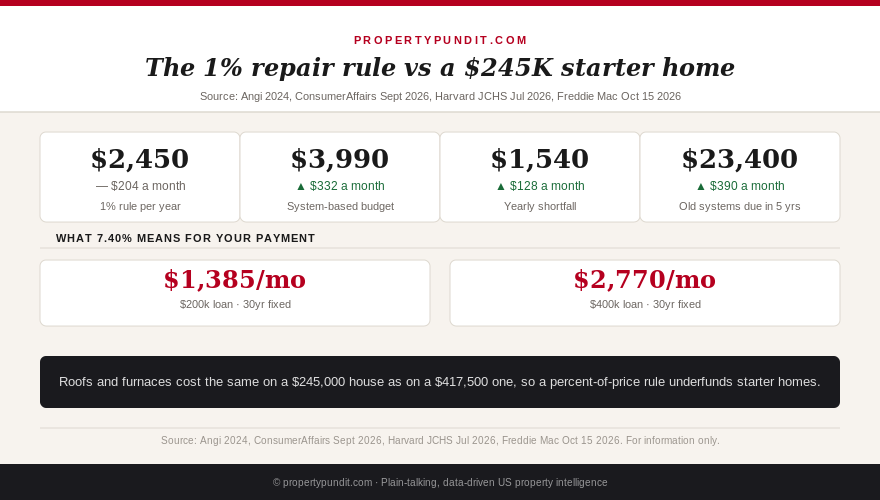
The 1% rule isn't wrong about the total. For the median home sold in September ($417,500, NAR, released October 13, 2026) it gives $4,175 a year, and the system costs I priced come to almost exactly that. The rule goes wrong on starter homes and on timing. A roof and a furnace cost what they cost whether the house sold for $245,000 or $417,500, so a rule based on price underfunds the cheaper house by about $1,540 a year.
If you buy a house whose roof and furnace are original, the bills also arrive years before an averaged-out budget would have saved the money. That's the part nobody tells first-time buyers when mortgage rates sit at 7.40% (Freddie Mac, October 15, 2026) and every dollar of payment room is already spoken for.
Get this in your inbox every Friday.
One email. The number that matters and what it means for you.
What the 1% rule gets right
Start with what homeowners actually spend. Angi's 2024 State of Home Spending Report (released January 2025) found the average household spent $1,750 on maintenance and $978 on emergency repairs, or $2,728 in total. That's 0.65% of the $417,500 median price, about 35% below the 1% rule's $4,175. In a typical year, the rule overshoots.
Other surveys are far higher. Thumbtack's 2024 Home Care Price Index put the average at $6,543.50 for 2023 (as reported by Amerisave), and Bankrate's 2025 study used 2% of home value. The spread tells you the number depends on who was surveyed, which homes they own and whether they count remodeling. Harvard's Joint Center for Housing Studies, using the 2023 American Housing Survey (July 16, 2026), found owners spent an average of $4,500 a year on improvements and maintenance in homes built in 2010 or later and $6,000 in homes built before 1960.
So what for you: use $2,728 a year as the floor for routine upkeep plus ordinary surprises, and treat anything lower as wishful thinking.
Repairs scale with systems, not price
A percentage of price assumes that a $245,000 house costs 40% less to keep up than a $417,500 one. The big items don't work that way. ConsumerAffairs (updated September 29, 2026) lists roof replacement at $5,800 to $13,000 with a lifespan of 15 to 50 years, and HVAC replacement at $10,000 to $14,000 with a lifespan of 15 to 20 years. Amerisave puts a water heater at $1,000 to $3,000, and ConsumerAffairs gives it a life of 8 to 12 years. I used the midpoints of those ranges and a 25-year roof, so these are illustrations, not quotes.
| Item | Midpoint cost | Life used | Saved per year |
|---|---|---|---|
| Roof | $9,400 | 25 years | $376 |
| HVAC | $12,000 | 17.5 years | $686 |
| Water heater | $2,000 | 10 years | $200 |
| Big-ticket subtotal | $1,262 | ||
| Routine upkeep and emergency repairs (Angi 2024) | $2,728 | ||
| Total | $3,990 |
That $3,990 a year is $332 a month. On the $417,500 median it's 0.96% of the price, which is why the 1% rule looks fine on a typical sale. On a $245,000 house it's 1.63%, and the 1% rule gives only $2,450 a year ($204 a month). The gap is $1,540 a year, or $128 a month.
So what for you: if you're shopping below $300,000, ignore the percentage and budget a flat $330 or so a month, then raise it if your inspection finds older systems.
The age of the roof and furnace sets your timing
An averaged budget assumes you buy a house at the start of every system's life. Most starter homes aren't. The Harvard analysis found owners of pre-1960 homes put 39% of their spending into replacing components such as roofing, siding, windows, insulation and HVAC, against 24% for homes built in 2010 or later. Applying those shares to the average spending above, replacements come to about $2,340 a year in the older homes versus $1,080 in the newer ones. Maintenance alone is 22% versus 16% of spending, roughly $1,320 versus $720 (my arithmetic from the published shares and averages).
Now run the five-year view on the $245,000 house. If the roof, furnace and water heater are all near the end of their lives, you face $23,400 within five years ($9,400 + $12,000 + $2,000), or $390 a month for 60 months. The 1% rule would have saved $204 a month, or $12,250 over the same period. You'd be $11,150 short, and that's before a single routine repair.
A house with a 3-year-old roof and furnace has the opposite profile. Nothing big comes due for a decade or more, so your first five years cost closer to the $2,728 routine figure, or about $227 a month.
So what for you: two houses with the same price and the same 1% rule can differ by $163 a month in what you actually need to save, and the difference is written on the roof and the furnace label.
What this does to your 28% math
Here is the worked example. A $245,000 house with 10% down is a $220,500 loan. At 7.40% the principal and interest payment is $1,527. I assumed property tax and insurance at 1.3% of the price, which adds $265, for a payment of $1,792 before mortgage insurance. That's 27.6% of $6,500 in gross monthly income, just inside the 28% rule.
| Monthly cost | Payment only | Plus 1% reserve | Plus $332 reserve |
|---|---|---|---|
| Principal, interest, tax, insurance | $1,792 | $1,792 | $1,792 |
| Repair reserve | $0 | $204 | $332 |
| Total | $1,792 | $1,996 | $2,124 |
| Share of $6,500 gross income | 27.6% | 30.7% | 32.7% |
Lenders approve you on the first column, not the third. Mortgage insurance on a 10% down loan would push the payment higher still. The 28% guideline was never designed to include a repair fund, which means a buyer who maxes out the approval has already spent the money the roof will need.
So what for you: set your own ceiling at the third column's logic, which on a $78,000 income means a payment closer to $1,500 than $1,820.
Before you make an offer
You can't change a roof's age, but you can price it. Ask the listing agent for the age of the roof, HVAC and water heater, and read the inspection report for each system's condition, not just whether it works today. The home inspection article covers what a standard inspection leaves out. Redfin reported that sellers offered concessions on 44.7% of August 2026 sales (September 2026), so asking for a credit toward a 12-year-old furnace is a normal request, not an aggressive one. A credit goes further than a promise to fix it later. If you're also stretching for cash at closing, the closing costs guide shows where the money goes, and the home warranty article explains why a warranty doesn't replace a reserve.
Put the reserve in a separate savings account and fund it from the first month's payment, even if you start with $100. A roof is much easier to pay for from $330 a month for five years than from a credit card in one afternoon.
So what for you: the cheapest time to deal with a failing system is before you own it, when the seller can still lower the price.
What this means for you
The math points toward budgeting by system, not by percentage. If the house is under about $300,000, plan on roughly $330 a month, and add up to $200 more if the roof, furnace and water heater are all past 12 years. If the house is under 10 years old with newer systems, you can start nearer $230 a month and still be safe. Frankly, if a payment plus a reserve takes you over about 32% of gross income, the answer is a cheaper house or a larger credit, not a thinner reserve.
The 1% rule survives as a sanity check for the median home. It isn't a plan for a $245,000 house with a 19-year-old roof.
What I couldn't verify
The system costs are national ranges from ConsumerAffairs and Amerisave, not Atlanta quotes, and lifespans vary with climate and installation quality. I used midpoints and a 25-year roof, which are my assumptions. The Angi figures are 2024 averages; a later Angi report summarized secondhand by HomeProBadge put 2025 maintenance at $2,041 and emergency repairs at $1,143, which would raise the routine total to $3,184 and the reserve to about $370 a month. Amerisave's references for the Thumbtack, Bankrate and American Home Shield figures weren't listed, so treat those as secondary. The 1.3% tax and insurance load is my assumption for a typical Southeast purchase, and I haven't included mortgage insurance.
Frequently asked questions
How much should a first-time buyer save for home repairs?
Plan on about $330 a month ($3,990 a year) for a typical house, built from $1,262 a year for the roof, HVAC and water heater plus $2,728 for routine upkeep and emergency repairs. Raise it if the roof or furnace is more than 12 years old.
Is the 1% rule for home maintenance accurate?
Only on average. For the $417,500 median home it gives $4,175 a year, close to the $3,990 built from system costs. On a $245,000 house it gives $2,450, about $1,540 a year short, because roofs and furnaces cost the same regardless of price.
Do new-construction homes need a repair budget?
Yes, but a smaller one at first. Harvard's analysis shows homes built since 2010 spent about $720 a year on maintenance versus $1,320 for pre-1960 homes. Big systems still wear out on the same schedule, so keep saving even when nothing is due.
What should I ask the seller about roof and HVAC age?
Ask for the installation year and any invoices for the roof, HVAC unit and water heater, then compare them to typical lifespans of 15 to 25 years for a roof, 15 to 20 for HVAC and 8 to 12 for a water heater. If one is near the end, ask for a price reduction or credit.