 Property
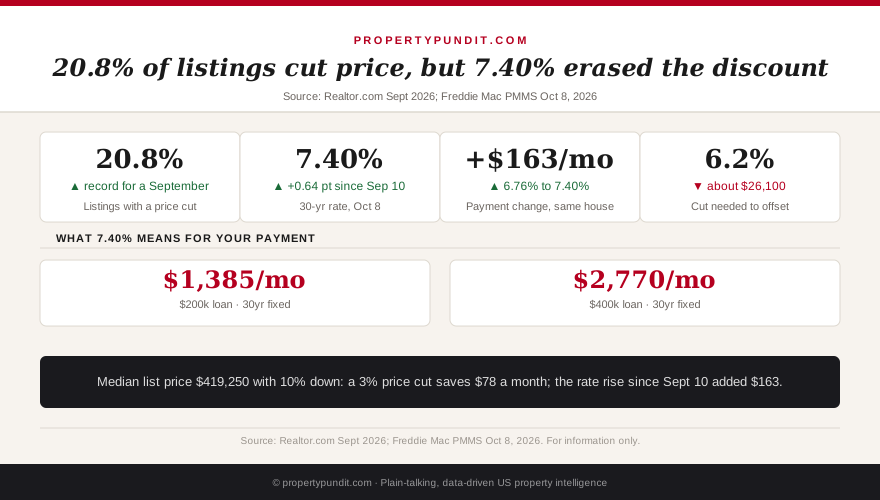
You've been refreshing listings since spring, and now the headlines finally say what you hoped to hear: sellers are blinking. Realtor.com's September report found that 20.8% of active U.S. listings carried a price reduction, the highest share the company has recorded for any September. If you're earning $112,000 and trying to buy in a metro like Nashville, that sounds like the discount you've been waiting for. It isn't big enough to matter, because your mortgage rate moved faster than the sellers did.
Here's the comparison that matters. The Freddie Mac 30-year rate was 6.76% on September 10. On October 8 it was 7.40%, the seventh straight weekly increase. On a median-priced listing with 10% down, that rate jump adds $163 a month. To pay it back through price cuts alone, the seller would have to drop the price about $26,100, or 6.2%. The typical cut doesn't come close.
This explainer walks through what the 20.8% number measures, what it leaves out, and how to turn a price cut into something that lowers your actual payment.
Get this in your inbox every Friday.
One email. The number that matters and what it means for you.
What the 20.8% price-cut share actually measures
The 20.8% figure counts listings, not dollars. It tells you how many of the 1,161,615 active listings on Realtor.com in September had dropped their asking price at least once. It does not tell you how deep the cuts were, and Realtor.com's September report did not publish an average cut size. That matters, because a seller who trims $2,000 off a $420,000 asking price counts the same as one who slashes $40,000.
The surrounding numbers suggest the cuts are frequent but shallow. The median list price was $419,250 in September, down 1.2% from August and 1.4% from a year earlier (Realtor.com, September 2026). If sellers were making deep cuts across the board, the median would be falling much faster than that. The median home also sat for 61 days, one day longer than in August, and 5.6% of listings were pulled off the market, in line with last September.
Demand is soft, too. Pending sales were down 4.1% from a year ago, and inventory was up 5.4% year over year (Realtor.com, September 2026). More homes, fewer contracts, and sellers who keep nudging the price down a little at a time. For you, that adds up to negotiating room that exists but is smaller than the headline suggests. The first thing to take from this section: a high share of price cuts means sellers are willing to talk, not that prices are collapsing.
Why a 7.40% rate beats most price cuts
Take the national median list price of $419,250 and assume you put 10% down, the share the National Association of Realtors reported for first-time buyers in its 2025 profile. Your loan is $377,325. The principal and interest payment on that loan depends heavily on which week you shop.
| Freddie Mac 30-year rate | Date | Monthly principal and interest |
|---|---|---|
| 6.05% | Late February 2026 (2026 low) | $2,274 |
| 6.76% | September 10, 2026 | $2,450 |
| 7.03% | September 24, 2026 | $2,518 |
| 7.28% | October 1, 2026 | $2,582 |
| 7.40% | October 8, 2026 | $2,613 |
From September 10 to October 8, the payment on the same loan rose $163 a month, or $1,952 a year. Against the February low, it's $339 a month. Now look at what a price cut buys. At 7.40%, every $10,000 off the price reduces the payment by about $62 a month with 10% down. A 3% cut ($12,578) saves $78 a month. A 5% cut ($20,962) saves $131. An 8% cut ($33,540), which would be a large reduction by any standard, saves $209.
So a typical 3% cut recovers less than half of the $163 the rate added in four weeks. You'd need roughly a 6.2% cut to break even on the September 10 payment, and about 12.9%, or $54,000, to get back to the February payment. Almost no listing offers that. The takeaway: when you compare a price cut to a rate move, the rate move wins unless the cut is deep.
Where the price cuts are concentrated
The national share hides a wide spread. Among the 50 largest metros, Salt Lake City had 33.6% of listings with a cut, Denver 32.1%, and Portland 31.6%. At the other end, New York had 10.3%, Hartford 12.6%, and Buffalo 12.9% (Realtor.com, September 2026). Salt Lake City also posted the largest annual jump, up 6.9 points. By region, the West ran at 22.8%, the South at 21.6%, the Midwest at 20.7%, and the Northeast at 15.2%.
The trend is broadening. Thirty-six of the 50 metros had a higher price-cut share than a year earlier, up from 27 in August. I couldn't verify a Nashville-specific figure from the sources available for this article, so treat the South's 21.6% as a rough guide and pull your own metro's share from your agent's listing data before you set a strategy.
The spread is a map of buyer bargaining power. In a metro where one in three listings has already cut the price, a cut by itself says little about a particular seller. In a metro where only one in ten has cut, a listing that has dropped its price twice is sending a real signal. Read the cut in context: the rarer it is locally, the more it tells you about that seller.
Same house, one year later: $244 more a month
The year-over-year comparison is where the "discount" disappears completely. A year ago, the Freddie Mac 30-year rate averaged 6.30%. Working backward from the 1.4% annual decline in the median list price, a median-priced listing a year ago would have been about $425,200 (my calculation, not a published figure). With 10% down at 6.30%, that loan's payment was about $2,369. Today's cheaper house, financed at 7.40%, costs $2,613 a month.
That's $244 more per month for a home listed at a lower price, which is $2,928 a year. If you take only one thing from this section, take this: record price cuts are happening at the same time as a payment that's higher than last year's. You can't judge affordability from the sticker price anymore.
It also explains why buyers aren't flooding in. Pending sales are down 4.1% because the payment, not the price, is the barrier. A 28% front-end ratio on a $112,000 income is $2,613 a month. That's almost exactly the principal and interest on the median-priced home with 10% down, before a dollar of property tax or insurance. Add roughly $450 a month for those (my assumption for a mid-priced Tennessee home; check your own quotes) and the payment is $3,063, or 32.8% of gross income.
How to turn a price cut into a lower payment
Since the rate is the bigger lever, use the price cut as a starting point for a second conversation, not as the end of the negotiation. Three moves are worth testing on any listing that has already cut its price and has been on the market for 45 days or more.
Ask for a seller credit instead of a bigger cut. A $12,578 credit applied to a 2-1 temporary buydown would cost about $8,950 on this loan and cut the payment by about $494 a month in year one and $252 in year two. The same dollars taken as a price cut save you $78 a month for the life of the loan. The buydown front-loads relief while you wait to refinance; the price cut is permanent. Which one wins depends on whether you expect to refinance within two years, and nobody can promise that rates will fall by then.
Ask for points, not just a cheaper house. One discount point costs 1% of the loan, or $3,773 here. Lenders usually price each point at roughly a quarter-point rate reduction, which would save about $64 a month, but the exact trade varies by lender and day. Compare the Loan Estimates from at least three lenders on the same day before you decide.
Pay attention to the days on market. The national median is 61 days. A cut listing that has passed 60 days has probably already outlasted its seller's patience. That's a better target than a listing that cut its price in week two.
What this means for you
If you're shopping on a $112,000 income, set your ceiling from the payment, not from the price. With roughly $450 a month for taxes and insurance, a 28% budget leaves $2,163 for principal and interest. At 7.40% with 10% down, that supports a purchase price of about $347,000. Any listing above that needs a bigger down payment, a seller credit, or a lower rate to fit.
The rate is moving by about $26 a month for every tenth of a point on a loan this size, so waiting costs you if rates keep climbing and helps you only if cuts outrun the rate. Right now the rate is winning. My call: treat price cuts as a reason to make an offer with a credit request attached, not as a reason to wait for a bigger discount. Lock only when your lender has quoted the credit in writing, and do the math on the monthly payment before you celebrate the sticker price.
Frequently asked questions
What percent of homes have a price cut right now?
Realtor.com reported that 20.8% of active U.S. listings had a price reduction in September 2026, the highest share it has recorded for any September. The share was 0.5 points higher than August and 0.9 points higher than September 2025.
How much does a price cut lower my monthly payment at 7.40%?
About $62 a month for every $10,000 off the price, assuming 10% down and a 30-year loan. A 5% cut on a $419,250 home is $20,962 and saves roughly $131 a month.
Should I wait for more price cuts before I buy?
Waiting only helps if cuts outpace rates. Since September 10, the 30-year rate rose 0.64 points, which added $163 a month on a median-priced home. A typical 3% cut saves $78. If rates keep rising, the wait costs more than the discount saves. If you can afford the payment now, negotiate a credit instead of waiting.
Which metros have the most price cuts?
Among the 50 largest, Salt Lake City (33.6%), Denver (32.1%), and Portland (31.6%) had the highest shares in September 2026, per Realtor.com. New York (10.3%), Hartford (12.6%), and Buffalo (12.9%) had the lowest.