 Property
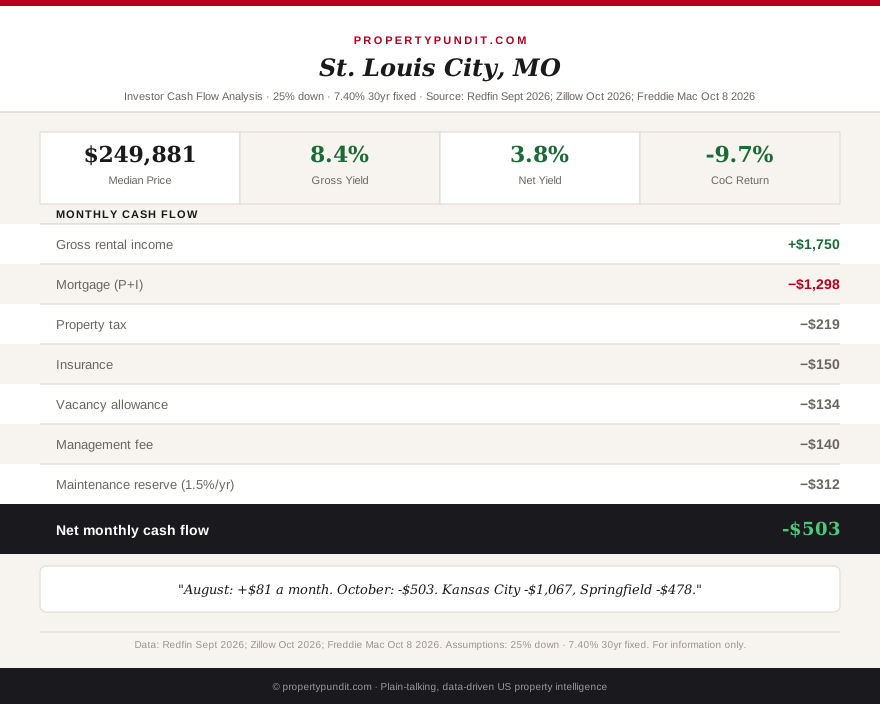
You're a two-property owner looking at Missouri because its landlord rules are friendly and its prices look gentle next to Texas. In August this site found one Missouri market that paid you to own it: St. Louis City at +$81 a month. At the October 8 Freddie Mac rate of 7.40%, with a maintenance reserve added, that same market loses $503 a month, and Kansas City loses $1,067.
All three Missouri markets underwritten here now run negative, from -$478 in Springfield to -$1,067 in Kansas City, on a 25% down payment. This is the third Missouri pass of the year, and it changes the verdict from "one winner" to "none."
The numbers below use the same method as the recent state passes: 25% down, a 30-year fixed at 7.40% (Freddie Mac, October 8, 2026), property tax at the county effective rate, 8% management, one month of vacancy a year, and a 1.5% annual maintenance reserve.
Get this in your inbox every Friday.
One email. The number that matters and what it means for you.
Missouri cash flow at 7.40%, city by city
| Market | Price | Rent | Full payment | Net cash flow | Coverage | Break-even rent |
|---|---|---|---|---|---|---|
| Kansas City | $309,900 | $1,650 | $2,071 | -$1,067 | 0.80 | $2,915 |
| St. Louis City | $249,881 | $1,750 | $1,666 | -$503 | 1.05 | $2,346 |
| Springfield | $219,855 | $1,500 | $1,469 | -$478 | 1.02 | $2,067 |
Prices are Redfin median sale prices: Kansas City $309,900 (up 3.3% year over year, August 2026), St. Louis $249,881 (up 2.0%, September 2026), and Springfield $219,855 (up 0.9%, three months ending August 2026). Rents are Zillow three-bedroom averages: St. Louis $1,750 (October 8, 2026) and Springfield $1,500 (September 17, 2026). The Kansas City rent of $1,650 is carried from the August pass because Zillow's Kansas City page I could reach was dated 2025. Treat it as the weakest input in the table. "Full payment" means principal, interest, property tax and insurance; "coverage" is rent divided by that payment.
The coverage column is the trap. St. Louis (1.05) and Springfield (1.02) clear the 1.0 line that many lenders want, yet both lose roughly $500 a month once management, vacancy and the maintenance reserve come out. Clearing a lender's test doesn't mean the property pays you. Your takeaway: underwrite net cash flow, not coverage.
Why St. Louis flipped from +$81 to -$503
Re-running August's St. Louis inputs through today's method gives +$92 (the published +$81 used slightly different rounding). Four changes took it to -$503:
| Step | St. Louis City | Kansas City | Springfield |
|---|---|---|---|
| August inputs, today's method | +$92 | -$227 | -$302 |
| Rate 6.66% to 7.40% | -$83 | -$96 | -$84 |
| Add 1.5% maintenance reserve | -$279 | -$319 | -$281 |
| New price | -$196 | -$400 | +$38 |
| New rent / insurance | -$37 | -$25 | +$151 |
| October result | -$503 | -$1,067 | -$478 |
Two of those steps are method, not market: the maintenance reserve, which August's pass left out, cost every Missouri market $279 to $319 a month. The rate move cost another $83 to $96. The price step is partly a change of yardstick. August used Zillow's typical-home value for Kansas City ($255,647) and a Redfin/Houzeo figure for St. Louis ($223,000); this pass uses Redfin's median sale price for all three. The newer figures are higher, and they're what a buyer closing this month would actually meet. The point for you: roughly half of the August-to-October swing in St. Louis and Kansas City comes from pricing your costs honestly, and only part of it from the market itself.
Kansas City: the biggest loss on the biggest price
Kansas City's median sale price sits at $309,900, with homes selling in 19 days at 99.9% of list price and 34.7% of listings carrying a price drop (Redfin, August 2026). Competition is real, so your entry price is high. A 25% down payment is $77,475. The full payment is $2,071 a month: $1,609 in principal and interest, $287 in tax (1.11% Jackson County effective rate) and $175 in insurance (a carried estimate, not a landlord quote).
Against $1,650 of rent, that's a net loss of $1,067 a month, or $12,804 a year. To break even, you'd need rent of $2,915, or a purchase price near $165,100, which is 47% below today's median. Neither is on the table. Kansas City works only as a bet on appreciation, so don't buy there unless you can fund $1,067 a month for as long as you hold.
Springfield: rent finally moved, cash flow didn't
Springfield is the one place where August's inputs were too pessimistic. The old pass used a $1,321 citywide rent that blended apartments of every size. Zillow's September 17 three-bedroom average is $1,500, which added $151 a month to the result. The median price also eased to $219,855 (Redfin, three months ending August 2026), which added $38. Even so, the rate and the reserve took $365 back, leaving -$478.
Springfield's data came with warnings. The Redfin page reported a sale-to-list ratio that conflicted with its own text, so I left it out. Zillow's page also showed a rent drop of $95 over the year for all property types. Rents here are soft, and the break-even rent of $2,067 is 38% above today's $1,500 three-bedroom average. For you, that makes Springfield the hardest of the three to justify: rents would have to jump by more than a third just to break even.
Missouri's tax edge: no landlord premium
Missouri's best feature for investors didn't change. The state assesses residential real estate at 19% of market value (per the Missouri State Tax Commission classification), and a rental house doesn't get a higher assessment ratio than an owner-occupied home. That's the opposite of the setup in Mississippi, where this site found rentals assessed 50% higher than owner-occupied homes yesterday. When you price a Missouri deal, the county effective rate in the listing is close to what you'll pay, not a number you need to inflate.
Missouri also eliminated its state tax on capital gains starting with the 2025 tax year, which helps your exit. Voters rejected Amendment 5 on August 4, 2026, by 82.4%, so the graduated income tax (top rate 4.7%) stays. Kansas City and St. Louis levy a 1% earnings tax on wages earned in the city, but it doesn't apply to passive rental income. There's no rent control, and the eviction process runs four to eight weeks in Jackson County. The law is friendly. The math is the problem.
Can appreciation cover the loss?
Here's the generous version. If last year's price growth repeated for a year, and you count the principal you pay down as a return, the cash loss shrinks fast:
| Market | Cash flow | Appreciation per month | Principal paid per month | Total return per month |
|---|---|---|---|---|
| Kansas City (+3.3%) | -$1,067 | +$852 | +$182 | -$33 |
| St. Louis (+2.0%) | -$503 | +$416 | +$147 | +$60 |
| Springfield (+0.9%) | -$478 | +$165 | +$129 | -$184 |
On paper, St. Louis comes out slightly ahead and Kansas City about even. That is a best case. It assumes prices keep rising at last year's pace, it ignores the 6% to 8% cost of selling, and it ignores your tax position. It also asks you to fund $503 to $1,067 a month out of pocket while you wait for a price gain you can't bank until you sell. Springfield doesn't pass even the generous test. If you're already carrying two Texas properties, ask whether your reserves can absorb a third negative carry.
What this means for you
My call: at 7.40%, none of these Missouri markets supports a cash-flow thesis, and I'd only consider St. Louis as a long-hold equity play with a year of losses pre-funded. Size the reserve first: $503 a month is $6,036 a year before repairs beyond the 1.5% allowance.
To make a deal work, the price has to come down. St. Louis needs a price near $181,200, about 27% below the $249,881 median, to break even at $1,750 rent. With 35.4% of St. Louis listings carrying a price drop (Redfin, September 2026), sellers are moving, but not that far. Ask instead for seller credits toward rate buydowns, and compare real landlord (DP-3) insurance quotes before you trust any figure here.
What I couldn't verify
Three inputs are carried or estimated, and a firm underwriting number should replace them: the Kansas City rent ($1,650, carried from August), the insurance costs ($175, $150 and $140 a month, carried estimates rather than landlord quotes), and the county tax rates, which are homeowner effective rates. Redfin's pages for these cities also contained internal inconsistencies, so I used the figures in each page's main data table. Pull a current rent comp and a landlord insurance quote for any address before you make an offer.
Frequently asked questions
Is Missouri still a good state for rental investors in 2026?
The legal setup is investor-friendly: no rent control, no higher assessment for rentals, and no state capital gains tax. The cash flow isn't. At 7.40%, Kansas City nets -$1,067 a month, St. Louis -$503 and Springfield -$478 on 25% down.
Which Missouri city has the best rental cash flow?
St. Louis City is the least negative per dollar invested, with rent coverage of 1.05, but it still loses $503 a month after management, vacancy and a 1.5% maintenance reserve. It was +$81 in August before the rate and reserve changes.
Does Missouri charge investors higher property tax than homeowners?
No. Missouri assesses residential property at 19% of market value regardless of whether it's owner-occupied or rented. That differs from Mississippi, Alabama and Minnesota, which tax rentals at higher ratios than homesteads.
What rent do I need to break even in Kansas City?
About $2,915 a month on a $309,900 house with 25% down at 7.40%, versus the $1,650 rent assumed here. At today's rent, the purchase price would need to be near $165,100.