 Property
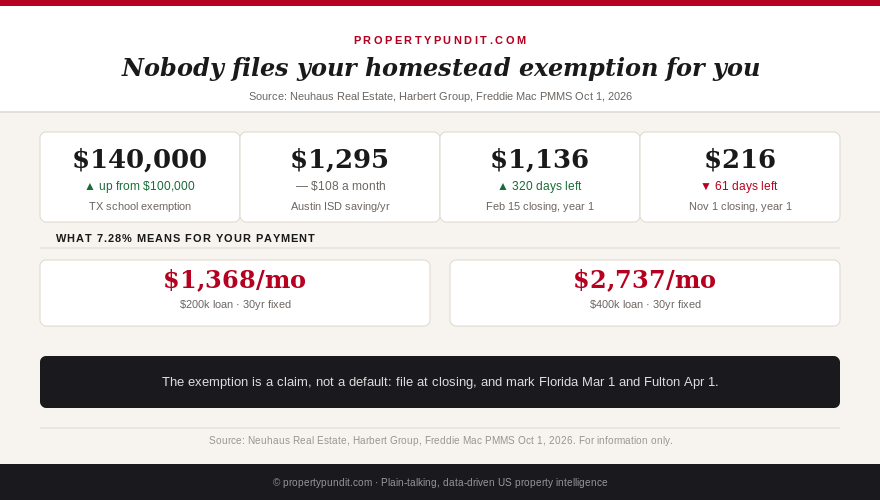
You close in November, the lender sets your escrow account using the seller's tax bill, and everyone congratulates you. Nobody mentions that a one-page form decides whether next year's tax bill is full price or discounted. In Austin ISD, the Texas homestead exemption is worth about $1,295 a year, or $108 a month (Neuhaus Real Estate analysis, 2025 tax rates). It never shows up on your closing disclosure, and the myth that the county, the title company or your lender files it for you costs first-time buyers real money.
It's easy to see why people assume it's automatic. You already told the lender this is your primary residence, the deed is recorded in your name, and the county knows you own the house. But a homestead exemption is a benefit you claim from the local appraisal or assessor's office, in most places on a deadline, and the rules differ by state. The closing agent has no obligation to file it, and a lender collects taxes into escrow without ever checking whether you're getting the discount you're entitled to.
The money is bigger than it looks. At today's 30-year rate of 7.28% (Freddie Mac PMMS, October 1, 2026), every dollar of monthly payment carries about $146 of mortgage balance. A $108 monthly tax saving is therefore the same as roughly $15,800 of loan you don't have to borrow. A missed deadline costs you the equivalent of a higher price on the house you just bought.
Get this in your inbox every Friday.
One email. The number that matters and what it means for you.
The myth: the exemption comes with the house
The most common version is "the seller had it, so I have it." It doesn't work that way. In Texas, the exemption doesn't transfer with the property, and Neuhaus Real Estate lists assuming it does as the first common mistake new buyers make. In Fulton County, Georgia, the county names homeowners who "purchased their home in the last year" among those who must apply or reapply (Rough Draft Atlanta, March 2025). DeKalb County is blunter: failing to file properly "shall constitute a waiver of the homestead exemption," and rentals are ineligible (DeKalb County Tax Commissioner, October 2026).
Florida spells out the same rule: owning a Florida home doesn't trigger the benefit, you must apply (LendFriend, October 2026). Here is the one-glance version of the four states I checked this week. What it means for you: if you closed on a house in the last 12 months and never filed anything with your county, assume you're still paying the full rate until you confirm otherwise on the county's website.
| State | What you get | Filing rule | Automatic? |
|---|---|---|---|
| Texas | $140,000 off school taxable value; 10% yearly cap on assessed value starting the year after your first exemption | Form 50-114 by April 30; in your purchase year, before the first anniversary of closing | No |
| Florida | First $25,000 off all taxes; second $25,000 off non-school taxes; 3% (or inflation) assessment cap | Own and live in it by January 1; file Form DR-501 by March 1 | No |
| Georgia (Fulton) | Basic exemption on the primary residence, plus new 2026 exemptions for Fulton County Schools and Atlanta Public Schools homeowners | Apply by April 1; buyers from the last year must apply | No for new buyers |
| Louisiana | First $75,000 of market value ($7,500 assessed) exempt from most taxes | Apply with your parish assessor (filing window not verified) | No |
What a missed form costs, in real numbers
Take Texas first, because it publishes the cleanest numbers. Voters raised the school-district homestead exemption from $100,000 to $140,000 in November 2025 (Harbert Group, 2026). Neuhaus estimates the annual saving by district at 2025 rates: $1,165 in Eanes ISD, $1,295 in Austin ISD and $1,550 in Pflugerville ISD. On a $350,000 home with a 1.0% school rate, the saving is about $1,400 a year, which matches the $140,000 times 1.0% arithmetic.
Timing inside the purchase year matters too. Neuhaus's worked example for an Austin ISD buyer says a February 15 closing leaves 320 days in the year and saves $1,136, while a November 1 closing leaves only 61 days and saves $216. The gap between those two buyers is $920 in year one, simply because of when the keys changed hands. That's the part nobody tells you: a fall closing makes the first-year saving small, so the real prize is filing early enough to start the 10% cap clock and lock in every full year after it.
Over ten full years at a constant $1,295, the exemption is worth $12,950 before any rate changes, and that's before counting the 10% annual cap on assessed value that starts the year after the first exemption (Harbert Group, 2026). So the decision is simple: file the week you close, not the week the bill arrives.
Missing the deadline: what you can still recover
Texas is the forgiving state. Beyond the April 30 deadline and the first-anniversary rule for new buyers, you can file up to two years late and receive refunds for overpaid taxes in those years (Harbert Group, 2026). Neuhaus lists the same two-year window under Tax Code 11.431. Sources differ on small details, so check your own appraisal district's rule before you count on a refund.
Florida is less forgiving. LendFriend states that missing the January 1 ownership-and-residence date "delays exemption eligibility an entire year," and the application deadline is March 1. That's an entire year of full-price taxes, plus the Save Our Homes cap, which limits assessed-value growth to 3% or inflation, whichever is lower, doesn't start until you qualify. For anyone buying in Florida this fall, the plan is to move in before January 1 and file by March 1, 2027.
What it means for you: put the deadline in your phone the day you sign. A missed Texas filing is a refund request, but a missed Florida filing is a lost year.
Atlanta buyers: the April 1 rule
Fulton County's 2026 deadline was Wednesday, April 1, and the county says every homeowner can qualify for a basic exemption on a primary residence (Fulton County, March 2026). The same notice adds two new district-specific exemptions for 2026, one for Fulton County School District homeowners and one for Atlanta Public Schools residents; existing basic-exemption holders get those automatically, which is exactly why a new buyer who never filed gets nothing. One form covers every exemption type, and the Board of Assessors applies the most beneficial one you qualify for. You can file online at fultonassessor.org or in person at any of six assessor offices.
I couldn't find a published dollar amount for the Fulton basic exemption in the county's own notice, which says only that the exemptions could "save thousands of dollars," so I won't invent a figure for you. DeKalb's rule gives the practical test for timing: you must own and occupy the home as your primary residence on January 1 (DeKalb County Tax Commissioner, October 2026). A buyer who closes this fall should file between January and the April 1 deadline for the 2027 tax year, and the deadline is the same date every year.
Louisiana: a $76 a month lesson for renters-turned-owners
Louisiana assesses residential property at 10% of market value, and owner-occupants can claim an exemption on the first $75,000 of market value, which is $7,500 of assessed value (Steadily and the City of New Orleans, October 2026). It applies only to owner-occupied primary residences. New Orleans' citywide total millage is 121.20 (City of New Orleans Treasury, October 2026), so the exemption is worth $7,500 times 0.1212, or $909 a year, about $76 a month, on any home in the city.
That's smaller than the Texas number, but it's free money on a form, and landlords can't claim it at all. I covered the investor side of the same rule in today's Louisiana market spotlight. Pull your parish assessor's filing instructions before closing, because I couldn't verify the filing window and don't want to guess at it.
A 10-minute checklist for the week you close
First, look up your county appraisal district or assessor's website and search your address; many show the exemptions currently on the property, and the seller's exemption disappears on transfer. Second, find the filing rule for your state in the table above and write the deadline down. Third, gather what the form wants: a state driver's license or ID showing the property address, your Social Security number and, in some counties, vehicle registration (Rough Draft Atlanta, 2025). A mismatched address on your ID is a common reason applications get rejected in Texas (Neuhaus Real Estate).
Fourth, when your lender runs its first annual escrow analysis, expect the payment to drop only after the exemption posts, so ask your servicer to recalculate after the county confirms. If the escrow account builds a surplus, you're entitled to a refund. Fifth, don't pay a third-party "exemption filing service." The Texas form is free (Neuhaus Real Estate), and Fulton's online portal is free as well.
What this means for you
Treat the homestead exemption as part of your purchase price, not an afterthought: in Austin ISD it's worth $1,295 a year, and in New Orleans $909. If you're closing this fall, file the day you get your keys in Texas and Louisiana, and mark January 1 and March 1 or April 1 on your calendar for Florida and Georgia. If you've already closed and never filed, do it this week; in Texas you may still get refunds for the missed years, and everywhere else every month of delay is money you aren't getting back.