 Property
You're standing in a condo in Atlanta with a $78,000 income, a pre-approval, and two nearly identical units at $210,000. One charges $285 a month in HOA fees, the other $345. You're about to pick the cheaper one, and that instinct may be the most expensive mistake on the page. A low fee is often the fee of a building that isn't saving enough for its own roof.
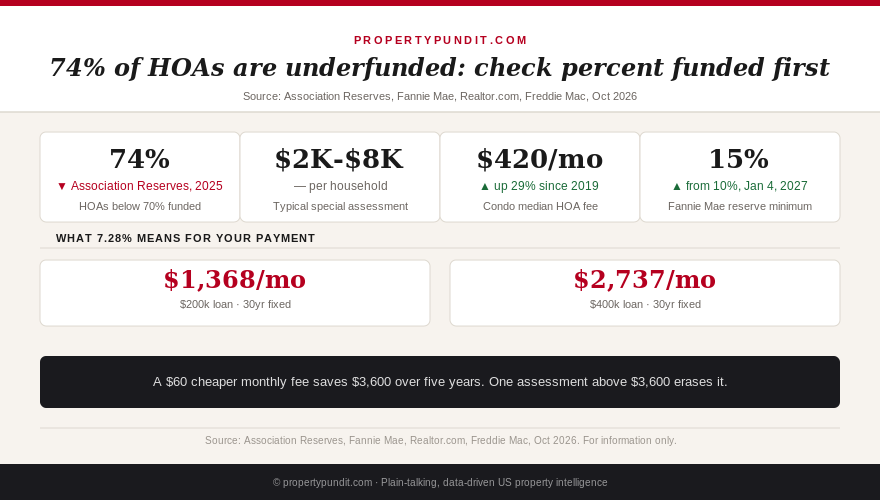
The myth is that a lower HOA fee means a cheaper condo to own. The fee is only the part of the cost you can see today. The median condo HOA fee is $420 a month, up 29% since 2019, and 43.6% of homes for sale now carry an HOA fee (Realtor.com and Barchart analysis, 2026). Mortgage rates add pressure: Freddie Mac's 30-year fixed rate hit 7.28% on October 1, 2026, the highest since November 2023 (Freddie Mac PMMS, October 1, 2026). With rates this high, every dollar of monthly fee matters, which is exactly why buyers grab the lower one.
Get this in your inbox every Friday.
One email. The number that matters and what it means for you.
The number that matters is percent funded, not the fee
Percent funded is a building's actual reserve balance divided by the balance it should have by now, based on how worn out the roof, paving, elevators and plumbing already are. In an analysis of more than 100,000 reserve studies from 1986 to 2025, Association Reserves found that 74% of communities fell below the 70% line that it calls strong. Underfunding historically ran between 61% and 73% and peaked at 82% in 2021 through 2023 (Association Reserves, 2025). The scale runs from 0% to 30% (weak) to 30% to 70% (fair) to 70% and above (strong).
Association Reserves notes that a low percentage doesn't guarantee a special assessment. It does mean the building is behind on bills it already owes, and the only ways to catch up are higher fees or a one-time charge. What it means for your decision: ask for the percent-funded figure before you compare fees, because the fee only tells you what the board is charging, not what the building needs.
What a $60 saving can cost you
Take a 100-unit building where a reserve study says the fully funded balance should be $1.5 million. At 22% funded, the reserve holds $330,000, leaving a gap of $1.17 million, or $11,700 per unit if the board levied it all at once. That is an illustration, not a quote, and boards rarely close a gap in one bill. But assessments are common: about 30% of associations issued one in the last five years and 35% expect one in the next five, with typical amounts of $2,000 to $8,000 per household and complex projects above $15,000 per unit (SwitchWize, citing Association Reserves and industry estimates, 2026).
Now price your choice. Condo A charges $285 a month and is 22% funded. Condo B charges $345 and is 84% funded. Over five years, A saves $3,600 in fees. A single assessment at the midpoint of the typical range, $5,000, flips the result and leaves you $1,400 behind. An $8,000 one leaves you $4,400 behind. Only an assessment below $3,600 leaves A ahead.
| Five-year cost, same $210,000 condo | Condo A (22% funded) | Condo B (84% funded) |
|---|---|---|
| Monthly HOA fee | $285 | $345 |
| Fees over 60 months | $17,100 | $20,700 |
| Fee saving vs Condo B | $3,600 | n/a |
| If a $2,000 assessment hits Condo A | Saves $1,600 net | n/a |
| If a $5,000 assessment hits Condo A | Costs $1,400 net | n/a |
| If an $8,000 assessment hits Condo A | Costs $4,400 net | n/a |
| Assessment that erases the saving | $3,600 | n/a |
Condo A can still be the right buy if the price reflects the risk. What it means for your decision: if the lower-fee building is the underfunded one, ask for a price cut that covers at least the $3,600 break-even before you sign.
Your lender is about to care about reserves too
Fannie Mae announced Lender Letter LL-2026-03 on March 18, 2026. It raises the reserve minimum from 10% to 15% of budgeted assessment income for loan applications dated January 4, 2027 or later, and lenders are encouraged to apply it sooner. Associations must use the highest recommended funding model rather than the baseline option, reserve studies must be less than 36 months old, and a project with more than 15% of units 60 or more days delinquent on dues is ineligible (Fannie Mae LL-2026-03, as reported by Cooperator News, March 2026). Limited Review is gone, so lenders now run a full review of budgets, reserve studies, board minutes and insurance (Cooperator News and RISMedia, 2026).
The reserve test counts the budget, not cash on hand, and it looks only at regular assessment income, so a special assessment doesn't help a building pass (RISMedia, August 14, 2026). For you, this cuts two ways. A building that fails will be hard to finance, which narrows the pool of buyers when you sell. A building that is raising fees to comply will pass the cost to you. Either way, a low fee in an underfunded building is a fee that's likely to rise.
Why boards keep fees low anyway
A board that raises fees gets angry emails, and a board that holds them flat gets a quiet building until the roof fails. That gap is why a low fee and an underfunded reserve so often travel together. Some states have started forcing the issue: Florida's rules, effective January 1, 2026, require full funding of structural reserves for condo buildings of three or more stories and bar boards from underfunding components whose failure could cost more than $25,000 (Florida DBPR, as summarized by SwitchWize, 2026). I could not confirm a comparable rule in many other states, so in much of the country the only check on a thin reserve is the buyer asking for the study.
If a seller or management company stalls on the reserve study, treat the stall as information. A building that is proud of its numbers hands them over in a day. Ask in writing, set a deadline that falls before your inspection contingency ends, and remember that you can usually cancel and keep your earnest money only while that contingency is alive. What it means for your decision: no study before the deadline means you either extend the deadline or walk.
The fee also shrinks the loan you qualify for
Lenders count HOA fees in your monthly obligations. At 7.28%, every $100 a month in dues removes about $14,615 of loan capacity, so the $60 difference between A and B is worth about $8,769 of borrowing power. On $78,000 of income, the common 28% guideline allows about $1,820 a month for housing. Condo A's principal and interest alone on a $199,500 loan (5% down) is about $1,365 before tax, insurance, mortgage insurance and the fee, so you have little room. That is a reason to compare buildings, not a reason to take the one with the lowest fee.
Five documents to request before your inspection deadline
- The most recent reserve study and its percent-funded figure. If it's older than 36 months, ask when the next one is scheduled.
- The current budget, with the reserve contribution as a share of assessment income. Compare it with 15%.
- Twelve months of board minutes. Search for the words "assessment," "roof," "elevator," "litigation" and "loan."
- The delinquency rate on dues. Over 15% of units 60 days behind disqualifies the project for Fannie Mae.
- The lender project-approval status, so your own loan doesn't fail late in the process.
What this means for you
Rank condos by percent funded first and fee second. If the building is 70% funded or better, a higher fee is usually a fair price for a building that pays its bills. If it sits between 30% and 70%, negotiate the price down by at least the five-year fee saving, and ask what the board plans to do about the gap. If it's under 30%, walk away unless the seller will cut the price by an amount you could survive paying as a surprise bill, which in our example was $5,000 to $8,000.
Run that check this week, while you still have an inspection contingency. Once you're under contract, the reserve study is the one document that can still change both your price and your decision.