 Property
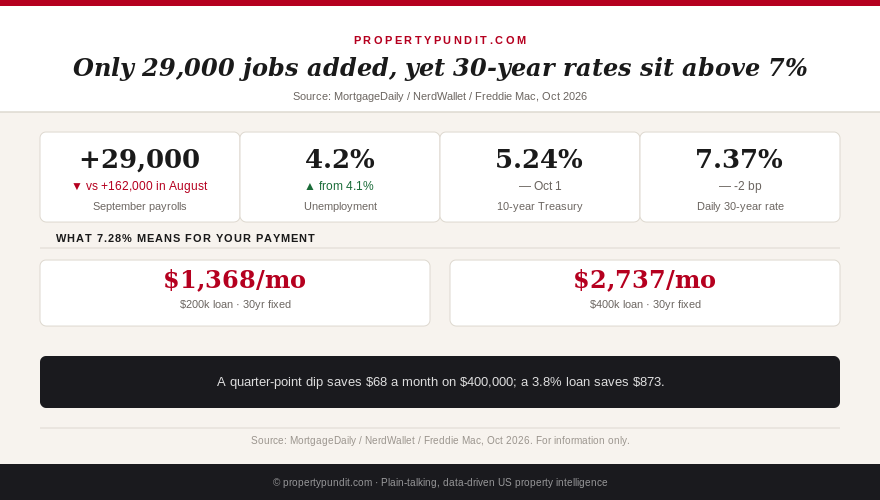
Employers added only 29,000 jobs in September, down from 162,000 in August, and unemployment rose to 4.2% from 4.1%. Mortgage rates barely noticed: the daily 30-year index slipped 2 basis points to 7.37% on October 2, and it has now printed at or above 7% thirteen readings in a row (MortgageDaily, October 2, 2026). If you're locked in at 3.8% and wondering whether this is the report that finally lets you move, the answer is no, and the math shows why.
I'm treating this as a data drop with a so-what. A weak labor report normally pulls Treasury yields down, and mortgage rates follow. This one did, but only a little, because the rate you'd pay isn't set by the jobs number alone.
Here is where everything stands, what moved, and what a 3.8% owner should do about it.
Get this in your inbox every Friday.
One email. The number that matters and what it means for you.
The numbers that moved on October 2
The September report showed payroll growth of 29,000 and unemployment of 4.2% (NerdWallet, October 2, 2026). August's gain was 162,000 with unemployment at 4.1%, so job growth fell by about 82% in a month. Treasury yields eased: the 10-year closed at 5.24% on October 1, down from a 5.29% high on September 30 (MortgageDaily, October 2, 2026).
| Indicator | Latest reading | Date and source |
|---|---|---|
| Payroll growth, September | +29,000 | October 2 (NerdWallet, MortgageDaily) |
| Payroll growth, August | +162,000 | September 4 (August report coverage) |
| Unemployment rate | 4.2% (from 4.1%) | October 2 (NerdWallet) |
| 30-year fixed, Freddie Mac | 7.28% (+25 basis points) | October 1 (Freddie Mac PMMS) |
| 30-year fixed, daily index | 7.37% (-2 basis points) | October 2 (MortgageDaily) |
| 10-year Treasury | 5.24% (high 5.29% on Sept 30) | October 1 (MortgageDaily) |
| Mortgage rate minus 10-year | 2.13 points | October 2 (MortgageDaily) |
| Fed funds target range | 3.75% to 4.00% | Raised September 16 (FOMC) |
So what: the labor market is softening, and the bond market noticed for a moment. NerdWallet's read is "think dip, not dive," meaning slightly softer rates rather than a sharp drop (NerdWallet, October 2, 2026).
Why a weak jobs report didn't lower rates by much
Three reasons show up in the data. First, rates had a long way to run up: the daily index sits 63 basis points above its September 3 level of 6.74%, and it hit a one-year high of 7.39% on September 30 (MortgageDaily, October 2, 2026). A 2-basis-point pullback doesn't reverse a 63-basis-point climb.
Second, the Fed raised its target range by 25 basis points to 3.75%-4.00% on September 16, its first hike since 2023, and Minneapolis Fed President Neel Kashkari said one more hike this year is likely, with another possible in 2027 (MortgageDaily, October 2026). NerdWallet notes that softer inflation figures alongside the weak jobs data suggest the Fed is less likely to raise rates at its next meeting. I couldn't verify updated futures odds after the report, and before it, CME pricing showed a 72.5% chance of an October 28 hike (CME FedWatch, cited in our September 30 article).
Third, mortgage rates sit 2.13 points above the 10-year Treasury (MortgageDaily, October 2, 2026). Even if the 10-year drops 20 basis points, that spread leaves the 30-year well above 7%. NerdWallet also flags global tension over Iranian oil supplies as a continuing inflation pressure.
So what: don't plan around a rate drop below 7%. Plan around a rate that's flat to a few tenths lower by year-end, and treat anything better as a bonus.
What the rate gap costs, in dollars
The question after any Fed move is simple: what does it do to your choices? On a $400,000 loan, the payment at your 3.8% rate is $1,864. At Freddie Mac's 7.28% it's $2,737, which is $873 more a month, or $10,476 a year. Since September 3 alone, the move from 6.74% to 7.37% on the daily index added about $170 a month ($2,035 a year) to a new $400,000 loan.
| Rate scenario (30-year, $400,000 loan) | Principal and interest | Versus a 3.8% loan |
|---|---|---|
| 3.8% (your existing mortgage) | $1,864 | n/a |
| 6.74% (MortgageDaily, September 3) | $2,592 | +$728 |
| 7.03% (Freddie Mac, September 24) | $2,669 | +$805 |
| 7.28% (Freddie Mac, October 1) | $2,737 | +$873 |
| 7.37% (MortgageDaily, October 2) | $2,761 | +$898 |
| 7.03% if rates "dip" 25 basis points | $2,669 | +$805 |
| 6.78% if rates fall 50 basis points | $2,602 | +$739 |
A quarter-point dip, which is what a weak report might deliver, saves $68 a month on a $400,000 loan. A half-point drop saves $134. Neither one closes the $805-to-$873 gap between your loan and a new one. For you to match a 3.8% payment you'd need a rate at or near 3.8%, and nobody is forecasting that.
So what: the weak report moves your decision by about $68 a month in the best realistic case. That's a rounding error against $873.
The risk the report does raise: your job, not your rate
A hiring slowdown matters to a fixed-rate owner in a different way. Your payment can't rise, but your income can fall. Payroll growth of 29,000 is thin enough that it's worth checking your cushion. At a $1,864 principal-and-interest payment, six months is about $11,184, before taxes, insurance, and utilities. If your emergency fund is under that, the report is a better reason to build cash than to refinance.
If you're considering a HELOC, remember that those rates float with the prime rate, which rose when the Fed hiked, as covered in our September 30 article on HELOC costs per $50,000 borrowed. A weak labor market is a poor time to add a variable-rate payment.
So what: your 3.8% mortgage is a financial asset. Treat it like one.
What this means for you
If you own at 3.8%: keep the loan, don't refinance, and don't list your house because of this report. The cost of replacing your mortgage is $805 to $898 a month per $400,000, and one weak jobs number won't change that. If you must move for work or family, price the full cost of the new loan first and plan to hold the old house as a rental only if the rent covers the payment, which is the arithmetic our investor spotlights run every day.
If you're shopping: Freddie Mac's next reading is due October 8. If you close within 30 to 45 days, lock now; if you close in 60 days or more, floating is defensible only if you can absorb a payment that's $50 to $100 higher on a $400,000 loan (the lock window is MortgageDaily's guidance, October 2026). Prepare for 7% as the base case.
One more number to watch: the 10-year Treasury at 5.24%. For rates to return to 6.5%, it would have to fall to about 4.37%, a drop of roughly 87 basis points, assuming the 2.13-point spread holds. That's what a real change in direction looks like, and a 29,000-job month alone doesn't deliver it.
Common questions
Will mortgage rates fall after the weak September jobs report? Only slightly. Rates eased a few basis points on October 2, but they remain above 7% on most indexes.
Should I refinance my 3.8% mortgage? No. A new 30-year loan at 7.28% costs $873 more per month on a $400,000 balance than 3.8% does.
What was the September jobs number? Payrolls rose 29,000 and unemployment climbed to 4.2%.
When is the next Freddie Mac rate update? Freddie Mac publishes on Thursdays; the next reading is October 8, 2026.