 Property
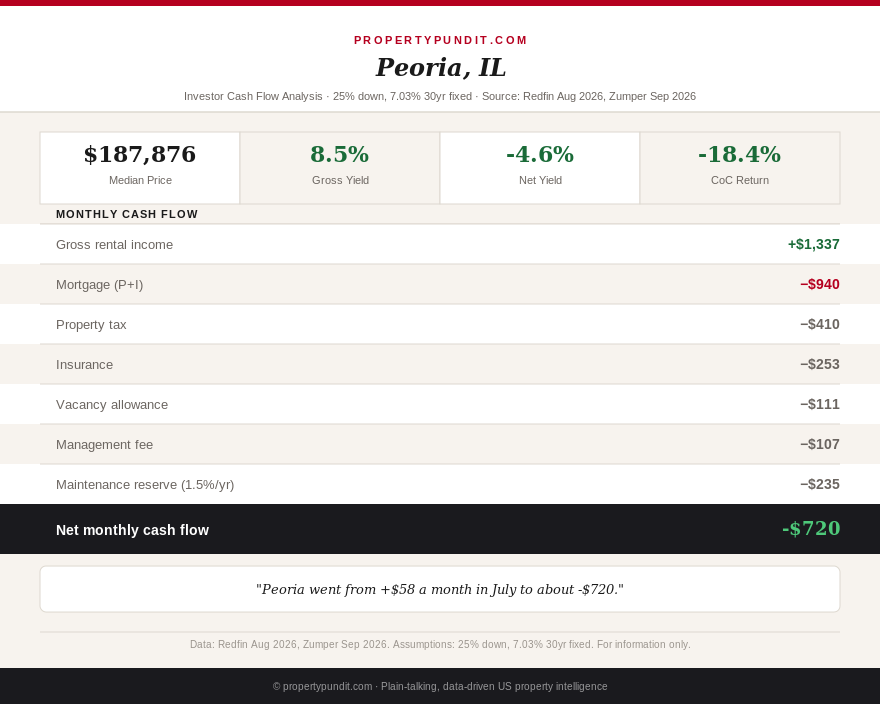
In July, Peoria was the one Illinois market that made money. Our second pass put it at +$58 a month, a rounding error of a profit but a profit. Today it loses about $720 a month. Nothing broke in Peoria: prices rose 7.4% to $187,876 (Redfin, August 2026), rents held near $1,337, and the city still sells homes in 13 days. The math changed underneath it, and if you own or are eyeing a rental in Illinois, the same change is hitting your spreadsheet.
Here's the full picture at Freddie Mac's 7.03% benchmark rate (September 24, 2026), with 25% down, an 8% management fee, one month of vacancy a year, and a 1.5% maintenance reserve. All four Illinois markets we checked lose money every month, from about $720 in Peoria to about $1,559 in Chicago.
Rockford is the hottest market in America and still loses $1,095 a month
Rock River Current reported in September that Rockford ranked as the nation's hottest housing market in August 2026, based on views per property and sales velocity. The three-month rolling average sale price hit $255,283, the second-highest on record, with 382 homes sold and 18 days on market (Rock River Current, September 2026). Inventory doubled from 215 to 423 homes year over year, which is the first crack in the tight-supply story. Rents are catching up fast: Zumper's September 2026 data shows Rockford's median rent up 20% year over year, with houses at $1,550. That's real momentum. It still isn't enough. On a $255,283 purchase, the loan is $191,462, principal and interest run $1,278, tax at Rockford's 2.61% rate adds $555, and insurance adds $240. Add the manager, vacancy, and reserve, and you lose about $1,095 a month. Break-even rent is about $2,859, which is 84% above today's $1,550. The lesson for your decision: a hot market and a good rental are different things. Speed of sale tells you what buyers will pay. It says nothing about whether tenants can cover what the buyer paid.Get this in your inbox every Friday.
One email. The number that matters and what it means for you.
Peoria: a $778 swing in three months
Peoria makes the cleanest before-and-after case because every input is documented. In our July 20 pass the model used a $148,000 price, $1,350 rent, a 2.24% tax rate, low insurance, and 6.55%. Re-running it one variable at a time shows where the money went.| What changed since July (Peoria, monthly) | Effect on cash flow |
|---|---|
| Price rose from $148,000 to $187,876 | -$264 |
| Maintenance reserve added (1.5% of price a year) | -$235 |
| Insurance re-priced at $253 a month (MoneyGeek, 2026) | -$163 |
| County tax rate moved from 2.24% to 2.62% (Ownwell) | -$59 |
| Mortgage rate rose from 6.55% to 7.03% | -$45 |
| Rent slipped from $1,350 to $1,337 | -$11 |
| Total swing from +$58 to about -$720 | -$778 |
Chicago: 9.3% price growth and a $1,559 monthly loss
Chicago's Redfin median hit $426,255 in August 2026, up 9.3% year over year, with 49.3% of homes selling above list and 49 days on market. S&P Cotality Case-Shiller separately showed Chicago leading every tracked metro at 6.9% in July (S&P Cotality, September 29, 2026). The appreciation is real. The rental math is the problem. At a 2.20% tax rate, the tax alone is $781 a month. The loan is $319,691, principal and interest run $2,133, and insurance adds $287 (MoneyGeek's Chicago figure of $3,445 a year). Against Zumper's $2,600 median for houses, DSCR (rent divided by the mortgage, tax, and insurance payment) is 0.81, and net cash flow after the manager, vacancy, and reserve is about -$1,559. Break-even rent is about $4,464. There's an honest sensitivity here. Ownwell lists Chicago proper at a 1.66% effective rate versus 2.14% for Cook County overall. At 1.66%, tax drops to about $590 a month and the loss improves to about $1,367. Better, still deeply negative. Cook County's own numbers show why you shouldn't count on relief: local governments requested $743.8 million more for 2025 taxes, a 3.9% increase that outran 3.1% inflation, with the north and northwest suburbs up 6.4% (Cook County Treasurer, 2026). If you're eyeing Chicago for its appreciation, price the tax at your actual district's rate and treat any successful appeal as upside, never as a base case.Springfield and the four-market comparison
Springfield's numbers come with a mismatch. The $203,878 median is a January to June figure (Capitol City Now, August 2026), up 7.2%, while the others are August readings. Rent is $1,250 for a three-bedroom (Zumper, September 2026), and the 2.41% Sangamon County rate carries forward from July. Result: about -$894 a month.| Market | Price | Rent | DSCR | Net cash flow | Break-even rent |
|---|---|---|---|---|---|
| Chicago | $426,255 | $2,600 | 0.81 | -$1,559 | $4,464 |
| Rockford | $255,283 | $1,550 | 0.75 | -$1,095 | $2,859 |
| Springfield | $203,878 | $1,250 | 0.74 | -$894 | $2,318 |
| Peoria | $187,876 | $1,337 | 0.83 | -$720 | $2,197 |