 Property
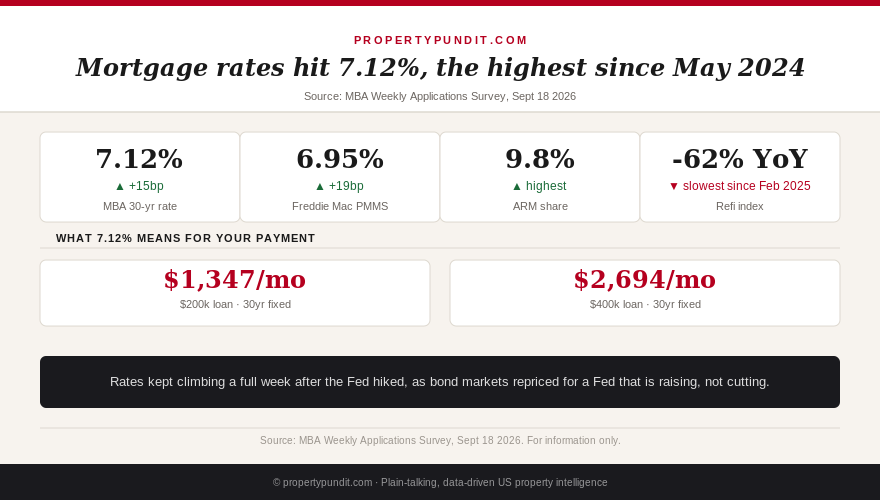
The average 30-year mortgage contract rate hit 7.12% this week, according to the Mortgage Bankers Association's Weekly Applications Survey for the week ending September 18, 2026. That’s the highest reading in MBA's own series since May 2024, and it landed a full week after the Federal Reserve's September 16 rate hike was supposed to have already been priced into the market.
Freddie Mac's Primary Mortgage Market Survey, the official weekly benchmark most lenders and headlines quote, still shows 6.95% as of September 17. Today's new PMMS reading publishes at noon Eastern, several hours after this was written, so treat 6.95% as the last confirmed official number until it updates. Daily rate trackers, which move faster than either weekly survey, showed 7.111% this morning, up from 7.047% yesterday and continuing a climb that started the moment the Fed's decision hit the wires.
Here is the part that surprises people: the Fed's hike itself did not move mortgage rates much. Rates barely budged the morning after the vote, because bond markets had already priced in a hike days earlier. What is pushing rates higher now is what came after: a full week of traders digesting a Fed that just raised rates instead of cutting them, with no clear signal on when, or whether, cuts return.
Get this in your inbox every Friday.
One email. The number that matters and what it means for you.
Why mortgage rates track the Treasury, not the Fed
Mortgage rates don’t move in lockstep with the Fed funds rate. They move with the 10-year Treasury yield, because lenders price 30-year mortgages off the long end of the bond market, not the short-term rate the Fed actually controls. A Fed hike raises the cost of overnight bank lending; it doesn’t automatically raise, or lower, what investors demand to hold a 10-year bond.
What actually moved this time was investor expectations. Once the Fed confirmed it’s willing to hike rather than hold or cut, with three regional presidents on record favoring even more tightening earlier this year, traders reset their assumptions about how long rates stay elevated. That reset showed up as higher Treasury yields over the following days, and mortgage rates followed with their usual lag of a few sessions.
The practical lesson for anyone shopping for a rate: a single Fed decision rarely tells you where mortgage rates are headed on decision day. It’s the days afterward, as the bond market works out what the decision means, that usually do the real moving.
Two official surveys, one confusing gap
If you are comparing rate quotes and getting frustrated that nothing matches, you aren’t imagining it. Two separate weekly surveys are both considered "official," and they currently disagree by 17 basis points. Freddie Mac's PMMS averages lender rate sheets from Monday through Wednesday and reports a single national figure every Thursday at noon. MBA's Weekly Applications Survey instead measures the actual contract rate on loan applications submitted that week, weighted by loan volume.
In a calm week, the two surveys usually sit within 5 to 15 basis points of each other. This week's 17-point gap, MBA's 7.12% against PMMS's 6.95%, is wider than typical but not unprecedented; the same two surveys diverged by a similar margin back in mid-July. The gap tends to widen exactly when rates are moving fast in one direction, since PMMS's Monday-Wednesday sampling window catches an average from a few days ago while MBA's application data reflects rates borrowers locked more recently.
The takeaway for a borrower shopping today: neither number is "the" rate you will get. Your actual quote depends on credit score, loan size, property type, and the specific lender, and it can sit meaningfully above or below either survey average.
What this actually costs you
The national median existing-home price is $429,100, per the National Association of Realtors' August 2026 report. A first-time buyer putting 10% down on that home borrows $386,190. Here is what that loan costs at three points on this month's rate curve:
- 6.76% (September 10 PMMS, before the Fed vote): $2,507 a month in principal and interest.
- 6.95% (September 17 PMMS, after the Fed vote): $2,556 a month, $49 more.
- 7.12% (this week's MBA average): $2,601 a month, $93 more than before the vote.
That $93-a-month swing adds up to $1,118 a year, on the same house, with the same down payment, purely from a rate move that happened over roughly two weeks. Scale that to a $600,000 loan and the same climb costs about $173 more a month, or nearly $2,080 a year. None of that reflects a change in what the home is worth; it’s purely the cost of financing shifting under buyers' feet while they shop.
ARM demand is answering the question fixed-rate shoppers are asking
MBA's data shows where borrowers are voting with their applications. Adjustable-rate mortgage share climbed to 9.8% of all applications this week, and MBA's chief economist Mike Fratantoni pointed out that 5/1 ARM rates are running more than a full percentage point below comparable fixed rates right now. Refinance activity, meanwhile, fell to its slowest pace since February 2025 and sits 62% below year-ago levels, since almost nobody locked at 3-4% five years ago has a reason to refinance into a 7% loan.
An ARM isn’t automatically the right move just because it is cheaper today. A 5/1 ARM adjusts after five years, and if rates are still elevated then, the payment can jump. It’s worth considering seriously only if you have a concrete reason to think you will move, refinance, or pay off a meaningful chunk of the loan before that five-year mark, not simply because the introductory rate looks better on paper this week.
The last time we were here
The spring of 2024 was the last stretch where MBA's weekly survey averaged this high for a sustained run, a period when the 30-year rate spent several months at or above 7% before drifting back into the low-to-mid 6% range through most of 2025 and the first half of 2026. Anyone who bought or refinanced in that 2024 window, and then watched rates ease over the following year, understandably expected the same pattern to repeat. This year's climb is testing that assumption.
What is different this time is the direction of Fed policy itself. The 2024 rate spike happened while the Fed was still holding at a peak rate before eventually cutting. This year's spike is happening while the Fed just hiked, its first increase since 2023, with three regional Fed presidents on record favoring even tighter policy earlier in the year. A rate cycle that peaks because the Fed is done raising looks very different from one that peaks because the Fed just started raising again. Nobody, including the Fed itself, has committed to when this hiking cycle ends.
None of this means rates are guaranteed to stay this high, or to climb further. It means the "rates spiked before and came back down" reasoning that worked in 2024 rests on a Fed backdrop that no longer applies, and treating this move as automatically temporary is a weaker bet than it looked a year ago.
What this means for you
If a rate works for your budget today, the case for waiting on a better one just got weaker, not stronger. The Fed hiking instead of cutting removes the most obvious near-term catalyst for lower rates, and this week's move shows rates can keep climbing well after the news that supposedly caused them has already happened. If your pre-approval is based on a rate from even two weeks ago, ask your lender to re-run the numbers before you make an offer: the market has moved enough to change what you can actually afford.