 Property
You're staring at a loan estimate with a line item called "discount points," and a loan officer just told you that paying $5,400 upfront would drop your rate from 6.95% to 6.45%. It sounds like free money: pay a little now, save a little every month, for as long as you own the place. Then you remember what every finance blog and Reddit thread has told you for years: don't buy points, because you'll probably move or refinance before you ever break even.
That advice made sense once. It doesn't anymore, and the data explaining why just changed under your feet.
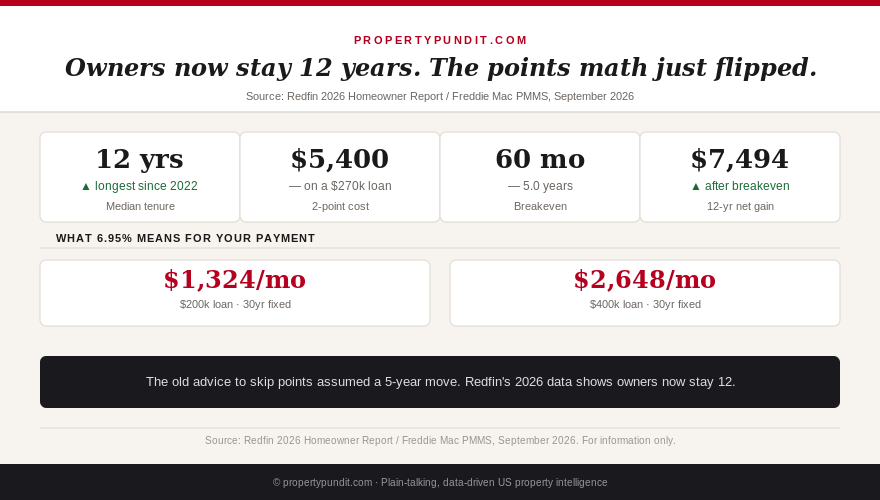
Here's the number that should make you reopen that loan estimate: the median American homeowner now stays in their home for 12 years before selling, the longest stretch since 2022, according to Redfin's 2026 homeowner report. Most points math breaks even in four to six years. That's not a close call. That's most buyers leaving real money on the table by following advice built for a homeownership pattern that no longer exists.
The advice you've heard is built on an old assumption
"Don't buy points, you'll move before it pays off" isn't a made-up rule. It came from somewhere. For years, financial writers pointed to short median tenure, often cited around five to seven years, as the reason paying upfront for a lower rate rarely made sense for the typical buyer. If you're statistically likely to sell or refinance in year five, and your breakeven sits in year six, you've paid for a discount you never collected.
The trouble is that the five-to-seven-year assumption is stale. Homeowner tenure collapsed in the years around the 2008 crash and the years right after, then climbed steadily back up as the "rate lock-in" effect took hold: people who bought or refinanced at 3% and 4% rates have had no financial reason to sell into today's 6.95% market. That behavior change didn't just nudge the tenure number. It reset it.
If the advice you're following was written more than a couple of years ago, or if the writer never cited a tenure figure at all, treat it as boilerplate rather than something anyone actually checked against current data. For your own decision, the only number that matters is your own realistic timeline compared to your own breakeven, not a rule of thumb from a market that no longer exists.
Get this in your inbox every Friday.
One email. The number that matters and what it means for you.
How the breakeven math actually works
The formula is simple, even if lenders rarely walk you through it unless you ask. Divide the dollar cost of the points by your monthly payment savings, and you get the number of months until the upfront cost pays for itself. After that, every additional month you stay in the home is pure savings.
One discount point typically costs 1% of your loan amount and, in the current rate environment, shaves roughly 0.25 percentage points off your rate. Two points cost 2% of the loan and cut the rate by about 0.50 points, which is the version most lenders quote when you ask about a buydown. The exact ratio moves with the lender and the day's pricing, so always ask for your specific breakeven number in writing rather than assuming the general rule applies to your quote.
This is also where a lot of first-time buyers get tripped up: the points cost is due in full at closing, while the savings arrive in small monthly installments over years. That mismatch is exactly why the "you'll move before you break even" warning caught on in the first place. It's a real risk. It's just no longer the typical outcome, and your final decision should rest on your own timeline, not the shape of the risk in general.
Homeowners are staying twice as long as the advice assumes
Redfin's 2026 homeowner report puts median US tenure at 12 years, up from 11.8 years in 2024 and a steady climb back from the pandemic-era churn. Tenure peaked even higher, at 13.4 years, in 2020, before easing slightly and now rebuilding. Regional variation is wide (Los Angeles homeowners stay a median of 20 years, for instance), but even the national median of 12 years is roughly double the five-year horizon that "don't buy points" advice typically assumes.
That gap matters because breakeven math isn't linear once you're past the crossover point. A buyer who breaks even in five years and stays 12 doesn't just "not lose money," they bank seven additional years of monthly savings with zero additional cost. The longer national tenure trend means that outcome, not the early-exit scenario the old advice warns about, is now the more likely one for a typical buyer.
The real math on a $270,000 loan at today's rate
Numbers make this concrete. Say you're financing a $300,000 home with 10% down, a $270,000 loan, at this week's 6.95% Freddie Mac rate (Freddie Mac PMMS, September 17, 2026). Principal and interest on that loan runs about $1,787 a month.
Buy two discount points for roughly $5,400 (2% of the loan amount) and your rate drops to about 6.45%. Principal and interest falls to around $1,698 a month, a savings of about $90 a month. Divide $5,400 by $90 and you get a 60-month breakeven, exactly five years.
If you match the 12-year median tenure, you'd collect 144 months of that $90 monthly savings, or $12,960, against a $5,400 upfront cost. Subtract the breakeven period and you're left with roughly $7,500 in savings that exist purely because you stayed longer than the old advice assumed you would. Ask your own lender for your loan's exact points-versus-rate tradeoff before committing; the ratio in this example is a common convention, not a guarantee for every lender or every day's pricing.
When the old advice is still right
None of this means points are automatically the right move. The "you might move first" risk is real, it's just no longer the base case. A few situations still argue for skipping points even with a 12-year national median: a genuinely uncertain timeline, such as a military family expecting PCS orders or a corporate transfer that could happen inside a couple of years; a starter home you already expect to outgrow before the breakeven hits; or a cash position tight enough that spending on points would leave you without a real repair and emergency reserve.
Points also don't touch a separate decision that trips up a lot of first-time buyers: whether that same cash is better spent pushing your down payment higher instead. If your down payment is already near a round number like 10%, extra cash toward points only lowers your rate, while extra cash toward the down payment shrinks your loan size and, if it's enough to cross the 20% threshold, removes your monthly PMI charge entirely rather than just shaving your rate. Our breakdown of the down payment myth and our guide to canceling PMI both cover that tradeoff in more depth; run both breakevens side by side before you commit cash either way.
It's also worth separating buyer-paid points from seller-paid ones. When a seller or builder offers a rate buydown as part of a concession, as we covered in our recent look at rate buydowns versus price cuts, that's the seller's money, not yours, so the breakeven math barely matters: take it. The math in this article is specifically for cash coming out of your own closing funds, which is a different decision with real opportunity cost attached. Points also show up as a line item alongside your other prepaid costs, and if you haven't already, it's worth reading our closing costs explained guide so the full picture of what's due at the table doesn't surprise you.
What this means for you
The math points toward buying points more often than the old rule of thumb suggests, but it isn't automatic. Pull up your own loan estimate, find the points-versus-rate quote, and divide the dollar cost by your actual monthly savings to get your real breakeven number. Then ask yourself honestly how long you expect to stay: not the five-year folklore number, but your actual plan, weighed against a national median that now sits at 12 years.
If your honest answer is "probably longer than five or six years," the math is on your side and skipping points on the old advice alone is likely costing you money. If your timeline is genuinely uncertain, keep the cash liquid instead. Either way, the decision should come from your own numbers, not a rule written for a housing market that moved on years ago.