 Property
You have run the spreadsheet on a dozen states this year, and most of them fail on rent versus price before you even get to the tax line. Alaska looks different at first glance: no state income tax, a rental market propped up by a reliable military tenant base, and a debt service coverage ratio that actually clears 1.0 in Anchorage. Then you get to the insurance page of the landlord policy and see the word "earthquake" followed by an exclusion, and the market that looked like the exception starts looking like every other state with a hidden cost nobody put in the listing.
This is a second look at Alaska, following up on our original underwrite from July. The DSCR math hasn't changed much, but a fuller accounting of insurance and maintenance costs tells a more complete story about what actually happens if the ground moves.
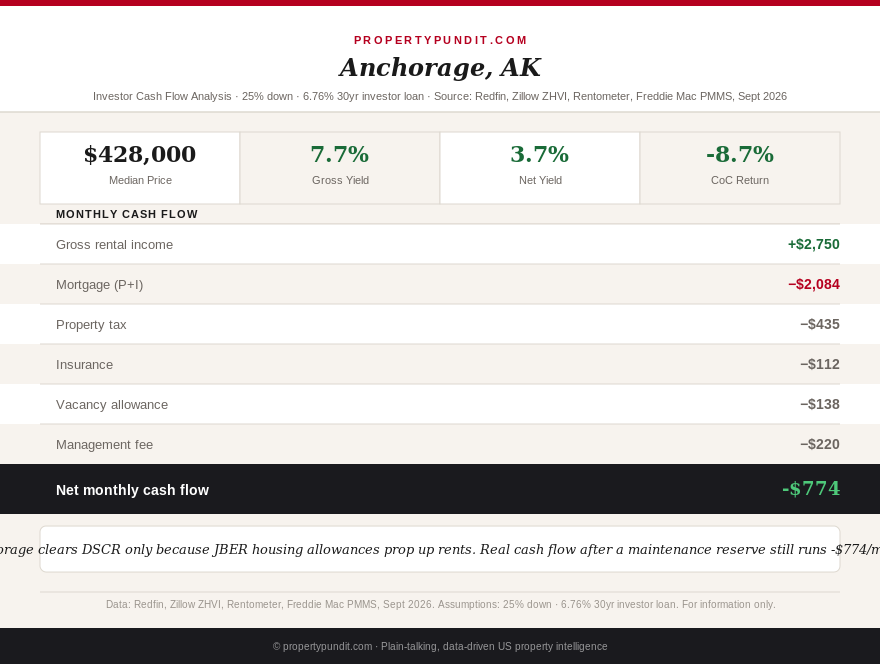
The only Alaska market that clears DSCR
Anchorage's median sale price hit $428,000 over the three months ending May 2026, up 3.1% year over year, per Redfin, though Zillow's smoother ZHVI average value index shows $394,266 for the same period, also up 3.1%. The two figures diverge because Redfin tracks closed sale prices while Zillow's index smooths for mix shift, a pattern we have flagged in several other states this cycle; either way, the trend direction agrees.
On a 25%-down investor loan at today's 6.76% rate, the $321,000 balance carries a principal-and-interest payment of about $2,084 a month. Add Anchorage's roughly 1.22% effective property tax rate, about $435 a month on this price point, and landlord insurance of about $112 a month (more on that below), and total PITI runs close to $2,631. Against a three-bedroom single-family rent of about $2,750, per Rentometer's August reading, that is a 1.05 DSCR, clearing the 1.0 threshold most DSCR lenders require.
The reason Anchorage clears when almost no other market in this 50-state series does comes down to one employer: Joint Base Elmendorf-Richardson. The Basic Allowance for Housing paid to JBER's service members rose about 5.4% in Alaska for 2026, well above the 4.2% national average, and dependents receive 25% more than single service members. An E-5 with dependents draws roughly $2,874 a month in BAH, an E-7 about $3,045, on top of a separate cost-of-living allowance for Anchorage specifically. That allowance sets a rental floor that most civilian wages in the city wouldn't support on their own, which is exactly why Anchorage passes DSCR while Fairbanks and Juneau, without the same concentration of allowance-backed renters, don't. If you're underwriting Alaska at all, that concentration is the thing to verify first, since it's the single input everything else in this article depends on.
The insurance line nobody models
Alaska sits on more active fault lines than any other state, and every standard homeowners or landlord policy in the state excludes earthquake damage by default. Coverage exists only as a separate endorsement, and it's cheap to add, typically around $116 a year. The catch is the deductible: insurers set it at 10% to 20% of the coverage limit, not a flat dollar figure. On a policy insuring a typical Anchorage rental for its roughly $300,000 rebuild cost, that works out to a deductible of $30,000 to $60,000 before the policy pays a dollar toward foundation or structural damage from a quake.
That isn't a rounding error in a cash-flow model. It means an investor who adds the endorsement and calls the risk handled is still self-insuring the first $30,000-plus of any seismic damage out of pocket, on top of whatever reserve they are already carrying for routine maintenance. For a market whose entire investment case rests on a single tight DSCR calculation, a deductible that size is the kind of number that belongs in the underwriting, not a footnote discovered after the policy is bound.
What the real cash flow looks like
DSCR only measures whether rent covers principal, interest, taxes, and insurance. It says nothing about property management, vacancy, or the maintenance reserve a landlord needs to actually hold a rental for years rather than one lucky season. Layer in an 8% management fee (about $220 a month) and a 5% vacancy allowance (about $138), and Anchorage's paper surplus of $119 a month narrows to a loss of roughly $239. Add a maintenance reserve of 1.5% of the property's value annually, about $535 a month on this price point, the same reserve line that flipped Milwaukee and Spokane from marginal passes into clear losses earlier this year, and the real monthly cash flow on Anchorage's entry-tier rental runs about negative $774.
That is the gap between "clears DSCR" and "makes money." Anchorage clears the lender's minimum test. It doesn't clear the bar an investor actually cares about once every real cost is on the page.
Get this in your inbox every Friday.
One email. The number that matters and what it means for you.
Fairbanks and Juneau miss by wider margins
Fairbanks, at a median price near $325,000, doesn't have Anchorage's military-anchored rent floor outside of a smaller Eielson Air Force Base presence, and thin rental data outside student and military niches makes the roughly $1,800 rent estimate soft. Even before a maintenance reserve, the math runs about $512 negative a month; with the reserve added, the loss widens past $900. Juneau is the weakest of the three: no road access in or out means every material and contractor trip adds cost, and a rent estimate of about $2,500 against a PITI near $2,865 leaves the market roughly $690 negative before maintenance, and closer to negative $1,291 once the reserve is included.
Neither city has Anchorage's underlying demand anchor, and both illustrate the same pattern showing up across this state-by-state series: a market can look investable on price alone and still fail once realistic operating costs replace an estimate.
The case for Alaska anyway
None of this makes Alaska irrational for the right buyer. Zero state income tax means whatever cash flow does exist isn't taxed twice, and Alaska residents also receive the Permanent Fund Dividend, $1,200 in 2026 after a base payment plus an energy relief add-on, though that dividend is a personal benefit, not a rental income offset, and shouldn't be modeled into a property's cash flow. Anchorage's appreciation has also been steady rather than spectacular, low single digits year over year, the kind of grinding gain that rewards patience more than a quick flip.
The honest version of the pitch is this: Alaska works as a tax-efficient, allowance-anchored hold for an investor who can absorb a multi-year negative cash flow and is underwriting the earthquake tail risk explicitly, not as a passive cash-flow play for anyone running the numbers the way most DSCR lenders do. We saw the same missing-maintenance-reserve pattern flip Milwaukee's paper DSCR pass into a real loss earlier this month, and the mechanism here is identical: a market that clears a lender's minimum test on paper and loses money every month it's actually held.
What this means for you
If you're underwriting Anchorage, run three numbers before you commit capital: the DSCR your lender will actually check, the fully loaded cash flow including a real maintenance reserve, and the earthquake deductible on whatever policy you bind, priced against your own reserve fund, not the premium alone. Our DSCR loan investor guide walks through how lenders calculate that ratio and what documentation they will want, and our county-by-county SFR yield map is a faster way to compare Anchorage against other markets before you commit to a deeper underwrite. The math points toward treating Alaska as a tax-and-appreciation play funded from other income, not a market that pays for itself month to month; most investors who run the full reserve-and-insurance numbers here end up sizing the position smaller than the DSCR pass alone would suggest.
Common questions
Does Alaska have a state income tax on rental income?
No. Alaska is one of nine states with no state income tax, so rental income is only taxed federally. There is also no statewide property tax; rates are set locally by borough, and Anchorage's effective rate runs about 1.22%.
Why doesn't standard homeowners insurance cover earthquake damage in Alaska?
Alaska is the most seismically active state in the country, so standard landlord and homeowner policies exclude earthquake damage by default. Coverage requires a separate endorsement, which typically runs about $116 a year but carries a deductible of 10% to 20% of the coverage limit, often $30,000 or more on a typical rebuild policy.
Does Anchorage real estate cash flow for investors?
Anchorage is the only Alaska market that clears a 1.0 debt service coverage ratio, at roughly 1.05, driven by military housing allowance-backed rents near Joint Base Elmendorf-Richardson. But once a realistic maintenance reserve and full insurance costs are included, the median entry-level rental still runs a net loss of several hundred dollars a month.
Why is Joint Base Elmendorf-Richardson important to Anchorage's rental market?
JBER houses thousands of active-duty service members who receive a Basic Allowance for Housing that rose about 5.4% in Alaska for 2026, well above the 4.2% national average. That allowance anchors rents at a level most civilian jobs in Anchorage wouldn't otherwise support, which is the main reason Anchorage clears DSCR when Fairbanks and Juneau don't.