 Property
You've probably told yourself some version of this plan: hold off, keep saving, buy once rates ease back down a bit. It's a reasonable-sounding plan, and today's rate print makes it feel even more reasonable. The 30-year fixed hit 6.71% this week, its sixth straight month of climbing. But the specific thing you're actually waiting for, a Fed rate cut that pulls mortgage rates down with it, is currently priced by prediction markets at about a 1% chance next month. Meanwhile, the number of homes for sale just hit its highest level in four years. One of those two facts is worth building a decision around. It isn't the rate.
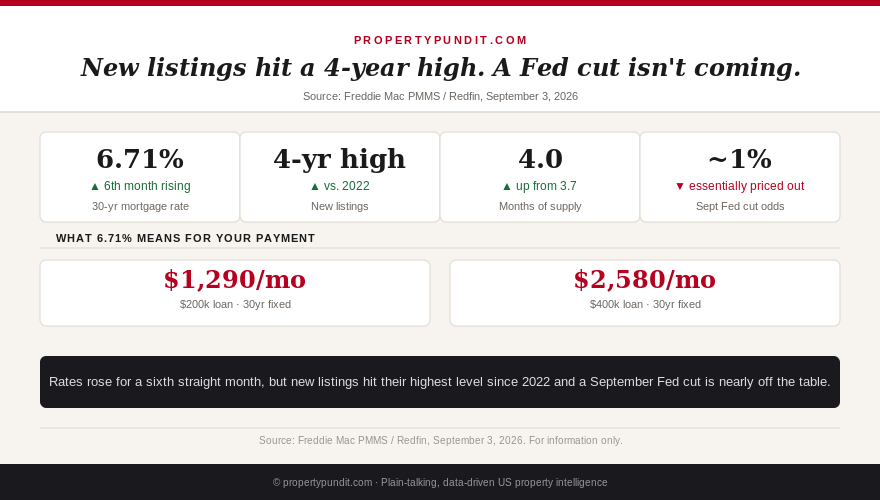
Two things are true about the housing market right now, and they pull in opposite directions. Freddie Mac's Primary Mortgage Market Survey put the 30-year fixed at 6.71% as of September 3, 2026, up from 6.66% the week before and a full 66 basis points above February's 6.05% low (Freddie Mac PMMS, September 3, 2026). At the same time, Redfin's weekly data for the four weeks ending August 30, 2026 showed new listings at their highest seasonally adjusted level in four years, months of supply climbing to 4.0 from 3.7, and pending home sales turning negative year over year for the first time in eight months (Redfin, September 3, 2026). Rates are working against you. Supply is working for you. This article is about which one you should actually act on.
The rate really has gone up six months in a row
There's no sugarcoating the rate trend. The 30-year fixed bottomed at 6.05% in late February 2026, climbed to 6.75% by May 21, eased briefly into the low 6.4s through June, then ground back up through the summer to 6.71% as of this week's reading. A year ago the 30-year averaged 6.50%, so today's rate is higher year over year as well as higher than where it started 2026. The 15-year fixed followed the same path, rising to 6.04% this week from 5.98%. If you've been waiting for relief on the rate itself, six months of data says that relief hasn't arrived.
What's driving it isn't the Fed directly. Mortgage rates track the 10-year Treasury yield, which has been pushed up largely by oil-price-linked inflation expectations rather than any Fed policy shift, since the Fed itself hasn't moved its target range all year. That distinction matters for what comes next.
So what for you: the rate isn't going to rescue your timeline on its own, and pretending otherwise just delays a decision that current data can actually inform.
Get this in your inbox every Friday.
One email. The number that matters and what it means for you.
The Fed isn't cutting rates on September 16, and the odds say so
The next FOMC meeting is September 15-16, 2026, and the setup going in is about as far from "cut" as it gets. The Fed has held its target range at every meeting so far this year, and prediction markets currently price a hold near 59-60%, a 25 basis point hike as high as 26-40% depending on which market you check, and an actual rate cut at roughly 1%. The reasoning is straightforward: July's PCE inflation reading came in at 3.7% year over year with core inflation at 3.3%, both well above the Fed's 2% target, while unemployment sits near a still-low 4.1%. There's no combination of numbers in that picture that produces a rate cut next month, and several Fed officials have leaned openly hawkish in recent public comments.
This is the part of the "wait for rates to fall" plan that rarely gets examined closely: it isn't a plan, it's a hope, and the specific event most people are implicitly hoping for has almost no chance of happening on the timeline they're picturing. A rate cut might eventually arrive once inflation cools meaningfully, but nothing in the current data points to that happening at the next meeting, or the one after.
So what for you: if your plan depends on the Fed cutting rates this month, you're planning around an outcome the market itself gives about 1-in-100 odds, and that's not a foundation to build a multi-month wait on.
What you actually have right now: the most listing choice in four years
While the rate story has been bad news, the supply story has quietly become the best it's been in years. Redfin's report for the four weeks ending August 30, 2026 shows new listings up 2.1% from a week earlier on a seasonally adjusted basis, reaching their highest level since 2022. Active listings are up 0.4% over the same period, and months of supply climbed to 4.0 from 3.7, approaching what's typically considered a balanced market. Pending home sales, meanwhile, dipped to their lowest level since February, and NAR's own July data showed pending sales down 2.2% year over year, the first negative annual read in eight months. Sellers are listing. Buyers are hesitating. That combination is real negotiating power, and it's available to you today in a way a hoped-for rate cut simply isn't.
Redfin specifically flagged 11 metro areas as prime buyer opportunities right now, including Miami, Nashville, much of Texas, parts of California, Seattle, and two New York City suburbs, markets where sellers currently outnumber buyers and are more willing than usual to negotiate on price or terms. If you're house hunting in or near one of those metros, that's not background noise, that's your actual negotiating position this month.
So what for you: the negotiating power you have right now is a direct result of sellers being nervous, and nervous sellers don't stay nervous forever once demand catches up, which is exactly why this window is worth using rather than waiting out.
The math: what today's negotiating power is worth versus waiting on a rate you won't get
Take a representative $400,000 purchase, close to the current national median, at 10% down, the median down payment first-time buyers actually used in 2025 (NAR). At today's 6.71% rate, the loan comes to $360,000, and principal and interest alone runs about $2,325 a month, plus a representative $180 in monthly PMI on a 90% loan-to-value loan, for a total of roughly $2,505.
| Scenario | Price | Down payment | Rate | P&I + PMI/mo |
|---|---|---|---|---|
| Buy today at asking | $400,000 | $40,000 | 6.71% | $2,505 |
| Negotiate 3% off, buy today | $388,000 | $38,800 | 6.71% | $2,430 |
| Wait for a Fed cut that has ~1% odds this month | $400,000 | $40,000 | 6.71% (unchanged) | $2,505 |
Negotiating a 3% reduction today, well within reach in the metros Redfin flagged, saves about $75 a month and $1,200 in upfront down payment cash, and it's available this week. Waiting for the Fed changes nothing on your payment unless the meeting delivers an outcome the market itself says has roughly a 1-in-100 chance of happening. That's the actual trade you're making every month you wait: a small, real, available saving today versus a large, unlikely, uncontrollable saving that may never arrive.
What this means for you
The math points toward using the negotiating power that exists right now rather than sitting out for a rate move the data doesn't support. That doesn't mean overpaying or ignoring your own budget, since the 20%-down assumption most buyers carry into this decision is often wrong and worth checking before you assume you need more cash than you actually do. It does mean recognizing that a market with the most listing choice in four years and sellers who are visibly more willing to deal isn't a market where "wait it out" is the safe choice, it's the choice that gives up the one advantage you currently hold. Before you make an offer, run your full numbers past what closing costs will actually add to your total, and if PMI is part of your monthly math, know that it doesn't have to stay on your loan forever once you build enough equity.
Frankly, if your plan has been "wait for rates to drop," it's worth replacing with a plan built on the negotiating power that's actually sitting in front of you this month, because a hoped-for rate cut with 1% odds is not a strategy, and a four-year high in listing choice is.