 Property
You've probably been refreshing the rate tracker again. It ticked up this week, to 6.66% from 6.65%, and it's tempting to read that one basis point as a signal to keep waiting for something better. Here's what that tracker doesn't show you: while rates inched up, the number of homes for sale hit its highest level since May, new listings hit a 4-month high, and the number of buyers actually signing contracts fell to a 6-month low. Sellers are more nervous than you are right now, and that's the number that should be driving your decision, not the one basis point.
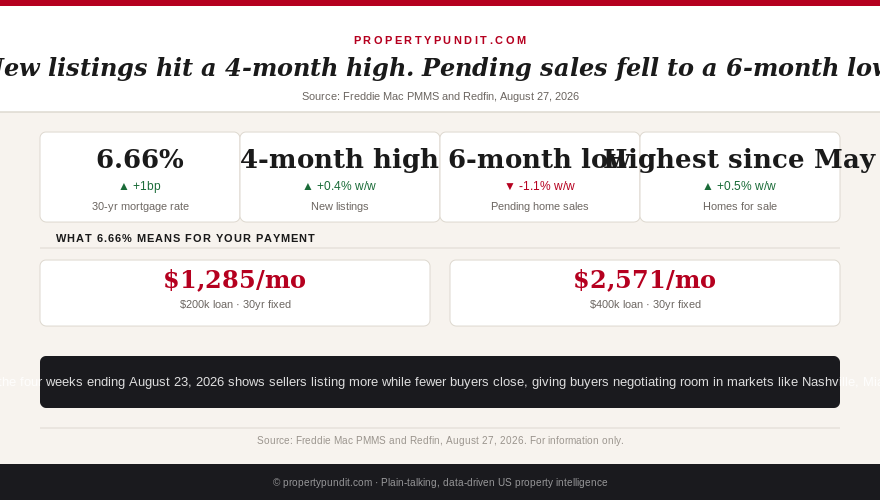
Two data points moved in opposite directions this week, and only one of them is actually useful to you. Freddie Mac's Primary Mortgage Market Survey put the 30-year fixed at 6.66% as of August 27, 2026, up one basis point from 6.65% the week before and ending two consecutive weeks of declines (Freddie Mac PMMS, August 27, 2026). At the same time, Redfin's weekly housing data for the four weeks ending August 23, 2026 showed new listings rising to their highest level since April, total homes for sale up 0.5% week over week to their highest level since May, and pending home sales falling 1.1% to their lowest level in six months (Redfin, August 26, 2026). More homes, fewer buyers closing deals: that combination is worth more to your monthly payment than a 1 basis point rate move, and this article runs the actual math on why.
This isn't about ignoring rates. It's about recognizing which lever you can actually pull today versus which one you're just hoping moves in your favor later.
Get this in your inbox every Friday.
One email. The number that matters and what it means for you.
What actually moved this week
Freddie Mac's 30-year fixed has spent August drifting in a narrow band: 6.69% on August 6, 6.67% on August 13, 6.65% on August 20, and now 6.66% on August 27 (Freddie Mac PMMS). That's the first uptick in three weeks, but it's a one basis point wobble inside a rate that's been stuck between 6.65% and 6.7% for a month. A year ago the 30-year averaged 6.56%, so today's rate is still higher year over year, and nothing this week changes that story in either direction.
The more useful data came from Redfin's own weekly tracker, not the official PMMS survey. For the four weeks ending August 23, 2026, new listings rose 0.4% from the prior week to their highest level since April, and the total number of homes for sale climbed 0.5% week over week to the highest level since May (Redfin, August 26, 2026). Pending home sales, the number of buyers actually under contract, fell 1.1% over the same period to their lowest level in six months. Redfin's own analysis called this out directly: "more homes are hitting the market, but fewer buyers are purchasing them, giving house hunters an opportunity to negotiate prices and ask for concessions." The median US home-sale price still rose 1.9% year over year to just over $400,000, but that's an average across a country where entire metro areas are quietly turning into buyer's markets underneath the headline number.
So what for you: a rate that moves one basis point in either direction this week isn't the story. A market where sellers are listing more and buyers are closing less is, and that story favors you specifically if you're ready to act.
Why a supply-demand gap beats a one-week rate move
Redfin named the markets where this gap is widest, and it's led by Miami, Nashville, and much of Texas, places where sellers now outnumber buyers by a wide margin and are increasingly willing to cut price or throw in concessions to get a deal done (Redfin, August 26, 2026). If you live in or near one of those metros, that's not background noise. That's your specific negotiating position this month, and it exists independently of whatever the Fed or the bond market does next.
Compare that to waiting on rates. Mortgage rates track the 10-year Treasury yield, driven by inflation data, Fed policy expectations, and global bond markets, none of which you control and none of which reliably move in a straight line. A hoped-for rate cut might arrive in three months, might not arrive at all, or might arrive alongside a price recovery that erases the gain, since a lower rate tends to pull more buyers back into the market and firm up prices again. A negotiated price cut, by contrast, is available to you this week, in a market that's currently handing sellers less bargaining power than they've had in months.
So what for you: the number worth chasing right now isn't a lower rate, it's a lower price, because one of those you can go negotiate today and the other you can only wait on.
The math: a negotiated price cut vs. waiting for a rate drop
Nashville is one of the specific metros Redfin flagged, and it's a useful test case. Nashville's median sale price over the three months through July 2026 ran about $480,000, in a market with roughly 129% more sellers than buyers and 4.92 months of supply, the most buyer selection since 2019 (Redfin, July 2026). Here's what three different paths look like on that home, all at 10% down with PMI included, comparing today's 6.66% rate against a hypothetical wait for a 25 basis point improvement.
| Scenario | Price | Down payment | Rate | P&I + PMI/mo |
|---|---|---|---|---|
| Buy today at asking | $480,000 | $48,000 | 6.66% | $2,992 |
| Negotiate 3% off, buy today | $465,600 | $46,560 | 6.66% | $2,902 |
| Wait for rate to fall 25bp, buy at asking later | $480,000 | $48,000 | 6.41% | $2,921 |
Negotiating a 3% price reduction today saves $90 a month over paying full asking at 6.66%, and it also requires $1,440 less cash at closing since the down payment is calculated on the lower price. Waiting for a 25 basis point rate improvement, a genuinely optimistic assumption given rates just ticked up, saves only $71 a month, and it comes with no guarantee the rate move actually happens, no guarantee Nashville's current buyer-favorable conditions still exist whenever it does, and months of rent paid in the meantime that builds you no equity. The negotiated-price path wins on every measure: bigger monthly savings, less cash required, and it's available this week instead of contingent on the bond market cooperating.
So what for you: the math doesn't just favor negotiating over waiting, it favors it by a wider margin than most buyers assume, because a price cut compounds into a smaller loan while a rate cut only touches the interest portion of a loan that stays the same size.
The call
The math points toward negotiating now rather than waiting on rates, particularly if you're shopping in a metro Redfin has flagged as buyer-favorable, Nashville, Miami, or much of Texas among them. Come to the table with the actual data: pending sales at a 6-month low and inventory at levels not seen since spring are your negotiating room, and a seller who's watched their listing sit is generally more receptive to a price conversation than the asking price implies. Ask for the price cut first, since it does more for your monthly payment than a comparable rate buydown, and only fall back to concessions or a temporary rate buydown if the seller won't move on price.
Frankly, if you've been holding off because rates ticked up one basis point this week, you're reacting to the wrong number. Most buyers who run this comparison honestly find that a modest, achievable price negotiation beats a speculative rate improvement on every measure that matters to a monthly payment. Before you make an offer, run your own numbers through a mortgage calculator, and if the down payment math still feels out of reach, the 20%-down assumption is worth checking since most buyers in your position aren't actually meeting it. Budget for closing costs separately from your down payment so a successful negotiation doesn't get eaten by a surprise at the closing table, and if PMI is part of your monthly number, it cancels sooner than most lenders explain up front.