 Property
You saw Thursday's headline: mortgage rates fell to 6.65%, a second straight weekly decline. Then your loan officer called back with a quote that didn't move down at all, or worse, ticked up. You're not misremembering the number, and nobody's padding your rate. Two official weekly surveys are measuring two different things this week, and they've moved 13 basis points apart, in opposite directions.
That gap matters more than the usual noise between rate trackers, because for the first time since spring, the official headline number and the number attached to real, locked applications are no longer even moving the same way.
Why the official rate and your quote don't match
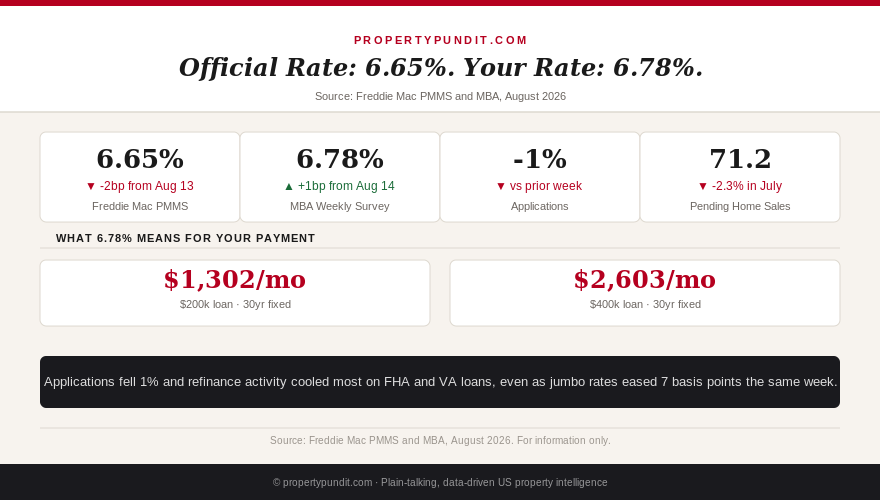
Freddie Mac's Primary Mortgage Market Survey (PMMS) averages loan applications submitted to its Loan Product Advisor system from Thursday through the following Wednesday, for well-qualified borrowers putting 20% down on a conforming 30-year fixed loan. It published 6.65% on August 20, 2026, down from 6.67% the week before, the second consecutive weekly decline.
The Mortgage Bankers Association runs a separate weekly survey across a broader panel of lenders and loan types, tracking the actual contract rate on applications that came in the door that week, including FHA, VA, and non-conforming loans alongside conventional ones. For the week ending August 21, 2026, that average rose to 6.78%, up from 6.77% the week before. MBA's Joel Kan noted rates have climbed roughly 20 basis points over the past two months, which is exactly the period PMMS has shown essentially flat to slightly lower.
Neither survey is wrong. They're built from different applicant pools with different underwriting profiles, and PMMS in particular skews toward the most creditworthy, highest-down-payment borrowers in the market. If you're not putting 20% down on a conventional loan with a strong credit score, the MBA figure is a more honest starting point for what you'll actually be quoted.
Get this in your inbox every Friday.
One email. The number that matters and what it means for you.
The gap is real, and it's moving the wrong way
PMMS has now eased for two straight weeks: 6.69% on August 6, 6.67% on August 13, 6.65% on August 20. Read in isolation, that looks like relief. But MBA's survey climbed the same two weeks, from 6.77% to 6.78%, continuing a slower grind upward that's been underway since late June. A 13 basis point gap between the two surveys is on the wide end of what PropertyPundit has tracked this year; most weeks it runs closer to 5 to 10 points.
On a $350,000 loan, the difference between 6.65% and 6.78% works out to roughly $31 a month, or about $370 a year, before accounting for how each lender prices points and fees on top of either base rate. That's not enough to change most people's decision on its own. What it does change is which headline you should be reading if you're actually trying to time a lock: the PMMS number that leads most news coverage, or the MBA figure that's closer to your actual contract.
Loan type matters here too. Daily tracker data from Mortgage Research Center, cited by Fortune on August 27, 2026, put the 30-year conventional rate at 6.668%, essentially flat week over week, while 30-year FHA sat at 6.065%, VA at 6.157%, and USDA at 6.147%, all comfortably below the conventional figure. The 30-year jumbo rate actually fell 7 basis points the same week, to 6.711%, even as conforming rates ticked up slightly. If you're comparing a conventional quote against an FHA or VA option, the PMMS-versus-MBA gap this article is built around barely applies to you; those government-backed programs are pricing in a different direction entirely this week.
If you've been holding off on a purchase or refinance while waiting for "the rate" to come down, the number that governs your monthly payment hasn't cooperated for two months running, even while the headline figure has eased. That's the distinction that should shape your next move, not which number made the news.
What's actually cooling: applications and pending sales
Total mortgage applications fell 1% on a seasonally adjusted basis for the week ending August 21, 2026, per MBA, with the unadjusted index down 2% from the prior week. Refinance applications pulled back specifically on FHA and VA loans, and the average refinance loan size hit its lowest level since June 2025, a sign that the remaining refinancers are mostly smaller-balance streamline borrowers, not homeowners chasing a materially better rate on a large loan. Adjustable-rate mortgages ticked up to 7.9% of applications, a common signal that some buyers are using ARMs to soften the monthly hit from a fixed rate stuck near 6.8%.
On the sales side, NAR's Pending Home Sales Index fell 2.3% in July 2026 to 71.2, a second consecutive monthly decline after June's 5.4% drop to 72.5. Existing-home sales had already eased 1.7% in July to a 4.06 million annualized pace, even as the median price rose to $434,100, up 2.0% year over year, the 37th straight month of annual gains.
None of this is a rate story on its own; it's a demand story that a flat-to-slightly-easing headline rate hasn't fixed. If you've been telling yourself buyers will flood back in once rates dip below 6.5%, pending sales already fell twice in a row without much of a dip, which tells you affordability, not the third decimal point on a weekly survey, is doing the real work.
What this means if you're deciding whether to lock
Freddie Mac itself has found that borrowers who shop around across multiple lenders in a high-rate environment can save $600 to $1,200 a year compared with accepting the first quote, according to reporting on Freddie Mac's own research. That gap is bigger than the 13 basis points separating this week's two surveys, which tells you where your energy is better spent: fewer hours refreshing rate trackers, more time getting three or four actual quotes.
For a homeowner sitting on a 3.5% to 4% rate from a few years back, this week's numbers don't move the refinance breakeven math in any meaningful way; the spread between your existing rate and either 6.65% or 6.78% is large enough that a couple of basis points of weekly noise won't tip the decision. For someone about to lock a purchase loan, though, the math points toward locking rather than floating: rates are up roughly 20 basis points over two months by the measure that actually reflects contracted loans, the next Fed decision isn't until September 15-16, and futures markets aren't pricing a cut at that meeting. Waiting on the strength of one weekly PMMS dip, while the number that reflects real applications keeps drifting higher, is a bet against the trend, not with it.
If you're new to rate shopping and unsure how much of your down payment or credit profile changes what you're offered, start with how much you actually need to put down and how your credit score moves your rate tier before you call a fourth lender. And once you've picked one, confirm what's actually included in your closing costs, since a lower headline rate paired with higher points can erase the saving you thought you'd locked in.