 Property
You crossed new construction off your list before you ever toured a model home. It felt obvious: builders mark up new houses, resale is where the deals are, and at $78,000 a year in Atlanta you don't have room to pay a premium for granite that's one shade newer. That assumption used to be correct. It stopped being correct four quarters ago, and most buyers still haven't caught up to the change.
In the first quarter of 2026, the median price of a new single-family home sold for $403,200. The median existing home sold for $404,600. New construction is now $1,400 cheaper, nationally, according to Census Bureau and National Association of Realtors data (Q1 2026, released May 2026). That's the fourth straight quarter this relationship has held, and the first time in 52 years the median new-home price has landed below the median resale price. For half a century, "new" meant "pay more." That's no longer a safe assumption anywhere you're shopping.
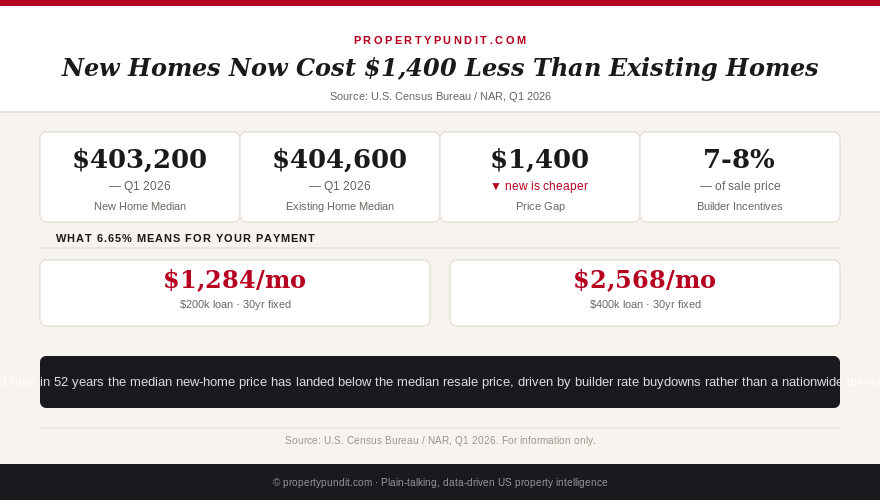
This doesn't mean the specific new-build community fifteen minutes from your current apartment is automatically the cheaper option. It means the blanket rule you've been shopping by, that new always costs more, is the part that's wrong, and it's worth a second look before you filter new construction out of your search entirely.
Get this in your inbox every Friday.
One email. The number that matters and what it means for you.
Why builders are suddenly the cheaper seller
The reversal isn't about builders getting more efficient. It's about who can afford to negotiate. A builder holding an unsold, finished house pays interest on construction debt and carrying costs for every month it sits empty. That pressure pushes them toward price cuts, mortgage rate buydowns, design credits, and closing-cost coverage rather than waiting for a full-price offer. John Burns Research puts the average value of these incentives at roughly 7% to 8% of the sale price, on top of whatever price cut shows up on the listing.
Existing-home sellers face no comparable clock. A large share of them locked in a 3% to 4% mortgage rate in 2020 or 2021 and have no financial reason to sell into today's near-6.65% rate environment unless life forces the move. That's the lock-in effect, and it means resale inventory sits with sellers who can afford to hold their price, while builders can't. The same forces produced the shrinking premium for new construction do not mean the housing market broadly is getting cheaper. Existing-home prices are still up about 2% year over year nationally (NAR, July 2026), and rates haven't moved enough to offset that. The relative gap between new and resale narrowed because sellers on one side are under pressure and sellers on the other side aren't.
For your search specifically, this means a builder's posted price is closer to their real floor than a resale seller's asking price. You have room to negotiate with both, but the mechanics behind each number are different, and builders are currently the side more likely to move first.
This flip isn't happening in every city
The national number hides enormous variation, and this is the part that matters most before you assume it applies to Atlanta. Of the 100 largest US cities, only four show new construction actually priced below existing homes citywide: San Francisco (new construction $85,000 cheaper), Austin ($72,041 cheaper), Honolulu ($67,298 cheaper), and Cape Coral ($20,000 cheaper). Everywhere else, the traditional premium for new construction still exists, just a smaller one than it used to be.
Regionally, the South, where Atlanta sits, has the narrowest gap in the country: new construction runs only about $700 above existing homes on average, essentially a rounding error compared to a $400,000-plus purchase. Compare that to the West, where existing homes still average $55,500 more than new construction, driven by a resale market with very little available inventory in expensive coastal metros. Atlanta specifically hasn't been broken out in the national release, so treat the South's $700 average as a starting point, not your answer, and pull actual builder pricing for the specific submarkets you're considering.
So what this means for your own search: don't assume the $1,400 national gap, or even the South's $700 regional gap, describes any one subdivision you're touring. Pull the builder's current price sheet and a comparable resale listing side by side before you decide either one is the cheaper path.
What this looks like on your $78,000 budget
Run the actual numbers rather than the headline. Say you're looking at a new-build townhome listed at $340,000 in an Atlanta-area suburb, and the builder is offering a 2-1 rate buydown worth roughly $14,000 instead of a price cut. At 6.65%, a $272,000 loan (20% down) runs about $1,747 a month in principal and interest. With the buydown, your first-year rate drops to around 4.65%, cutting that payment to roughly $1,398, a savings of about $349 a month for year one and a smaller savings in year two before the rate resets to the full 6.65% in year three.
Compare that to a resale townhome at the same $340,000 asking price with no seller concessions: you'd pay the full $1,747 from day one, but you'd also skip whatever HOA dues, mandatory landscaping fees, or storage-limited floor plan often comes standard in a new subdivision. At $78,000 income, the 28% housing-payment guideline caps you at roughly $1,820 a month including taxes and insurance, so the buydown gives you real breathing room in year one when your budget is tightest, but you need to be able to afford the full payment by year three regardless of which one you choose.
The math points toward treating the rate buydown as a two-year runway to build savings and improve your position, not as your permanent payment. If you can't comfortably afford the year-three payment at the full rate today, the buydown is a temporary relief valve, not a solution, and you should size the home to what you can afford at 6.65%, not at the teaser rate.
The catch that erases part of the discount
New construction has two costs that rarely show up in the sticker-price comparison. First, your property tax bill in year one is based on your actual purchase price, assessed fresh, while a resale home's seller may have been paying tax on an older, lower assessment that resets only when the county catches up. Your new-build tax bill will likely be higher than the number on the builder's estimated-payment sheet in month one. Second, most new subdivisions carry a mandatory homeowners association, typically $50 to $250 a month, funding shared amenities and landscaping that an established resale neighborhood may not require at all.
Neither of these erases the $1,400 national price advantage or the value of a rate buydown, but both narrow it. Before you compare two listings on price alone, ask the builder for the actual HOA dues and request their estimate of your first-year tax bill at full assessed value, not a rounded placeholder. That's the number that determines whether the new build is genuinely cheaper for you, not the headline sale price.
Frankly, if you've been filtering new construction out of your search on the assumption that it's automatically out of reach, that assumption is now costing you options rather than protecting your budget. Run a real builder incentive against a real resale listing before you decide, and check your down payment options and closing costs for both paths, since new-construction closings sometimes route through the builder's preferred lender with different fee structures than a typical resale purchase. A rate buydown is only worth taking if your credit profile already qualifies you for a competitive base rate before the builder sweetens it. Most buyers who run this comparison end up surprised by which option actually wins.