 Property
There's a number stuck in your head, and it's probably $96,000. That's 20% of a $480,000 home in Nashville, and it's the figure you've been saving toward for two years, the one that keeps the whole plan feeling out of reach. Every time rent goes up, that number gets a little further away. Every time you check your savings account, you do the math again and feel a little worse. Here's the thing nobody told you: the typical first-time buyer who closed on a home in the past year didn't put down $96,000. They put down about half that.
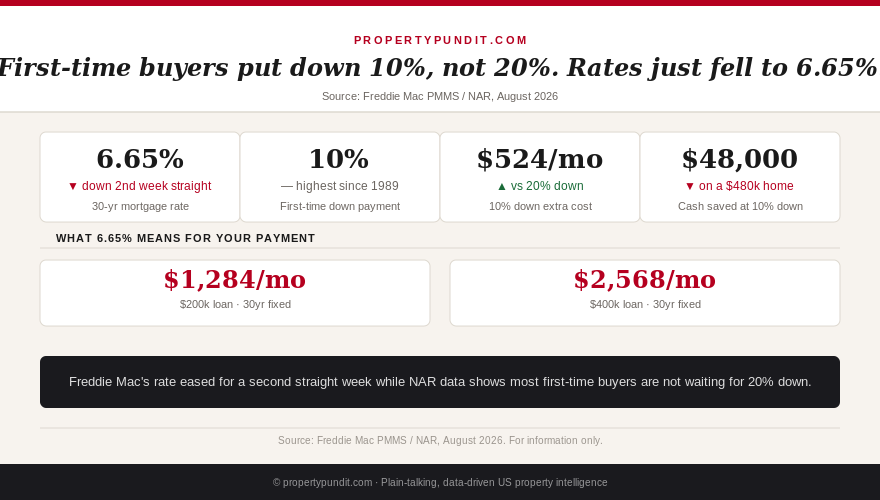
Two things moved this week that matter to your specific decision. First, Freddie Mac's Primary Mortgage Market Survey put the 30-year fixed rate at 6.65% as of August 20, 2026, down from 6.69% on August 6 and the second straight week of decline (Freddie Mac PMMS, August 20, 2026). Second, and more important for you, the National Association of Realtors' 2025 Profile of Home Buyers and Sellers, released in November 2025, confirmed that the median down payment for first-time buyers was 10%, the highest share since 1989, while repeat buyers with existing equity averaged 23% (NAR 2025 Profile of Home Buyers and Sellers, November 2025). The 20% rule most people carry around in their head hasn't described the real market in decades.
This article runs the actual numbers on what 10% down costs you every month versus what waiting to hit 20% costs you in time, and makes a direct call on which one wins for a buyer in your position.
Get this in your inbox every Friday.
One email. The number that matters and what it means for you.
What actually moved this week
The 30-year fixed rate has now eased for two consecutive weeks: 6.69% on August 6, 6.67% on August 13, and 6.65% on August 20 (Freddie Mac PMMS). The 15-year fixed followed the same path, down to 5.95%. This isn't a collapse. A year ago the 30-year averaged 6.58%, so today's rate is still higher than where you would have locked in 2025. But direction matters more than most people give it credit for, and two weeks running in the same direction is the first real signal in over a month that the ceiling might be behind us rather than ahead.
Meanwhile, mortgage applications tell a more complicated story. The Mortgage Bankers Association's weekly survey for the week ending August 14 showed purchase applications down 2% even as rates eased, while refinance applications rose 2% and now make up 41.9% of all activity (MBA Weekly Applications Survey, released August 19, 2026). Existing homeowners are moving fast to capture the lower rate. Prospective buyers, largely, aren't moving at all. That gap is exactly the hesitation this article is trying to talk you out of.
So what for you: a rate move this small won't fix affordability on its own, but it also isn't nothing, and the buyers who are actually acting on it right now are the ones who already own homes, not the ones sitting on the sidelines waiting for a bigger signal.
The 20% number was never the real number
Here's where the math actually breaks in your favor. NAR's 2025 Profile of Home Buyers and Sellers, covering transactions from July 2024 through June 2025 and released in November 2025, found first-time buyers put down a median of 10%, the highest share since 1989 (NAR 2025 Profile of Home Buyers and Sellers, November 2025). That isn't a fringe statistic from a niche lender. It's the industry's flagship annual survey of actual closed transactions. Ten percent, not twenty.
The confusion is understandable. Twenty percent is the number where private mortgage insurance disappears, so it shows up constantly in mortgage calculators, bank marketing, and casual advice from people who bought their house a decade ago under different rules. But it was never a requirement. Conventional loans go as low as 3% down for qualified first-time buyers, FHA loans require 3.5%, and if you qualify for a VA or USDA loan, the requirement is zero. The down payment myth has been quietly costing buyers years of unnecessary waiting, and the fresh NAR data confirms that most of your actual competition in the market right now is buying with half the cash you've been holding out for.
So what for you: if you've been treating $96,000 as the entry ticket to homeownership, you've been solving a problem the typical buyer in your exact position wasn't required to solve.
What 10% down actually costs on a $480,000 home
Numbers, not vibes. Nashville's median sale price over the three months through July 2026 was about $480,000 (Redfin, July 2026), a market where sellers currently outnumber buyers by roughly 129%, the second-strongest buyer's market in the country. Here's what the payment looks like at 6.65% under both down payment scenarios.
| Scenario | Down payment | Loan amount | P&I/mo | PMI/mo | Total/mo |
|---|---|---|---|---|---|
| 20% down | $96,000 | $384,000 | $2,465 | $0 | $2,465 |
| 10% down | $48,000 | $432,000 | $2,773 | $216 | $2,989 |
Putting 10% down instead of 20% costs you $524 more every month, between the larger loan and the PMI payment. But it also means you need $48,000 in the bank instead of $96,000, cutting your required cash in half. And that PMI charge isn't permanent. Under the Homeowners Protection Act, it cancels automatically once your loan balance reaches 78% of the original purchase price, which on this loan happens after you've paid the balance down to roughly $374,400. Extra principal payments can pull that date forward by a year or more, and the PMI cancellation rules are more buyer-friendly than most lenders bother to explain at closing.
So what for you: the extra $524 a month is a real cost, but it's a cost with a known expiration date attached to it, while the $48,000 gap between the two scenarios is cash that has to come from somewhere in the meantime.
What closing the gap actually takes
Here's the part most affordability advice skips. If you're determined to hit 20% down instead of buying at 10%, you need to save an additional $48,000 beyond what you would need to buy today. At $1,000 a month in extra savings, a genuinely aggressive number on a $112,000 income once rent, taxes, and normal living costs are accounted for, that's four more years. At a more realistic $800 a month, it's five years.
During those four or five years, you're still paying rent, which is money that builds no equity and disappears the moment it leaves your account. You're also exposed to whatever Nashville's median price and the mortgage rate do in the meantime, and neither is guaranteed to sit still in your favor. The buyer's-market conditions helping you right now, with sellers outnumbering buyers and 4.92 months of supply on the ground (Redfin, July 2026), won't necessarily still be there in 2030. Your credit score also matters here: a stronger score lowers both your rate and your PMI cost, and the credit score mortgage myth article covers exactly what improving it from good to excellent is worth in dollar terms before you commit to either path.
None of this means saving is pointless. It means the specific target of 20% is the wrong target for most first-time buyers, including you. A better target is the smallest down payment that gets you a monthly payment you can comfortably carry, plus enough cushion for closing costs, which typically run 2-5% of the purchase price on top of the down payment itself and catch first-time buyers off guard more than almost anything else in the process.
So what for you: every year you spend chasing 20% is a year of rent paid with nothing to show for it, set against a temporary PMI charge that ends on a fixed schedule you can actually see in advance.
The call
The math points toward moving forward at 10% down rather than continuing to save toward 20%, provided the $2,989 total payment fits comfortably inside your budget alongside the rest of your obligations. That's the actual test, not the size of the down payment. Run your specific numbers through a mortgage calculator using your real income, debts, and the current 6.65% rate before you commit to anything.
Frankly, if you're sitting on 10-15% saved and a stable income, and you've been waiting because 20% felt like the responsible number, you aren't being cautious. You're matching your plan to a rule that stopped describing the market decades ago while the buyers actually closing deals right now use half your target. Most people who run these numbers honestly end up moving well before they hit 20%, and the two-week rate decline this month is a reasonable moment to go run yours.