 Property
You've been sitting this out for two years now, watching every headline that promised the door was about to open. This week's version said mortgage credit availability just hit a four-year high, and you probably felt that small, familiar lift: maybe this is the one. Before you call a loan officer, look at what's underneath the number, because the piece of it that applies to a first-time buyer with 10% down went the other way.
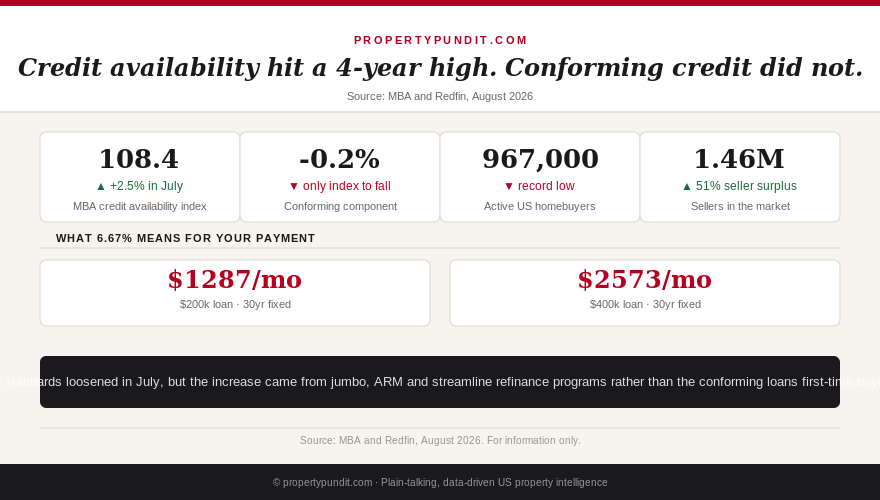
The Mortgage Bankers Association's Mortgage Credit Availability Index rose 2.5% in July 2026 to 108.4, its highest reading since July 2022 (MBA, August 11, 2026). That's real. Lending standards genuinely loosened. But the index is a bundle, and the components tell four different stories. The Jumbo index climbed 4.2%. The Government index rose 1.8%. The Conventional index gained 3.0%. And the Conforming index, the one that covers the standard Fannie and Freddie loan most first-time buyers use, fell 0.2%.
Meanwhile, the number that actually moved in your favor last month had nothing to do with lending. Redfin counted roughly 967,000 active homebuyers in July 2026, a record low, against 1.46 million sellers (Redfin, August 13, 2026). That's a 51% seller surplus, the widest gap on record outside last December. Nearly 80% of major US metros are now buyer's markets, and 34 of the 39 that already were got more buyer-friendly between June and July.
Get this in your inbox every Friday.
One email. The number that matters and what it means for you.
What a 108.4 credit reading actually measures
The MCAI tracks the supply of loan programs lenders are willing to offer, not the odds that you personally get approved. When the index rises, it means more products exist: lower minimum credit scores on some programs, higher allowable debt-to-income ratios on others, more loan types on the shelf. When it falls, programs come off the shelf.
MBA's own commentary attributed July's increase largely to expanded adjustable-rate mortgage and streamline refinance programs. Streamline refis are irrelevant to you: they're for existing FHA and VA borrowers lowering a rate on a loan they already have. ARMs are relevant, but not in the way a rising index suggests. More ARM programs on offer at a moment when the 30-year fixed sits at 6.67% (Freddie Mac PMMS, August 13, 2026) means lenders are building products to make an elevated rate feel survivable, not products that make the house cheaper. We ran the reset math on what an ARM adjustment actually costs in 2026, and the short version is that a 2/2/5 cap structure can add several hundred dollars to a payment in year six.
So the practical read on 108.4 is this: if you were planning a 30-year fixed conforming loan, essentially nothing in July's credit reading changed your approval odds, and you should not let the headline pull your timeline forward by a single week.
The conforming index went the other way
A 0.2% decline in the Conforming MCAI is small. It isn't a slamming door. But direction matters more than magnitude here, because it's the only component that moved against the trend, and it's the component that covers the loan you'd sign.
Conforming credit tightening while jumbo credit loosens 4.2% is a familiar shape. Jumbo loans are held on bank balance sheets, so when banks feel confident about high-income borrowers, jumbo supply expands quickly. Conforming loans get sold to Fannie and Freddie, so their availability moves with agency guidelines and with lender appetite for lower-down-payment risk. When those two diverge this sharply, the market is telling you it wants borrowers with more cash, not fewer.
That maps almost exactly onto what NAR reported for July: first-time buyers fell to 29% of sales from 33% in June, while cash sales held at 26% (NAR, August 11, 2026). If you're financing at 10% down, the competitive gap between you and a cash buyer widened last month, and the fix for that is not a better loan product, it's a stronger offer structure.
967,000 buyers is the number that changed your position
Here's the part worth sitting with. A record-low buyer count is not a warning sign for you. It's the closest thing to negotiating power a financed buyer has had since 2019.
Redfin was explicit that this is a demand story rather than a supply story: buyers who can't stomach current prices and rates are simply waiting. Nashville, where you're looking, ranked as the nation's second-strongest buyer's market with 129% more sellers than buyers in June, behind only Miami. The typical Nashville home now sits 78 days on market against 49 days nationally, at 4.92 months of supply, the most selection buyers have had since 2019 (Redfin, July 2026).
The catch is that Nashville prices haven't broken. The median sale price was about $480,000 over the three months through July, up 1.0% year over year. Sellers are conceding on terms long before they concede on price, which is exactly the environment where the shape of your offer matters more than the number at the top of it.
The $14,400 question: price cut or rate buydown
Run it with your numbers. A $480,000 Nashville home, 10% down, $432,000 loan at 6.67%. Principal and interest comes to $2,779 a month. Add roughly $220 for Tennessee property tax at a 0.55% effective rate, about $150 for insurance, and roughly $180 for PMI at 10% down, and you're at about $3,329 a month.
On $112,000 of gross income, that's $9,333 a month, so your housing payment lands at 35.7% of gross income. The standard 28% front-end guideline would cap you at $2,613. That gap is the whole reason you're still renting, and no credit index fixes it.
Now take a 3% seller concession, which is $14,400 and sits comfortably inside the 6% conventional cap at 10% down. There are two ways to spend it.
Option one, take it as a price cut. Purchase price drops to $465,600, loan drops to $419,040, and principal and interest falls to $2,696. You save $83 a month.
Option two, spend it on a permanent rate buydown. At roughly one point per 0.25% of rate, $14,400 buys about 3.3 points on a $432,000 loan, which at current pricing takes you to somewhere near 5.85%. Principal and interest falls to $2,549. You save $230 a month.
Same $14,400. The buydown is worth 2.8 times as much every month, and it keeps working for as long as you hold the loan. Over five years that's $13,800 versus $4,980. The mechanics of getting a seller to agree to this are covered in our piece on how seller concessions actually get applied at closing, and there's a Nashville-specific version in what Nashville sellers are currently conceding.
One caveat that matters: the buydown only wins if you keep the loan. If rates fall far enough that you refinance in year two, you've spent $14,400 to save about $5,500. With Fannie Mae forecasting a 6.4% average for the rest of 2026 and the MBA at 6.5% for Q3 and Q4, a refinance-triggering drop doesn't look imminent, but it's the risk you're accepting.
Rates aren't the variable you should be watching
July CPI came in at 3.4% annually with core at 2.5%, the second consecutive monthly decline (BLS, August 12, 2026). Traders cut September Fed hike odds to 42% on the news (CME FedWatch). The bond market barely moved, because the print landed in line with expectations.
Every meaningful rate move this year has been driven by oil prices and the US-Iran conflict rather than by Fed policy, and the Fed has now held at 3.50% to 3.75% for five straight meetings. Forecasting the next 50 basis points is a coin flip you don't need to win. Forecasting that Nashville will still have 129% more sellers than buyers in September is a much safer bet, because a seller surplus that took eighteen months to build doesn't unwind in six weeks.
Which means the thing you can actually control right now is not your entry rate. It's how hard you push on terms while the person across the table has 78 days of holding costs behind them.
What the math points toward
Frankly, if you're a Nashville buyer at $112,000 with 10% saved, the credit availability headline is noise and the buyer count is the signal. The math points toward three moves.
First, stop watching the MCAI. Get a pre-approval and find out your actual number, because your credit file and debt-to-income ratio decide your rate far more than any industry index does. Our breakdown of what a credit score really moves on a mortgage rate is the faster path to a lower payment than waiting for lenders to loosen.
Second, if you write an offer, ask for the maximum concession you can get and direct it at the rate, not the price. On these numbers that's a $147 a month difference for identical seller cost, and most buyers who run this comparison end up choosing the buydown.
Third, don't take an ARM just because ARM programs got easier to find in July. A lower start rate on a product that resets in year six is a different bet than the one you think you're making, and at a 51% seller surplus you have enough negotiating room to fix your payment without changing loan type.
The door didn't open this month. But the room on the other side got a lot emptier, and that's worth more to you than a 2.5% index reading.