 Property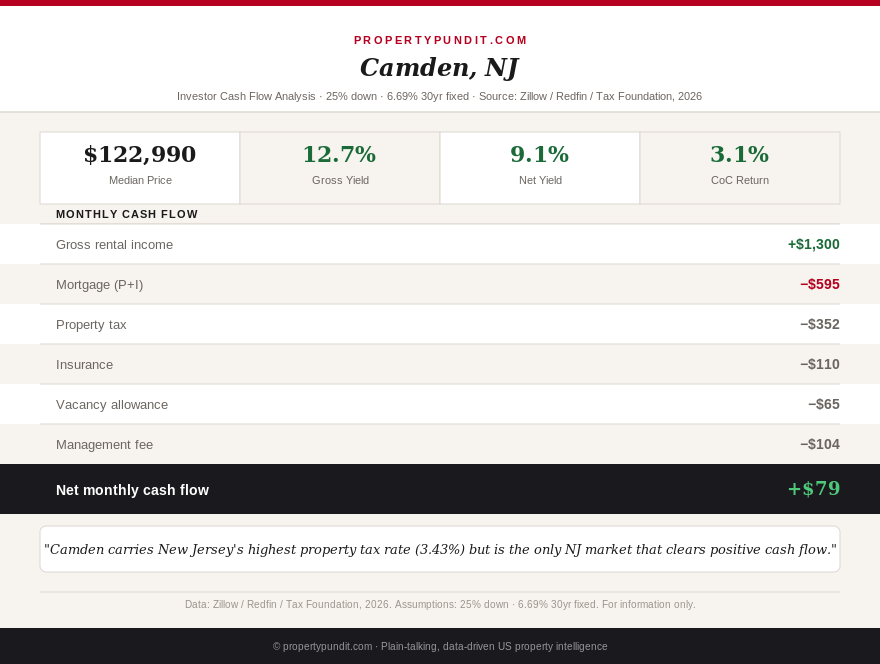
You already ran the numbers on New Jersey once this year and walked away. Back in June, the statewide median sat near $565,000 and nothing pencilled, not even Ocean County's relatively gentle 1.24% property tax rate. Two months later, prices are higher, not lower, and the obvious conclusion is that New Jersey got even worse for investors. It did, everywhere except one city, and the answer comes from the county with the ugliest tax rate on the entire list. Camden County's effective property tax rate is the highest in New Jersey. Camden City is also the only New Jersey submarket in this analysis, first pass or second, that clears a positive cash flow.
New Jersey's record price is a Redfin story, not a Zillow one
Redfin put New Jersey's statewide median sale price at $598,128 in June 2026, up 5.9% year over year. Zillow's Home Value Index, which smooths across the entire housing stock rather than just closed transactions, shows $584,681, up a slower 3.3% year over year. The two numbers diverge because they measure different things: Redfin's figure reflects what actually closed this month, weighted toward whatever mix of homes sold, while Zillow's index tracks the estimated value of every home in the state, sold or not. A third data cut adds more texture: the statewide median across all residential property types, including condos and multifamily, is $516,833, well below the $592,000 single-family-only figure, because cheaper attached housing drags the blended number down.
Underneath all three prices sits the same supply story. Active listings statewide are around 25,700, translating to roughly 2.2 to 3.2 months of supply depending on county, well below the 4-to-6-month range that defines a balanced market. In June, 48.3% of New Jersey homes sold above list price, down just half a point from a year ago. For an investor shopping today, that means the number on the listing is close to what you'll actually pay. There's little room to negotiate off list in a market this tight, so the only lever left is picking the right submarket, not talking a seller down.
Get this in your inbox every Friday.
One email. The number that matters and what it means for you.
Camden's tax rate is the highest in the state. It still doesn't sink the deal.
New Jersey's property tax map runs from Ocean County's 1.24% effective rate, the lowest in the state, up through Monmouth (1.52%), Hudson (1.69%), Gloucester (2.34%), Essex's non-homestead rate (around 3.21%), and finally Camden, the highest in New Jersey at roughly 3.42% to 3.43% depending on the assessment year (Tax Foundation; Ownwell 2026 county filings). That rate looks like a reason to skip Camden entirely. The dollar math tells a different story, because Camden also has New Jersey's lowest entry price by a wide margin.
Camden's typical home value is $122,990, up 7.9% year over year (Zillow, 2026). At 25% down and today's 6.69% Freddie Mac PMMS rate, the loan amount is $92,243 and principal and interest runs about $595 a month. Property tax at the city's 3.43% effective rate adds $352 a month, insurance runs an estimated $110, for a PITI of roughly $1,057. Rent for a comparable 2-to-3-bedroom unit runs an estimated $1,300 a month (Zillow Rental Manager / Rent.com, 2026); after 8% management and 5% vacancy, effective rent is about $1,136. That leaves cash flow of positive $79 a month and a DSCR of 1.23, comfortably above the 1.0 minimum most DSCR lenders require and above the more conservative 1.20 threshold some use.
Run the same math on the statewide median. At $598,128, 25% down, and 6.69%, PITI lands near $4,130 a month against an effective rent of about $2,797 (on a $3,100-to-$3,300 typical 3-bedroom rent range, RentCafe, June 2026). That's a cash flow of roughly negative $1,333 a month and a DSCR of 0.78. Camden's punishing tax rate turns out to be the wrong thing to screen on. What matters is the tax bill in dollars against the rent roll, and Camden's rock-bottom price means that even at the state's highest rate, the actual monthly tax bill is smaller than what a median-priced New Jersey home pays at a far gentler rate.
| Market | Price | PITI | Rent (effective) | Cash flow | DSCR |
|---|---|---|---|---|---|
| NJ statewide median | $598,128 | $4,130 | $2,797 | -$1,333 | 0.78 |
| Newark | $373,700 | $2,508 | $1,405 | -$1,103 | 0.64 |
| Camden City | $122,990 | $1,057 | $1,136 | +$79 | 1.23 |
New Jersey's largest city fails the same test it always has
Newark, the state's largest city and its obvious first stop for name recognition and transit access, doesn't fare better than the statewide median. At a typical home value of $373,700 (Zillow, 2026) and the city's own effective property tax rate of about 1.85% ($6,895 a year on that value), 25% down at 6.69% produces a PITI near $2,508 a month. Average rent across Newark runs about $1,608 a month; after management and vacancy, effective rent is roughly $1,405. That's a monthly loss of about $1,103 and a DSCR of 0.64, meaningfully worse than Camden despite Newark's lower headline tax rate. Trenton, the state capital, isn't meaningfully better: its typical home value actually fell 1.9% year over year to $356,470, and it doesn't clear positive cash flow either at current rates.
The pattern holds across every second-look market this routine has checked in New Jersey: price, not tax rate, is the variable that decides whether a deal pencils. For an investor drawn to Newark on brand recognition alone, the math says that premium isn't showing up in the rent roll. It costs about $1,100 a month out of pocket at today's rates to own the state's biggest city name.
The rent control catch in Camden most investors miss
New Jersey has no statewide rent control law, but it lets municipalities pass their own, and roughly 117 to 128 towns and cities have done so, covering an estimated two-thirds of the state's rental housing stock. Camden is one of them. The city's rent control ordinance, in place since 1981, caps annual increases at a maximum of 10% pending a formal determination, with most units landing closer to a general 6% ceiling under the ordinance's standard formula. Critically, Camden's rules include voluntary vacancy decontrol: when a tenant leaves on their own, or is evicted for nonpayment, the landlord can reset the unit to market rate before the next lease. That single provision is the difference between a cap that erodes returns over time and one that simply limits mid-lease increases.
Before closing on a Camden property, confirm the specific ordinance details for your ward with the city's Rent Control Office, because the $79-a-month cushion in the math above assumes normal turnover and market resets, not a building where a long-tenured cash-flowing tenant caps your rent growth indefinitely. A rent-controlled unit with a low-paying, long-term tenant and no near-term vacancy is a very different asset than the same unit in the open market, even though the purchase price looks identical.
The mansion tax now bills the seller, not the buyer
New Jersey overhauled its so-called mansion tax and Controlling Interest Transfer Tax effective July 10, 2025. Under the old rule, buyers paid a flat 1% tax on any purchase over $1 million, on top of the seller's standard realty transfer fee. Under the new law, sellers pay both taxes, and the rate is now tiered by sale price: 1% from $1 million to $2 million, 2% from $2 million to $2.5 million, 2.5% from $2.5 million to $3 million, 3% from $3 million to $3.5 million, and 3.5% above that. A seller closing a $1.5 million multifamily sale, for example, now owes 1% on the $500,000 above the $1 million threshold, a $5,000 bill that would have landed on the buyer's side of the ledger a year earlier.
This doesn't touch a Camden-tier purchase directly, but it matters for anyone building toward an eventual exit on a larger New Jersey holding, a multifamily rollup, or a portfolio sale that crosses the $1 million mark. Budget the tax as a seller cost in your underwriting from day one rather than discovering it at the closing table, because the law shifted the bill onto the side of the transaction you'll eventually be on.
What this means for your next move
The math points toward Camden's entry-level stock, not Newark's name recognition or Ocean County's lower tax rate, as New Jersey's one working investor answer at today's rates. That was true in the state's first pass in June, when Gloucester County's $270,000 tier was the closest thing to a working deal, and it's even more true now that a direct look at Camden City shows a cleaner number: positive cash flow and a DSCR over 1.20, the only market on this list that clears it. Most investors who run New Jersey's numbers stop at the tax-rate map and never get to the dollar math underneath it. That's the mistake worth avoiding here. For the broader framework on how DSCR lending actually qualifies a property like this, see our DSCR loan investor guide, and for how the numbers below Camden's price tier tend to move, our county-by-county SFR yield map is the companion piece to this one.