 Property
You have been told you're priced out for so long that you stopped checking. Somewhere around the third year of headlines about record medians and a locked-out generation, you quietly moved buying a house from "thing I am working toward" into "thing that happens to other people," and you stopped opening the listing app on Sunday mornings. If that's roughly where you're, there's a number from last week you should see, because the story changed while you were not looking and nobody sent you the memo.
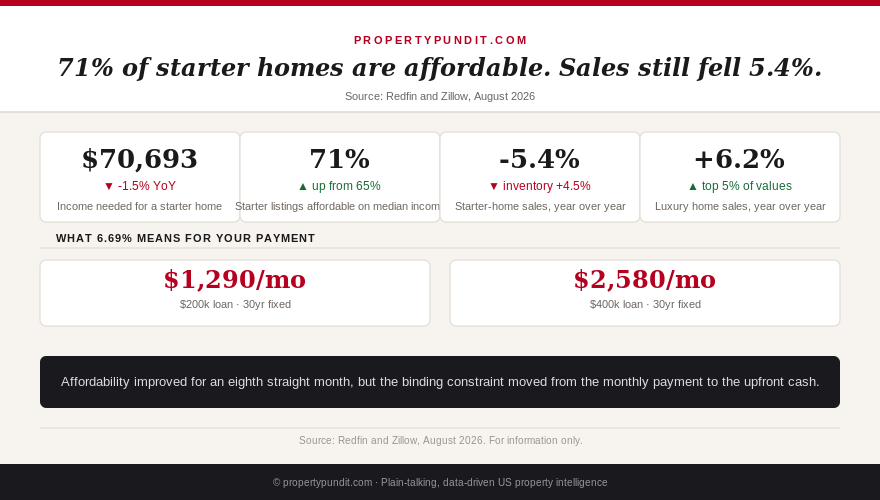
The income needed to afford a typical US starter home is now $70,693, down 1.5% from a year ago and falling for eight consecutive months (Redfin, August 2026, using June data). The typical American household earns about $87,599. That's roughly $17,000 more than the threshold, and the cushion has widened from about $12,500 a year earlier. Nationally, 71% of starter-home listings are affordable on the median income, up from 65%.
And starter-home sales fell 5.4% year over year anyway, with 4.5% more of them sitting on the market (Zillow, May 2026 data, reported August 2026). Luxury sales, meanwhile, rose 6.2%. Something is stopping people, and after running the numbers it is fairly clearly not the monthly payment.
Get this in your inbox every Friday.
One email. The number that matters and what it means for you.
What the $70,693 figure actually measures
Before anyone gets excited or angry, the definitions matter. Redfin counts a starter home as one priced in the 5th to 35th percentile of sale prices in its market. It assumes 15% down. It calls a home affordable if the monthly payment consumes no more than 30% of gross household income, using prevailing mortgage rates and local property tax. Zillow, using a slightly different cut, puts the typical US starter home at about $202,000, up 2.3% year over year.
Those assumptions are defensible but not neutral, and the 15% down one is doing heavy lifting. On a $202,000 purchase, 15% down is $30,300 in cash before you touch closing costs, which typically add another 2% to 5% of the purchase price. So the study's "affordable" household is one that has already solved a $35,000 problem. That's the gap between the headline and your bank balance, and it's the whole article.
The improvement itself is real, though, and worth understanding: starter-home prices rose just 1.2% year over year in June against 2.2% for the market overall. Wages grew faster than starter-home prices, which is the first time that has been true in a sustained way in years. The share of income a typical household would spend on a starter home fell to 24.2% from 25.6%. If you have been assuming the gap between your income and entry-level prices keeps widening, that assumption is now factually wrong, and it's worth re-running your own numbers before you write off another year.
Why sales fell anyway
Three things are happening at once, and only one of them is about affordability in the way the word usually gets used.
The first is the cash wall. Monthly-payment affordability improved; down payment affordability did not. The median US down payment did fall to $23,400 in the first quarter of 2026, a four-year low, but the typical renter holds around $2,600 in liquid savings. A payment test you pass and a cash test you fail still adds up to no house. We went through the ways people are actually funding that gap in our piece on what a down payment really has to be, and the short version is that the 20% rule is the single most expensive myth in the category.
The second is condition. Redfin senior economist Yingqi Xu put it plainly: first-time buyers in the market now are already stretching to make the monthly payment work, so they're hesitant to take on expensive renovations. Move-in-ready starter homes attract strong demand; fixer-uppers sit. That's why inventory can rise 4.5% while sales fall. A lot of the extra supply is stuff nobody with a thin cash reserve can responsibly buy.
The third is competition you don't see on the listing page. First-time buyers are bidding against move-up buyers who are shopping the same price band with equity from a previous sale. Those buyers can waive contingencies and cover an appraisal gap in cash. If you have been losing entry-level homes and blaming your budget, it may not be your budget: it may be that you're the only bidder in the room without a closing statement from a prior sale in your back pocket.
The national number hides five metros doing all the damage
The "starter home is dead" narrative is largely a coastal one, and the geography is stark.
| Metro | Share of median income to buy a starter home |
|---|---|
| Detroit | 13.9% |
| Pittsburgh | 14.8% |
| St. Louis | 14.9% |
| San Francisco | 47.3% |
| Anaheim | 47.6% |
| Los Angeles | 51.0% |
Source: Redfin, August 2026, using June 2026 data across the 46 most populous US metros with sufficient data.
In 22 of those 46 metros, every single starter-home listing is affordable on the local median income. In San Diego, Los Angeles and San Francisco, virtually none are. Austin posted the biggest improvement in the country, with the income needed to buy a starter home down 6.1% year over year to $92,607. Detroit went the other way, requiring 8.3% more income than a year ago, though a typical Detroit household still earns $65,687 against the $30,511 needed.
If you're reading national coverage from a market in the affordable column, you're absorbing anxiety generated by housing conditions in metros you don't live in. Check your own metro's number before you accept the national mood as a description of your situation.
What the payment actually looks like
Concrete example. Take a $202,000 starter home, the Zillow national typical value, at the current 30-year fixed of 6.69% (Freddie Mac PMMS, August 6, 2026), 15% down on a $171,700 loan. Principal and interest come to $1,107 a month. Add property tax at 1.0% and insurance at roughly 0.4% of value and you're at about $1,342 all in, before any private mortgage insurance, which at 15% down will typically add $60 to $100 a month depending on your credit score.
Call it $1,420. On a $78,000 income, the 28% front-end guideline allows $1,820 a month, and 30% allows $1,950. The payment clears with room. The obstacle is the $30,300 down payment plus roughly $6,000 in closing costs, and if you're wondering what that second number covers, our closing costs breakdown itemizes it. Meanwhile PMI, the thing everyone treats as a permanent penalty for not having 20%, comes off automatically at 80% loan-to-value under federal law, which on this purchase is a few years of normal payments away rather than a life sentence: the rules for cancelling it are more favorable than most buyers assume.
Run your own version of that arithmetic with your real income and your real savings, because it will tell you which of the two tests you're actually failing, and those two problems have completely different solutions.
The call
If you can cover the cash and the payment lands under 30% of your gross income at today's rate, the math points toward buying this autumn rather than waiting. Three reasons. Starter-home prices are growing at half the rate of the broader market, so the entry-level discount is currently widening rather than shrinking. Starter homes sit 43 days on market against 39 for median-priced homes, which is real negotiating room in a segment where sellers are watching listings age. And the price you agree is fixed for as long as you own the house, while the rate is refinanceable if it falls.
If the cash is what is stopping you, stop treating it as a savings problem and start treating it as a research problem. There were 2,619 active homebuyer assistance programs nationwide as of the most recent count, averaging around $18,000 in benefit, and just over half are partially or fully forgivable if you stay in the home. Most people who genuinely cannot close the cash gap have never checked what their state and county actually offer, and the difference between a $30,300 down payment and a $12,000 one is usually a form, not a raise.
What you shouldn't do is keep using a national headline about unaffordability as a reason not to check. Eight straight months of improvement isn't a blip, and the household earning the median income is now $17,000 clear of the threshold. The question worth asking this week is no longer whether you're priced out. It's whether you have the cash, and if not, which specific program in your county closes the gap.