 Property
Jackson, Mississippi's home values jumped 32.4% year over year through May 2026, the fastest appreciation of any market in the state (WLBT/Redfin, May 2026). If you already own a rental two states away and someone just told you Mississippi is where the numbers finally work, that headline is the reason. It is also the reason to slow down before you wire a deposit, because the state behind that number is still one of the cheapest places to buy a house in America, and the fastest-growing metro in it is not automatically the best-performing one.
Mississippi's statewide typical home value sits at $172,654, up 2.7% year over year (Zillow ZHVI, 2026), placing it among the five cheapest states in the country alongside West Virginia, Louisiana, Oklahoma, and Arkansas, all four of which this site has already covered this summer. Mississippi is the last of that group, and its numbers tell a different story from the other four: instead of one statewide market failing everywhere, Mississippi has one market that almost works, one that is close, and one where the insurance bill alone should rule it out before you even look at the mortgage.
Mississippi's price floor, and who is chasing it
Zillow's statewide typical home value of $172,654 makes Mississippi the cheapest or second-cheapest state to buy in depending on the month, trading places with West Virginia at the bottom of every national ranking (Zillow, 2026). Redfin's competing view of the market, based on actual closed sales rather than Zillow's model, puts the statewide median closer to $279,990 across roughly 9,400 closings over six months, a meaningfully higher figure that reflects Redfin's inclusion of new construction and a different geographic mix (Redfin, 2026). Name both numbers rather than picking one: Zillow's figure is the better gauge of what the typical existing home is worth, while Redfin's is closer to what an actual closing looks like this year.
Whichever number you anchor to, the takeaway for an investor is the same. Mississippi's entry price is low enough that even a modest rent roll has a real shot at covering the mortgage, which was not true in most of the states this site has covered in recent weeks.
Jackson is up 32.4%. The math still isn't a green light.
Jackson's home values rose 32.4% year over year through May 2026, the largest jump of any Mississippi metro, while nearby Ridgeland posted the second-largest gain at 23% (WLBT/Redfin, May 2026). Zoom into the transaction data and the number looks less dramatic: Redfin put Jackson's median sale price at $145,000 for the three months ending May 2026, up 11.9% year over year, with homes selling in 35 days on average and a 0.951 sale-to-list ratio (Redfin, May 2026). A 32.4% headline built on a low, thin base describes a genuinely cheap market repricing upward, not a market suddenly competing with Nashville.
Get this in your inbox every Friday.
One email. The number that matters and what it means for you.
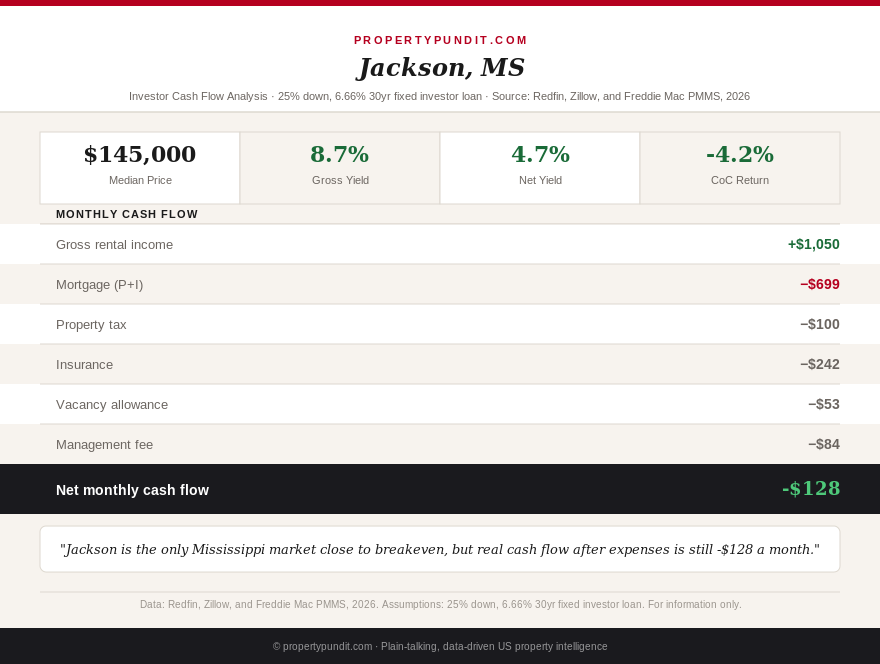
Run the numbers on that $145,000 median with 25% down and today's 6.66% rate. Principal and interest on the resulting $108,750 loan comes to about $699 a month. Hinds County's 0.83% effective property tax rate, the highest in the state, adds another $100. A landlord policy in inland Jackson, away from the coastal wind pool, runs roughly $242 a month based on statewide averages excluding the coast (Insurify; ValuePenguin, 2026). That puts total PITIA at about $1,041. Median asking rent for a house in Jackson runs about $1,050 a month (Zillow, 2026), which technically clears the 1.0 DSCR minimum lenders look for, the only Mississippi market in this analysis that does. Subtract an 8% property management fee and a 5% vacancy reserve, though, and real cash flow comes out to roughly negative $128 a month. Jackson is the closest thing to a working deal in Mississippi. It still is not quite one.
If you are chasing the appreciation headline, know that you are buying a repricing story, not a cash-flow story right now, and the deal still needs a rent increase or a purchase price below the median to turn positive.
The Coast's insurance bill eats the math before you reach the mortgage
Gulfport's median sale price sits at $230,315, down 1.6% year over year, while nearby Biloxi's average value runs $226,754, up a modest 0.6% (Redfin; Zillow, 2026). At first glance the Coast looks like Mississippi's mid-tier option, priced well above Jackson but nowhere near the coastal premiums investors pay in Florida or the Carolinas. The insurance bill changes that. Mississippi Gulf Coast homeowners pay some of the highest premiums in the country, with the Gulfport-Biloxi metro averaging $7,459 a year in homeowners insurance by the end of 2026, more than triple Mississippi's statewide average (Insurify, 2026). Wind coverage alone can account for 70% of that premium in south Mississippi, and policyholders covered through the state-backed Mississippi Windstorm Underwriting Association are absorbing a 17.2% rate increase that took effect January 1, 2026. It is the same insurance-driven trap this site flagged on the Louisiana Gulf Coast, where a landlord's flood and wind bill nearly matched the mortgage payment outright.
On Gulfport's $230,315 median with 25% down, principal and interest runs about $1,110 a month, Harrison County's 0.65% effective property tax rate adds $125, and that $7,459 annual insurance bill adds another $622. PITIA lands at $1,857. A three-bedroom house on the Coast rents for somewhere between $1,550 and $1,773 a month depending on the source (Rentometer; RentCafe; Apartments.com, 2026); split the difference at $1,650 and DSCR comes out to 0.89, the weakest of any Mississippi market in this analysis. Real cash flow after management and vacancy runs about negative $422 a month, and that is before a single named storm forces a claim.
The one piece of relief working in the Coast's favor is new, and not yet reflected in most premiums: Mississippi's Strengthen Mississippi Homes Program, created by Senate Bill 2409 in April 2026, will fund up to $10,000 per home in wind-mitigation upgrades designed to lower insurance costs and storm damage. It is a genuine long-term lever on that $7,459 bill. It is not a reason to underwrite today's deal as though the discount already applies.
If insurance is the line item you are least confident modeling correctly, the Coast is the Mississippi market most likely to punish that blind spot, and it is the one place in this analysis where the math does not get close even before you touch the mortgage.
Hattiesburg splits the difference, and still misses
Hattiesburg's average home value sits at $224,680, up 3.0% year over year (Zillow, June 2026), roughly between Jackson's entry price and Gulfport's coastal premium, without the coastal insurance bill. The University of Southern Mississippi anchors steady rental demand that keeps vacancy low, and rent for a three-bedroom house runs roughly $1,450 a month by the more conservative estimates, with active listings ranging as high as $1,700-plus (Apartments.com; Redfin, 2026).
On that $224,680 value with 25% down, principal and interest comes to about $1,083 a month. Forrest County's 0.78% effective property tax rate, among the highest in the state, adds $146. Inland insurance similar to Jackson's adds roughly $242. PITIA totals about $1,471 against $1,450 in rent, a DSCR of 0.99, essentially a rounding error from Jackson's 1.01 but still on the wrong side of it. After management and vacancy, real cash flow lands around negative $210 a month: better than the Coast, worse than Jackson.
Hattiesburg is the market to watch rather than the market to buy in today. A modest rent increase driven by steady university demand, not a repeat of Jackson's price surge, is the more realistic path to breakeven here.
The real Mississippi advantage is on the tax return, not the closing statement
Where Mississippi does offer investors something genuine is state income tax. House Bill 1, signed into law in March 2025, cut the top rate from 4.4% in 2025 to 4% in 2026, with automatic quarter-point reductions scheduled each year after that down to 3% by 2030, and a revenue-trigger mechanism that could eventually eliminate the tax altogether. That is a real, compounding saving on rental income for an investor holding property for years, and it puts Mississippi in the same conversation as zero-income-tax states like Tennessee and Texas over a long enough hold. It will not offset a market that fails DSCR on day one, and it will not show up in year-one cash flow the way an actual positive-cash-flow deal would.
Treat the income tax phase-down as a reason to hold longer once you own something that already cash-flows, not as a reason to buy something that does not.
Put the three markets side by side and the math points toward Jackson as the only Mississippi metro worth underwriting seriously right now, and even there, only at a price below the $145,000 median or with a rent roll above $1,050. Most investors who run these numbers end up passing on the Coast entirely until either insurance premiums come down or the state's new mitigation grants actually lower a specific policy quote, and Hattiesburg is a market to revisit once its rent-to-price ratio moves a little further in a landlord's favor. Similar to what this site found in Alabama, where the advertised property tax rate hides a much higher rate charged specifically to investors, Mississippi's headline affordability does not automatically translate into a working deal once you underwrite the real bill. Before you commit capital to any of these three markets, run the same math against your own target property using our DSCR loan investor guide, and compare Mississippi's county-level yields against markets you are already watching in our SFR yield county map.