 Property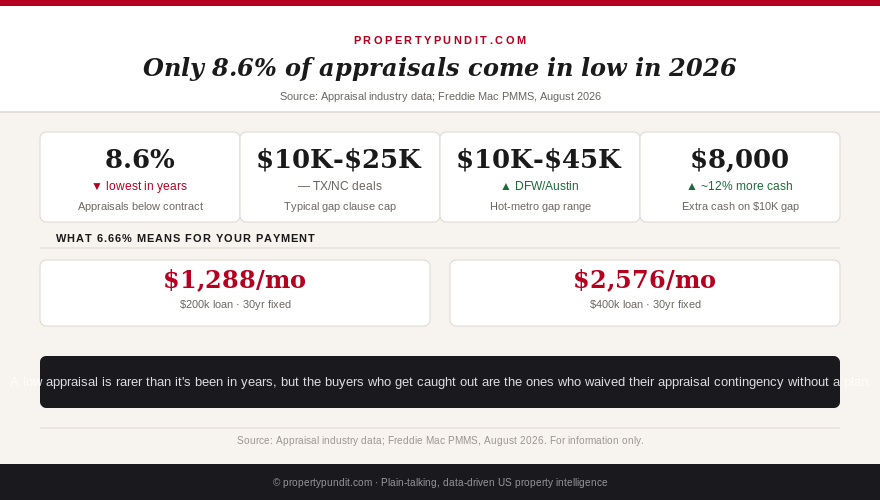
You have an accepted offer at $340,000 in Nashville, your earnest money is already wired, and the one thing standing between you and a closing date is a stranger walking through the house with a clipboard. If the appraisal comes in under your offer, does the whole deal fall apart, and does it cost you the money you already sent? That question keeps more first-time buyers up at night than almost any other step in the process, and the honest answer is: it depends entirely on what you agreed to in the contract, not on the appraisal itself.
The good news for anyone buying in 2026: a low appraisal is rarer than it's been in years. Only about 8.6% of appraisals nationally are coming in below the contract price this year, down from the double-digit rates common during the 2021-2022 bidding-war era. But rare is not the same as never, and the buyers who get caught out are almost always the ones who didn't understand their contract's appraisal terms before they signed, not the ones who happened to draw an unlucky appraiser.
What an appraisal gap actually is
An appraisal is the bank's independent estimate of a home's value, ordered by your lender and paid for by you, typically $400 to $700. It exists to protect the lender, not you: a mortgage lender will never finance more than a set percentage of whichever number is lower, the contract price or the appraised value. If you offer $340,000 and the appraiser says the home is worth $330,000, your lender treats $330,000 as the ceiling, no matter what you agreed to pay the seller. That $10,000 difference is the appraisal gap, and closing the gap between what you promised and what the bank will lend is entirely your problem to solve, not the seller's.
This is the mechanic first-time buyers most often get backward: the appraisal doesn't cancel your contract by itself. It just tells your lender how much they're willing to hand over. Everything that happens after a low number comes down to what you and the seller agreed to do about it before you ever got here.
How rare a low appraisal really is in 2026
During the frenzy years, appraisals routinely lagged behind what buyers were bidding, because comparable sales data couldn't keep up with prices that were rising 15-20% a year. In 2026's more balanced market, with active listings up and roughly 46% of spring sales including some form of seller concession, appraisals are catching up to reality instead of chasing it. That's why the national miss rate has fallen to around 8.6%, and why in some regions, appraisers are now coming in at or above the agreed price more often than below it.
The exception is anywhere prices are still moving fast. Metros posting outsized year-over-year gains, the kind driven by a single hot submarket rather than broad demand, are exactly where a comparable-sales appraisal struggles to keep pace with what buyers are actually paying this month. If you're bidding in one of those pockets, the national 8.6% figure understates your real risk. If you're buying almost anywhere else in 2026's buyer-friendly conditions, it overstates it. Know which situation you're actually in before you decide how much appraisal protection to give up.
Get this in your inbox every Friday.
One email. The number that matters and what it means for you.
The gap clause: what it actually commits you to
In competitive offers, agents sometimes recommend an "appraisal gap coverage" clause: a written promise to bring extra cash if the appraisal lands short, so the seller sees your offer as safer than one with an open financing contingency. In Texas and North Carolina deals right now, those clauses typically cap coverage at a specific dollar figure, commonly $10,000 to $25,000, rather than leaving your exposure unlimited. In hotter Dallas-Fort Worth and Austin submarkets, real gaps of $10,000 to $45,000 are showing up on deals where the sale price has run ahead of what recent comparables support.
The cap matters more than most buyers realize. A clause that says "buyer will cover up to $10,000 of any appraisal gap" protects you from an open-ended obligation: if the actual shortfall turns out to be $20,000, you're only on the hook for your $10,000 cap, and the rest becomes a fresh negotiation rather than an automatic bill. Never sign a gap clause without a number attached to it, and never assume "I'll cover the gap" without a cap means the same thing as a specific dollar limit; to a seller's attorney, it doesn't.
Your options when the appraisal actually comes in low
If the number comes back short, you have four real paths, and they're not mutually exclusive. First, pay the difference in cash, which keeps the deal moving fastest but requires funds beyond your planned down payment. Second, ask the seller to lower the price to match the appraisal, which real 2026 sellers are considerably more willing to do than they were during the frenzy years, given the current concession environment. Third, challenge the number through a Reconsideration of Value, where your lender submits additional comparable sales the appraiser may have missed for the same appraiser to review; this isn't a new appraisal and you can't contact the appraiser directly, but it resolves in your favor often enough to be worth the few extra days. Fourth, walk away, which only protects your earnest money if you kept an appraisal contingency in your offer.
Most real transactions end up splitting the difference: the seller cuts the price partway, and the buyer covers the remainder in cash or through a capped gap clause negotiated in advance. The worst outcome by far is discovering, after the appraisal comes back low, that you have none of these options because you waived the contingency to make your offer look stronger. If you're weighing whether to compete aggressively on an offer, price that risk in before you write it, not after.
The math on an actual $10,000 gap
Say you're under contract at $340,000 with 20% down, a $68,000 down payment and a $272,000 loan. The appraisal comes back at $330,000, a $10,000 gap. Your lender won't finance 80% of $340,000 anymore, they'll finance 80% of the lower number, $330,000, which caps your loan at $264,000. That's $8,000 less financing than you planned on. To still close at the original $340,000 price, you need to bring that $8,000 in additional cash on top of your original down payment, for a total of $76,000 to close instead of $68,000, about 12% more cash than you budgeted for, with no change to the mortgage rate or monthly payment math you'd already run through the mortgage calculator. That's real money most first-time buyers haven't set aside, which is exactly why the alternative, negotiating the seller down to $330,000 instead, is usually the better move if you have the standing to ask for it.
Why the appraisal contingency is still worth keeping in 2026
During 2021-2022, waiving the appraisal contingency was standard advice for winning a bidding war, because everyone else was doing it too and the risk of losing the house otherwise felt higher than the risk of a low appraisal. That calculation has flipped. With sellers offering concessions on nearly half of spring 2026 sales and active listings elevated compared to a year ago, most buyers now have enough negotiating room to keep their appraisal contingency intact without losing the house over it. The frenzy-era advice to waive it by default is exactly the kind of leftover habit that costs buyers money in a market that has already moved on. If your agent suggests waiving it as a default strategy rather than a response to a specific bidding war on a specific home, ask them why, given where the market actually sits today.
None of this replaces doing your own homework before you write an offer. Understanding your real minimum down payment options, knowing how your credit score affects your rate, and budgeting for the closing costs beyond the down payment itself all matter more to your actual affordability than any single appraisal outcome. The buyers who handle a low appraisal calmly are almost always the ones who already know their full financial picture going in, not the ones who get surprised by it mid-transaction.
The bottom line for your next offer
The math here points toward a specific strategy: keep your appraisal contingency in nearly every 2026 offer, reserve a capped gap clause only for a genuine bidding war on a listing you can prove is worth the premium, and treat your earnest money deposit as money you should never risk without a contingency protecting it. Frankly, if you're bidding in one of the still-hot metros where real appraisal gaps are showing up, run the $8,000-on-$10,000-gap math from this article against your own numbers before you sign anything, not after your offer gets accepted. Most buyers who run these numbers ahead of time end up negotiating a lower price instead of writing a bigger check, and that's the better outcome nearly every time.