 Property
You've been checking the Fed's calendar for two years the way some people check sports scores, hoping the next meeting is the one where "hold" finally turns into "cut" and refinancing off today's rate actually starts to pencil out. Yesterday's decision looked, on the surface, like more of the same. The Federal Reserve held its target range at 3.50%-3.75% for a fifth consecutive meeting. But look past the 9-3 headline vote and the real story is worse for anyone waiting on lower rates: three of the twelve voting members didn't want a hold at all. They wanted to raise rates, and the futures market just told you it thinks they might get their way twice more before this year is out.
Here's what actually happened at the meeting, why three dissents matter more than a routine hold, and what it means for the mortgage rate sitting in front of you today.
What the Fed actually decided on July 29
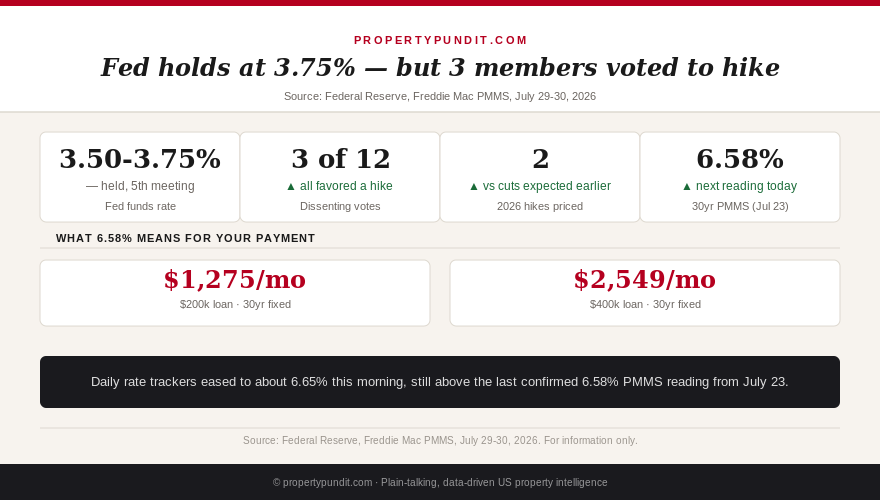
The Federal Open Market Committee voted 9-3 on July 29, 2026 to hold the federal funds rate at 3.50%-3.75%, the fifth consecutive meeting without a move. Three regional Federal Reserve Bank presidents, Cleveland's Beth Hammack, Minneapolis's Neel Kashkari, and Dallas's Lorie Logan, dissented. All three wanted the same thing: a quarter-point hike, not another pause. The post-meeting statement described economic activity as expanding at a solid pace despite elevated uncertainty tied in part to the conflict in the Middle East, with strong productivity growth and capital investment, job gains keeping pace with the workforce, and an unemployment rate that has changed little. This was a non-SEP meeting, meaning no updated economic projections or dot plot accompanied the decision.
A 9-3 vote sounds like a comfortable majority for staying put. If you're tracking every 25 basis points the way a rate watcher does, it isn't cover for "more of the same." It's the closest the Fed has come to an internal push for higher rates since this hold streak began, and it came from three people whose job is reading the exact same data you're reading.
Get this in your inbox every Friday.
One email. The number that matters and what it means for you.
Why 3 dissents matter more than a 5th consecutive hold
Three dissenting votes pushing the same direction, all toward a hike, is a meaningfully larger signal than the same three votes splitting between "hike" and "cut" would have been. It tells you a real hawkish minority inside the Fed doesn't think the current hold is enough of a brake on inflation risk, even with job growth soft for most of 2026 and an economy that Harvard's own housing researchers have already flagged for collapsing employment growth. The dissenters' concern lines up with a specific, ongoing driver: oil prices above $100 a barrel from the escalating Iran conflict, which pushed Fed-hike odds from roughly 11% in mid-July to the mid-30s by decision week, per CME FedWatch. That's an energy-and-geopolitics story, not a story about the labor market suddenly overheating.
What this means for you if you've been banking on "the Fed will eventually blink" is that the blink you've been waiting for just got three votes less likely, not more.
Markets now price two hikes, not cuts, before year-end
Following the decision, futures markets are pricing two separate 25-basis-point hikes before the end of 2026, with no further moves expected through 2027. That's a sharp reversal from the "when will the Fed finally cut" framing that dominated housing coverage for most of the past two years, including on this site. It doesn't mean a hike is guaranteed. Pre-decision odds still favored a hold at this specific meeting, and they were right. But the forward pricing has moved from "cuts eventually" to "maybe two more hikes first," and that shift alone changes how you should plan the next six months, regardless of whether the hikes actually land.
If you've been floating a rate-lock decision on the assumption that a cut-driven refi window opens later this year, that specific bet no longer has consensus market support behind it.
What this means for your mortgage rate today
Mortgage rates track the 10-year Treasury yield, not the fed funds rate directly, which is why a Fed hold doesn't guarantee your own quote stays put. Freddie Mac's PMMS last confirmed the 30-year fixed at 6.58% on July 23, 2026, up from 6.55% the week before. Daily rate trackers were already running well ahead of that official figure heading into the decision, with some sources posting 6.75% on decision day itself; as of this morning, trackers have eased slightly to around 6.65%. Freddie Mac's next official PMMS reading publishes today at noon ET, the first confirmed rate check since the Fed's vote.
On a $200,000 loan, the gap between 6.58% and a plausible near-term ceiling of 6.75% is about $22 a month ($1,275 versus $1,297). On a $400,000 loan, it's about $45 a month ($2,549 versus $2,594). Neither number is dramatic on its own, but both are moving in the same direction as the Fed's internal dissent and the market's forward pricing, not against it.
Your credit score still moves your actual quote more than any of this. A 40-60 basis point spread between a 660 and a 760 FICO score is larger than the payment gap above, and it's the one part of your rate you control before you ever apply.
The refi math changes if the Fed actually hikes twice more
If you're sitting on a rate around 3.8% the way many current homeowners are, today's decision isn't a refi trigger either way; refinancing out of a sub-4% loan into a mid-6% rate still doesn't pencil, hold or hike. Where two hikes would actually reach your household is anything priced off the prime rate rather than the 10-year Treasury: home equity lines of credit, variable-rate personal loans, and credit card APRs all move in near lockstep with the fed funds rate. Two 25-basis-point hikes add up to roughly half a point of direct cost on a HELOC balance, showing up in your next statement within a billing cycle or two, not gradually over months the way a fixed-rate mortgage market repricing does.
If a HELOC or a cash-out refinance was part of your plan for a renovation, a move, or bridging a purchase before selling, model that plan against a fed funds rate half a point higher than today's, not the one you've gotten used to over the last five holds.
The call: what to actually do with this
If you're shopping a purchase mortgage right now, lock rather than float on hope of a Fed-driven rate drop landing this year. The market itself no longer prices that path as the likely one. If you're an existing low-rate homeowner watching every Fed meeting for a sign, this is not a signal to refinance; the math on trading a sub-4% rate for today's mid-6% environment still doesn't work, and nothing in this decision changes that. The one place this decision should actually move your planning is variable-rate debt tied to your home: if a HELOC draw is on your calendar for later this year, price it now against two more hikes rather than the rate on offer today, because most people who run these numbers only check the fixed-rate mortgage side and miss the part of their balance sheet that would move first.
Frequently asked questions
Did the Fed raise interest rates in July 2026? No. The FOMC voted 9-3 to hold its target range at 3.50%-3.75% on July 29, 2026, a fifth consecutive pause. Three regional Fed presidents, Cleveland's Beth Hammack, Minneapolis's Neel Kashkari, and Dallas's Lorie Logan, dissented and preferred a quarter-point hike instead.
Will mortgage rates go up because the Fed didn't cut? Not directly. Mortgage rates track the 10-year Treasury yield, not the fed funds rate itself. But bond markets price in expectations ahead of time, and with futures markets now pricing two additional hikes before the end of 2026, upward pressure on Treasury yields, and therefore mortgage rates, can show up before the Fed actually moves again.
When will the Fed cut interest rates? Current market pricing shows no rate cuts expected through 2027. Instead, futures markets are pricing two additional quarter-point hikes before the end of 2026, a sharp reversal from the rate-cut expectations that dominated housing coverage earlier this year.
Should I refinance my mortgage now? If your current rate sits well below today's roughly 6.6% market rate, no. Refinancing only pays off when the new rate is meaningfully lower than your existing one once closing costs are factored in, and today's rate environment doesn't support that math for most homeowners locked in below 5%. If you're instead looking to trim your payment without refinancing, checking whether you've crossed the threshold to cancel PMI early is usually the faster win, and it doesn't depend on what the Fed does next.